Quick Answer
Does a broken life line mean death? Absolutely not.
This is the single biggest myth in palmistry. Every classical tradition — Cheiro and Benham in the West, Hast Samudrika Shastra in India, and the major Chinese palmistry schools — reads a break in the life line as a transition: a significant life change like a move, a career pivot, a recovery, or an inner shift. Not death. Not illness. The life line does not predict mortality in any careful school.
Broken Life Line: It Does NOT Mean Death (Palmistry Myth-Bust)
Last reviewed: 2026-06-27 by ReadMyPalms editorial
A careful guide to the broken life line in traditional palmistry, directly addressing the central myth and explaining what every classical tradition actually reads it as.
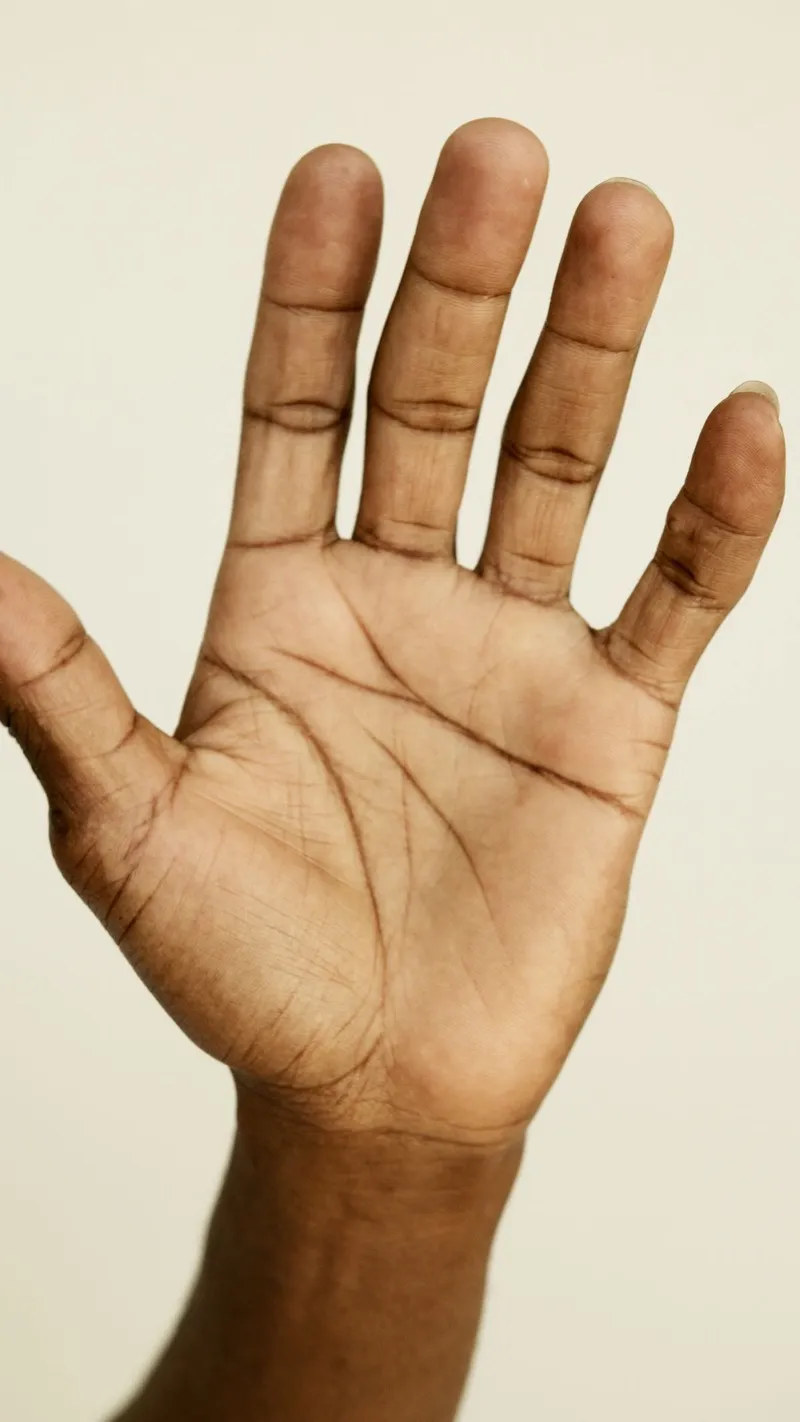
The life line (highlighted in violet) curves around the base of the thumb. A “break” is a gap or interruption along the line — not a death omen.
What Is a Broken Life Line?
A broken life line is a life line with one or more visible interruptions: places where the line stops, leaves a small gap, and then resumes further along its arc around the thumb. The break may be clean (a simple gap) or overlapping (where the new section of line begins alongside the old before the original stops). It can appear anywhere along the line — near the start, in the middle, or near the end.
Broken life lines are common. Many palms have at least one small break somewhere along the line, and a substantial number have several. The break itself is anatomically unremarkable — the line is just a crease that happens to be discontinuous — but it attracts more anxious misinterpretation than any other palm feature. The remainder of this page is dedicated to addressing that misinterpretation honestly.
What a Broken Life Line Symbolises
Transitions and Change
The central reading of a break in the life line across every classical tradition is transition. A break is the line’s way of marking a significant change in the texture of life — the kind of change that, looking back, feels like a clear before-and-after. People with breaks in their life lines often describe their lives in episodes: “the years before X happened” and “the years after.” The break is the X.
Moves, Pivots, and Reinventions
Tradition catalogues the kinds of transitions a break can mark. Geographic moves — emigration, relocation, leaving home for the first time — are read as classic break-causing events. Career pivots — changing fields, becoming self-employed, returning to school in midlife — are read similarly. Deep recoveries from illness, grief, or major loss are read as breaks. So are spiritual awakenings and identity shifts — anything that fundamentally re-orients how a person lives.
A Life Lived in Chapters
A third tradition reading is that broken life lines describe people whose lives have chapters — distinct phases rather than one continuous arc. This is read as a temperament shaped by reinvention. It is treated positively in every careful source: Cheiro associated it with rich, eventful lives. The life that continues unchanged across decades is one kind of life; the life that turns sharply several times is another. The broken line marks the second kind, neither better nor worse.
Adaptability and Resilience
The fourth tradition reading is adaptability. A life line that breaks and resumes is read as a constitution capable of starting again — of letting an old life end and a new one begin. People with broken life lines are often read as resilient in a specific way: not unbreakable, but practiced at coming back. This is one of the warmest readings in classical palmistry. The break is not damage; it is the line’s way of showing that this person has crossed thresholds and is still here, drawing the next part of the line.
How to Read a Break — Position, Width, and Continuation
Four observations refine the reading of a broken life line: where on the line the break appears, the width of the gap, whether the line overlaps, and what direction the line takes after the break.
Where on the life line the break appears is the traditional timing marker. Breaks near the start (high on the palm, near where the line begins between the thumb and index finger) are read as transitions earlier in life. Breaks in the middle are read as midlife transitions. Breaks near the end of the line are read as later-life transitions. Timing is always approximate in tradition — no classical school assigns precise ages to specific positions.
Width of the gap describes the abruptness of the transition. A small, narrow gap is read as a quick or contained change. A wider gap is read as a more significant or longer transition — a fuller threshold. Hindu palmistry in particular weights gap width as a description of how clearly the person crossed the threshold.
Overlap is one of the most positively read configurations. Overlapping breaks — where the new section of the line begins alongside the old, parallel for a short distance, before the original stops — are read as smooth transitions where the new direction is established before the old one ends. People with overlapping breaks often describe their transitions as having had a long lead-up: the next chapter started before the previous one finished.
Direction after the break describes what kind of life the transition initiated. A line that resumes deeper and clearer than before is read as a transition into greater vitality. A line that resumes fainter is read as a transition into a quieter, more interior life. A line that resumes curving more outward (away from the thumb) is read as a transition toward more adventure or expansion. None of these are predictive; they describe the shape of the life now being lived.
Common Broken Life Line Variations
Single Clean Break
One distinct break in an otherwise clear life line. Tradition reads this as a single major transition — the kind of life change the person can probably name. Many people have a single break, and tradition treats it as the most common configuration of a life shaped by one defining pivot.
Multiple Breaks
Multiple breaks along the life line are read as multiple transitions — a life shaped by repeated reinvention. Tradition treats this positively as adaptability and eventfulness. Cheiro associated multiple breaks with rich, story-filled lives, not with instability.
Overlapping Break
The most positively read break configuration. Where the new section of the life line begins alongside the old, parallel briefly, before the original stops. Read as a smooth, well-prepared transition where the next chapter began while the previous one was still in motion.
Break with Continuation Line
Sometimes a break in the life line is accompanied by a small inner line running parallel during the break itself — a kind of bridge across the gap. This is called a sister line or guardian line in classical Western palmistry. It is read as protection through the transition — the person did not cross the threshold alone, or had inner resources sustaining them. Hindu palmistry calls a similar configuration the rakshak rekha, the protector line, and reads it as the most positive form a break can take.
What a Broken Life Line Does NOT Mean
More than any other palm feature, the broken life line attracts misreading. Here are the five most important corrections, stated plainly.
Myth: “A broken life line means I’ll die young.” Reality: this is wrong in every careful tradition. Cheiro, Benham, Hast Samudrika Shastra, and the major Chinese palmistry texts all read breaks as transitions, not deaths. No careful palmist makes mortality predictions from any palm feature. The break is the change, not a warning about death.
Myth: “A broken life line means major illness.” Reality: tradition does sometimes associate breaks with health-related transitions — a serious illness that becomes a turning point, a long recovery that changes a life — but the break marks the transition, not the illness itself. People with broken life lines are not at higher risk of illness; they are people whose lives have been shaped by major change of some kind.
Myth: “The length of my life line tells me how long I’ll live.” Reality: length and lifespan are not connected. Plenty of people with short life lines live long lives; plenty with long life lines die young. The life line describes vitality and direction, not duration. Cheiro and Benham both wrote explicitly that the life line is not a lifespan predictor.
Myth: “A break in both hands is more dangerous than one in one.” Reality: bilateral breaks are read as transitions that touch both inherited tendency and active life — bigger in scope, not more dangerous. Cheiro reads bilateral breaks as major life pivots fully integrated by the person. Nothing about “both hands” makes a break more ominous.
Myth: “A psychic or palmist can tell me when something bad will happen from my broken life line.” Reality: anyone making specific date predictions from a broken life line is not practising any classical tradition. Hindu, Chinese, and Western palmistry all refuse this kind of reading. The break describes a pattern, not a date. Anyone using it to instil fear is misusing palmistry.
Tradition Attribution: How Every School Reads Breaks
Western palmistry, in Cheiro and William Benham, is explicit and consistent: breaks in any major line, including the life line, are read as transitions and not as deaths. Benham wrote that “a break is a change of direction, not a closing of the line’s subject.” Cheiro emphasises this repeatedly, sometimes with frustration at popular misreadings of his work.
Hindu palmistry — Hast Samudrika Shastra — reads breaks (khandit rekha) as transitions and major life changes. The tradition catalogues protective configurations (the rakshak rekha or guardian line) that can accompany breaks and are read as carrying the person through. No careful Hindu palmistry source reads a break as a death sign.
Chinese palmistry reads breaks in the life line as life-stage transitions. The Chinese tradition is often the least anxious of the three about breaks, reading them simply as the natural marks of a long, eventful life. As in the other traditions, no careful Chinese palmist reads a break as death.
How to Read Your Own Broken Life Line
If you have a break in your life line, here is how tradition recommends reading it honestly.
- Open your dominant palm in natural light. Trace your life line from where it starts between the thumb and index finger, around the base of the thumb, toward the wrist. Note any breaks.
- Identify the type of break. Is it a clean gap, an overlap, or a break with a small parallel guardian line bridging the gap? Each carries a different reading.
- Locate the break’s position. Is it near the start of the line (earlier life), the middle (midlife), or the end (later life)? Use this as approximate timing only.
- Identify the transition. Ask yourself: what major life change does the position of this break correspond to? An overseas move? A career pivot? A relationship beginning or ending? A spiritual shift? A recovery? Naming the transition is the whole point of the reading.
- Read warmly. The break is not a warning. It is a sign that you have crossed a threshold and continued. Treat it as a mark of life lived, not as an omen.
Want an AI-assisted reading of your full life line, including any breaks?
Get a Free AI Palm Reading →Frequently Asked Questions
Does a broken life line mean death?
No. This is the single most important correction in palmistry. Every major classical source reads a break as a transition or major life change, not as death or illness. Palm lines do not predict mortality in any careful school.
What does a broken life line actually mean?
A significant transition — a period of major life change. Moves, career pivots, the start or end of important relationships, deep recoveries, and inner shifts are all read as the kinds of transitions a break marks.
Does the life line predict how long I will live?
No. The life line’s length does not predict lifespan. Cheiro and Benham both wrote explicitly that the life line is not a lifespan predictor.
What if my life line has multiple breaks?
Multiple breaks are read as multiple transitions — a temperament shaped by reinvention. Tradition reads this positively as adaptability and eventfulness, not negatively as instability.
What is the difference between a break and an overlap?
A clean break is a gap where the line stops and resumes. An overlap is where the new section begins alongside the old before the original stops. Overlaps are read as smoother transitions; both are read as change, not harm.
Does a broken life line in both hands mean something worse?
No. Bilateral breaks are read as transitions that touch both inherited tendency and active life — bigger in scope, not more dangerous.
Should I worry about my broken life line?
No. Tradition is unanimous: breaks are not warnings, not death omens, not illness predictions. They describe the texture of a life lived through change.
How Broken Life Line Is Read Across Traditions
Palmistry is a layered tradition, not a single system. Indian, Chinese, and Western lineages each read the broken life line a little differently — here is how the same line is named and interpreted across the three schools.
| Tradition | Local Term | Meaning |
|---|---|---|
| Indian (Hast Samudrika Shastra) | Jeevan Rekha / जीवन रेखा (khandit / खंडित — broken) | In Hast Samudrika Shastra, a break in the Jeevan Rekha is traditionally read as a karmic transition — a change in environment, health, or circumstance rather than a literal interruption of life. Readers cross-reference the Mangal Rekha (Mars line) and a break supported by a sister line is treated as a protected passage. |
| Chinese (手相 Shǒuxiàng) | 生命线 / Shēngmìng Xiàn (断 / duàn — broken) | In Chinese palmistry, a break in the Shēngmìng Xiàn is traditionally read alongside facial features and TCM signs, framing it as a shift in qi at a life-stage rather than a fated event. Some lineages place strong emphasis on whether the break appears on the left or right hand and whether overlapping segments suggest energy resumes smoothly. |
| Western (Cheiro / Benham revival) | Life Line (also called the Line of Life or Vitality Line) | Cheiro and Benham emphasised that a broken Life Line should never be read as a death omen, but as a symbolic marker of major change — especially when both hands show the break at the same point. The Cheiro/Benham revival looks for repair markers (squares, sister lines, overlaps) as protective signs in context of the Mars line. |
Jeevan Rekha / जीवन रेखा (khandit / खंडित — broken)
In Hast Samudrika Shastra, a break in the Jeevan Rekha is traditionally read as a karmic transition — a change in environment, health, or circumstance rather than a literal interruption of life. Readers cross-reference the Mangal Rekha (Mars line) and a break supported by a sister line is treated as a protected passage.
生命线 / Shēngmìng Xiàn (断 / duàn — broken)
In Chinese palmistry, a break in the Shēngmìng Xiàn is traditionally read alongside facial features and TCM signs, framing it as a shift in qi at a life-stage rather than a fated event. Some lineages place strong emphasis on whether the break appears on the left or right hand and whether overlapping segments suggest energy resumes smoothly.
Life Line (also called the Line of Life or Vitality Line)
Cheiro and Benham emphasised that a broken Life Line should never be read as a death omen, but as a symbolic marker of major change — especially when both hands show the break at the same point. The Cheiro/Benham revival looks for repair markers (squares, sister lines, overlaps) as protective signs in context of the Mars line.
Myth vs. Reality
The broken life line attracts more pop-culture invention than almost any other palm feature. These are the claims you will find on low-quality palmistry sites — and how traditional palmistry across Indian, Chinese, and Western schools actually reads them.
| Myth | Reality |
|---|---|
“"A broken life line means you will die young or have a short life."” | No serious palmistry tradition equates a break with predicted death. Cheiro and Benham explicitly cautioned against reading lifespan from the life line, treating breaks as symbolic of transitions or lifestyle changes. Indian and Chinese sources similarly read breaks as periods of change, not termination. Sources: Cheiro, Language of the Hand (1894), Benham, Laws of Scientific Hand Reading (1900), Hast Samudrika Shastra tradition |
“"A broken life line on the left hand means a fated tragedy you cannot escape."” | In most Western and Indian schools, the non-dominant hand is traditionally read as inherited tendencies or potential, while the dominant hand reflects what the person is actively shaping. A break on one hand alone is generally read as a possibility or past influence rather than fixed fate, and many readers note that lines visibly change over years. Sources: Cheiro, Language of the Hand (1894), Benham, Laws of Scientific Hand Reading (1900) |
“"Multiple breaks in the life line guarantee multiple disasters or illnesses."” | Traditional readings treat repeated breaks as symbolic of multiple transitions — moves, career shifts, lifestyle changes — rather than guaranteed misfortune. Benham in particular stressed looking for overlapping or sister lines that classical Western palmistry treats as protective markers. Sources: Benham, Laws of Scientific Hand Reading (1900), Chinese palmistry (手相) tradition |
“"If a square or overlapping line covers the break, the danger is cancelled completely."” | Repair markers like squares, sister lines, or overlapping segments are traditionally read as mitigating or protective in Western palmistry (especially Benham), and as signs of recovery or support in Indian and Chinese readings. They are interpreted symbolically as resilience, not as a literal cancellation of any specific event. Sources: Benham, Laws of Scientific Hand Reading (1900), Cheiro, Language of the Hand (1894) |
“"A life line with no breaks means a perfect, problem-free life."” | An unbroken life line is traditionally read as steady vitality or continuity of circumstances, not a guarantee against hardship. Cheiro, Benham, and the Hast Samudrika lineage caution that the life line is one marker among many and says nothing about emotional, financial, or spiritual challenges read elsewhere on the palm. Sources: Cheiro, Language of the Hand (1894), Hast Samudrika Shastra tradition |
“"A broken life line means you will die young or have a short life."”
No serious palmistry tradition equates a break with predicted death. Cheiro and Benham explicitly cautioned against reading lifespan from the life line, treating breaks as symbolic of transitions or lifestyle changes. Indian and Chinese sources similarly read breaks as periods of change, not termination.
Sources: Cheiro, Language of the Hand (1894), Benham, Laws of Scientific Hand Reading (1900), Hast Samudrika Shastra tradition
“"A broken life line on the left hand means a fated tragedy you cannot escape."”
In most Western and Indian schools, the non-dominant hand is traditionally read as inherited tendencies or potential, while the dominant hand reflects what the person is actively shaping. A break on one hand alone is generally read as a possibility or past influence rather than fixed fate, and many readers note that lines visibly change over years.
Sources: Cheiro, Language of the Hand (1894), Benham, Laws of Scientific Hand Reading (1900)
“"Multiple breaks in the life line guarantee multiple disasters or illnesses."”
Traditional readings treat repeated breaks as symbolic of multiple transitions — moves, career shifts, lifestyle changes — rather than guaranteed misfortune. Benham in particular stressed looking for overlapping or sister lines that classical Western palmistry treats as protective markers.
Sources: Benham, Laws of Scientific Hand Reading (1900), Chinese palmistry (手相) tradition
“"If a square or overlapping line covers the break, the danger is cancelled completely."”
Repair markers like squares, sister lines, or overlapping segments are traditionally read as mitigating or protective in Western palmistry (especially Benham), and as signs of recovery or support in Indian and Chinese readings. They are interpreted symbolically as resilience, not as a literal cancellation of any specific event.
Sources: Benham, Laws of Scientific Hand Reading (1900), Cheiro, Language of the Hand (1894)
“"A life line with no breaks means a perfect, problem-free life."”
An unbroken life line is traditionally read as steady vitality or continuity of circumstances, not a guarantee against hardship. Cheiro, Benham, and the Hast Samudrika lineage caution that the life line is one marker among many and says nothing about emotional, financial, or spiritual challenges read elsewhere on the palm.
Sources: Cheiro, Language of the Hand (1894), Hast Samudrika Shastra tradition
Related Palmistry Topics
Broken life lines are one variation of the life line. Explore the rest of the cluster:
Life Line
The line curving around the thumb, traditionally read as vitality and life transitions.
Read the guide →Heart Line
The horizontal line across the upper palm, read as emotional life and attachment.
Read the guide →Head Line
The line across the middle of the palm, read as thinking style and decision-making.
Read the guide →Fate Line
The vertical line rising up the palm, read as direction and outside forces in life.
Read the guide →Sun Line
Vertical line associated with creativity and recognition.
Read the guide →Marriage Line
Short horizontal lines on the palm edge below the pinky.
Read the guide →