Quick Answer
“I don’t have a fate line — am I doomed?” No.
A missing fate line is completely common and is not read as bad in any traditional palmistry. Many highly successful people have no visible fate line. The line, when present, is read as the external structure of one’s path — not as destiny itself. Without it, your direction is simply more internally chosen than externally shaped, and classical palmistry treats both patterns as equally valid lives.
Fate Line Palm Reading: What It Means, What ‘No Fate Line’ Means, and Late Starts
Last reviewed: 2026-06-27 by ReadMyPalms editorial
A reassuring, classically-grounded guide to the most anxiety-inducing line in popular palmistry — including why an absent fate line is normal, what a late-starting fate line really means, and which modern myths to ignore.
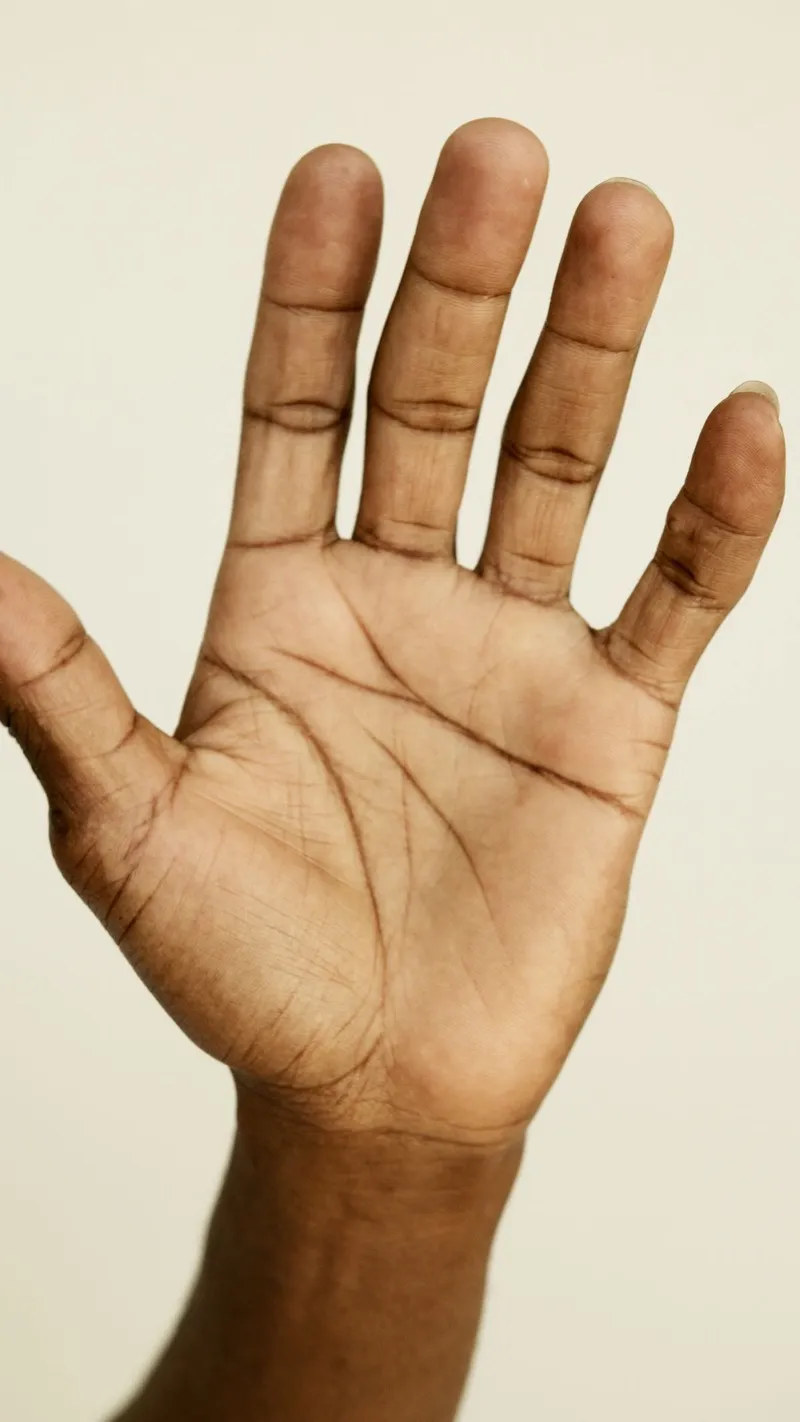
The fate line runs vertically up the centre of the palm, traced in highlighted deep violet. Many people don’t have one — and that’s completely normal.
What Is the Fate Line?
The fate line is a vertical line that, when present, runs up the centre of the palm from near the wrist toward the base of the middle finger — the finger Western palmistry assigns to Saturn. For this reason it is also called the Saturn line or the line of destiny. Of the secondary lines on the palm, it is the most prominent and the most often discussed, which is why it tends to attract the heaviest mythology.
Unlike the life, heart, and head lines — which essentially every adult palm carries — the fate line is optional. A substantial percentage of healthy, ordinary, successful people have a faint, fragmented, or entirely absent fate line. It is not counted among the three classical “major” lines in the strict sense, though many modern guides loosely include it.
“I Don’t Have a Fate Line” — What It Actually Means
This is the single most searched question about the fate line, and the one that brings anxious readers to palmistry sites at three in the morning. So let us answer it plainly: an estimated 20 to 40 percent of people have no clearly visible fate line. That is normal, not abnormal — not a defect, not an omen, not a sign that something has gone wrong with your life.
Traditional Western palmistry — most explicitly William G. Benham in The Laws of Scientific Hand Reading (1900), still the most cited English-language source on the subject — reads an absent fate line as freedom from external constraints. Benham does not call it failure or lostness. He describes it as a path not being structured by outside forces — family business, inherited duty, conventional career ladder — and that is consequently structured from within. People on unstructured, self-directed, or unconventional paths tend, in this reading, to have faint or absent fate lines.
The famous-successful-people comparison is overused but valid: many entrepreneurs and creatives, when their palms are examined, show faint or absent fate lines. The line, in tradition, tracks external structure, and people who built their own path from the inside out often did so without inheriting that structure.
The fate line, when present, is read as the external structure of one’s path. Without it, the path is internally directed. Both are valid life patterns. The idea that no fate line is a sign of bad luck, lack of direction, or doomed prospects is not classical palmistry. It is a modern social-media invention, generated by short-form content that needed something dramatic to say.
What the Fate Line Symbolises (When Present)
Sense of Direction
When a fate line is present and reasonably clear, its first meaning is sense of direction. This is read broadly — not as a specific career or a job title, but as the trajectory a life takes, the through-line of vocation, the way a person’s work and contribution accumulate over decades. A clear fate line is read as someone with a recognisable arc to their path: a thread that connects what they were doing at twenty, at forty, and at sixty. The line does not name the vocation; it describes that there is one.
External Forces and Circumstances
The fate line’s second meaning — the one that gives it the older name “line of destiny” — is the action of external forces on the life: family expectations, social structure, economic conditions, the inherited shape of the world a person was born into. Tradition reads the fate line as the imprint of these forces, the way the outside has pressed on the inside. A strong fate line is read as a life visibly shaped by such forces; an absent one as a life that has not. Neither is read as morally superior.
Continuity vs. Change
The third meaning lives in the line’s shape over its length. A straight, unbroken fate line is read as a continuous path — one chapter flowing into the next without sharp turns. A broken or pivoting fate line is read as transitions, course corrections, deliberate changes of direction. Western tradition is firm here: breaks are pivots, not failures. A career that began in law and ended in music, a quiet decade that preceded a loud one — these are the lives the broken fate line describes.
Visibility and Strength
The fourth meaning lives in the line’s depth and clarity. A deep, well-incised fate line is read as strong external structure — a path reinforced by clear circumstances and visible role. A faint fate line is read as subtle external structure with greater internal direction. A fragmented line is read as a path made of pieces. As with every line, these are descriptions of texture, not verdicts — and depth in particular is known to change across decades as lives reshape themselves.
How to Read the Fate Line — Start Point, Endings, Breaks
Of all the lines on the palm, the fate line carries the most information in its origin — where it begins. Tradition reads four starting points, each with a different meaning.
Starting at the wrist is read as early-life direction set in childhood or adolescence. Starting from the life line is read as a family-directed early career — a path shaped by parental expectation, family business, or inherited duty. Starting from the mount of the moon (the fleshy area on the percussion side, opposite the thumb) is read as a people-influenced career: often public-facing, audience-shaped, or community-led. And starting partway up the palm is the classic late starter — a career direction that emerges in adulthood. Tradition treats this last pattern with particular respect, which we’ll return to below.
Endings matter too. A fate line ending under the middle finger is read as career being a central life theme. Ending under the index finger is read as leadership — authority or responsibility for others. Ending under the ring finger is read as creative recognition — a vocation yielding public visibility or artistic acknowledgement.
Breaks are read, as elsewhere in palmistry, as transitions: career pivots, life changes, deliberate course corrections — not failures. Forks, where the line splits into two branches, are read as dual focuses, parallel vocations, or career options developing alongside each other. None of these markings is an omen.
Common Fate Line Variations
Common Fate Line Variations
No Fate Line / Absent Fate Line
Covered in detail above, but worth repeating because it is the most common anxiety: an absent fate line is completely normal and is not bad. Tradition reads it as freedom from external constraints, a self-directed life, an internally chosen path. Many entrepreneurs and creatives show this pattern. Nothing in classical palmistry treats it as a warning — the older sources frame it as a kind of independence.
Late-Starting Fate Line
A fate line that begins partway up the palm, rather than at the wrist, is the late-starting fate line. Tradition reads this as someone who finds their calling later in life — often in their thirties or beyond. Far from wasted years, classical palmistry treats this pattern as a wisdom-accumulated path. Many master traditions celebrate the late starter explicitly, because a vocation that emerges through lived experience is held more deliberately than one inherited.
Broken Fate Line
A fate line with breaks along its length is read as a life of pivots: career changes, course corrections, chapters that ended so other chapters could begin. Tradition is firm that breaks are not failures. An overlapping break is read as a smoother transition; a clean-gap break as a sharper pivot. Lawyers who became writers, teachers who became founders — these are the lives the broken fate line describes.
Forked Fate Line
A fate line that splits into two branches is read as dual focus: parallel vocations, two career strands developing simultaneously, or a life holding more than one calling at once. Tradition reads this arrangement as commitment to both paths, not as conflict or indecision.
Doubled Fate Line
A second fate line running parallel to the main one is extremely rare. Where it genuinely appears, tradition reads it as exceptional fortune in career direction — a path supported by an additional strand of structure. Reserve interpretation: most palms claimed to have a doubled fate line turn out, on closer look, to have ordinary branches.
What Your Fate Line Does NOT Mean
What Your Fate Line Does NOT Mean
The fate line attracts more myths per square millimetre than any other line on the palm. Here are the five most common, each followed by what tradition actually says.
Myth: “No fate line means no future.” Reality: completely false. Many highly successful people have no visible fate line. Tradition reads its absence as freedom from external structure, not doom. Benham frames it as an internally-directed life, not an empty one. This myth is a social-media artefact, not a teaching from any classical text.
Myth: “A broken fate line means career failure.” Reality: breaks are read as transitions — career pivots, deliberate course corrections, life changes by choice. The broken fate line is the line of someone who changed paths and kept moving, not a warning.
Myth: “The fate line predicts how much money you’ll make.” Reality: the fate line is about direction and path, not wealth. Classical palmistry does not assign currency values to lines. The so-called “money lines” that surface on social media are separate markings — and even those are widely overclaimed (we cover this in our forthcoming palm reading for money guide).
Myth: “A late-starting fate line means you’ve wasted years.” Reality: tradition reads late starts as wisdom-accumulated paths. Master traditions explicitly celebrate the late starter, because a vocation found through experience is held more deliberately than one inherited. The years before the line begins are read as preparation, not loss.
Myth: “Without a fate line, I have no purpose.” Reality: purpose is internal, not visible on the palm. Palmistry has never claimed to read purpose. It reads texture — the shape of how a life has been structured by external forces — and the absence of that texture simply means the structure was made elsewhere.
Reading the Fate Line on Your Own Palm
Reading the Fate Line on Your Own Palm
Locating a fate line on your own palm is harder than locating the major lines. The fate line is often faint, sometimes fragmented, and sometimes simply not there. Be patient and willing to conclude that you may not have one — which, again, is completely normal.
- Sit in natural daylight, dominant hand open and relaxed. The fainter the line, the more even the light needs to be. Overhead artificial light tends to wash out shallow lines.
- Look for a vertical line up the centre of the palm. Start from somewhere near the wrist and trace upward toward the middle finger. If nothing obvious appears, look again from above with the palm slightly tilted.
- Note its starting point. Wrist? Life line? Mount of the moon? Mid-palm? Each origin tells a different story about how your sense of direction took shape.
- Trace its journey for breaks, forks, and depth changes. The fate line often shifts more visibly than the major lines, and small changes in its pattern carry meaning in their own right.
- If you cannot find one, conclude that you may not have one. Read the central section of this page again. An absent fate line is not a bad result. It is a different kind of life pattern, and a common one.
Want an AI-assisted look at your fate line — including whether you have one?
Get a Free AI Palm Reading →Left Hand vs. Right Hand Fate Line
Left Hand vs. Right Hand Fate Line
ReadMyPalms follows the Western convention by default: read your dominant hand’s fate line as your active, current direction, and the non-dominant hand’s fate line as inherited tendencies or the path you were born toward. If you are right-handed, read the right fate line for what is unfolding now; if you are left-handed, read the left.
It is common, and meaningful, for the two hands to disagree — a clear fate line on one hand and a faint or absent one on the other is read as a person whose path is actively diverging from what they inherited. Indian and Chinese palmistry use different conventions, sometimes including gender-based ones in classical schools. We’ll cover the full split in our forthcoming left-vs-right hand guide.
Frequently Asked Questions
Frequently Asked Questions
What does it mean if I don’t have a fate line?
A missing fate line is completely common and is not read as bad in any traditional palmistry. An estimated 20 to 40 percent of people have no clearly visible fate line, and classical Western palmistry — Benham in particular — reads its absence as freedom from external constraints rather than as failure. The fate line, when present, describes the external structure of your path; without it, your direction is more internally chosen. Many entrepreneurs, creatives, and self-directed people have faint or absent fate lines, and they do not lack a future.
Is it bad to have no fate line?
No. No classical palmistry tradition — Indian, Chinese, or Western — reads an absent fate line as a bad sign. The idea that a missing fate line means doom, failure, or aimlessness is a modern social-media invention, not a teaching from any major palmistry text. Traditionally, an absent fate line simply means a person follows a self-directed or unstructured path rather than a conventional, externally-shaped one. Both patterns are valid.
Why is my fate line late-starting?
A fate line that begins partway up the palm rather than at the wrist is traditionally called a late-starting fate line, and it is read as someone whose sense of direction or vocation emerges later in life — often in their thirties or beyond. Classical palmistry treats this as a positive, wisdom-accumulated pattern, not as wasted years. Many master traditions explicitly celebrate the late starter, because a vocation found through experience tends to be held more deliberately than one inherited at birth.
What does a broken fate line mean?
A broken fate line is read as a transition — a career pivot, a deliberate change of direction, a new chapter — not as failure. Across every major palmistry tradition, breaks in any line symbolise change rather than loss. If the broken section overlaps before continuing, that overlap is read as a smoother, more chosen transition. A clean break with a noticeable gap is read as a sharper pivot. Neither is an omen.
Where should the fate line start?
There is no single correct starting point. The fate line can begin at the wrist (early-life direction set in childhood), from the life line (a family- or duty-shaped early career), from the mount of the moon (a people-influenced or public-facing path), or partway up the palm (a late starter). Each origin tells a different story about how a person’s sense of direction takes shape — none is better than another.
Does the fate line predict my career?
Not in the predictive sense. The fate line is read as a symbolic reflection of how external structure interacts with your sense of direction — not as a forecast of which job you will hold. Classical palmistry never claimed to name careers or salaries from a line. Treat the fate line as a mirror for the texture of your path, not a job description.
Can my fate line change?
Yes. The fate line is one of the more changeable lines on the palm. It can deepen, fade, lengthen, break, or even appear where there was nothing before. This is one reason traditional palmists recommend revisiting a reading every few years rather than treating any single look as final. A fate line that emerges in adulthood is traditionally read as a vocation taking clearer shape.
Which hand’s fate line should I read?
ReadMyPalms follows the Western convention by default: read the fate line on your dominant hand (the one you write with) for your active, current direction. The non-dominant hand reflects inherited tendencies and the path you were born toward. Indian palmistry uses different conventions, including gender-based ones in some classical schools, so cross-tradition readings can vary.
How Fate Line Is Read Across Traditions
Palmistry is a layered tradition, not a single system. Indian, Chinese, and Western lineages each read the fate line a little differently — here is how the same line is named and interpreted across the three schools.
| Tradition | Local Term | Meaning |
|---|---|---|
| Indian (Hast Samudrika Shastra) | Bhagya Rekha / भाग्य रेखा | In Hast Samudrika Shastra, the Bhagya Rekha is traditionally read as the line of destiny and karmic unfolding, with its starting point (wrist, life line, or mount of Moon) signalling the source of one's fortune. Vedic readers often correlate it with Shani (Saturn) and weigh it alongside planetary mounts. |
| Chinese (手相) | 事业线 / Shìyè Xiàn (career line) | In Chinese palmistry the line is most often called the career line (事业线) and is traditionally read together with face reading and the three palm regions, emphasising worldly work and timing of career shifts. Some lineages map it to the Heaven-Man-Earth divisions of the palm. |
| Western (Cheiro / Benham revival) | Fate Line (also Line of Saturn) | Cheiro and Benham emphasised the Saturn line as an indicator of life path, vocational steadiness, and how far a life is shaped by circumstance versus self-direction. Benham in particular read its origin and terminations against the mounts of Jupiter, Saturn, and the Sun to infer the flavour of ambition. |
Bhagya Rekha / भाग्य रेखा
In Hast Samudrika Shastra, the Bhagya Rekha is traditionally read as the line of destiny and karmic unfolding, with its starting point (wrist, life line, or mount of Moon) signalling the source of one's fortune. Vedic readers often correlate it with Shani (Saturn) and weigh it alongside planetary mounts.
事业线 / Shìyè Xiàn (career line)
In Chinese palmistry the line is most often called the career line (事业线) and is traditionally read together with face reading and the three palm regions, emphasising worldly work and timing of career shifts. Some lineages map it to the Heaven-Man-Earth divisions of the palm.
Fate Line (also Line of Saturn)
Cheiro and Benham emphasised the Saturn line as an indicator of life path, vocational steadiness, and how far a life is shaped by circumstance versus self-direction. Benham in particular read its origin and terminations against the mounts of Jupiter, Saturn, and the Sun to infer the flavour of ambition.
Myth vs. Reality
The fate line attracts more pop-culture invention than almost any other palm feature. These are the claims you will find on low-quality palmistry sites — and how traditional palmistry across Indian, Chinese, and Western schools actually reads them.
| Myth | Reality |
|---|---|
“"No fate line means you have no destiny or will never succeed in life."” | Across Indian, Chinese, and Western palmistry, an absent or faint fate line is traditionally read as a self-directed life rather than a doomed one. Cheiro and Benham noted many successful people lacked a clear Saturn line, reading it as a life shaped by personal choice rather than fixed circumstance. Sources: Cheiro, Language of the Hand (1894), Benham, Laws of Scientific Hand Reading (1900) |
“"A short fate line means a short career or that you'll stop working at a young age."” | Length is traditionally read as duration of a particular phase, not total lifespan or career length. Most schools read the fate line in segments tied to crossings of the head and heart lines, and Benham warned specifically against equating line length with literal years. Sources: Benham, Laws of Scientific Hand Reading (1900), Hast Samudrika Shastra tradition |
“"The left hand shows your fated career and the right shows what you actually do."” | Left/right conventions vary sharply by tradition. Indian lineages often read the dominant hand for men and non-dominant for women; Cheiro used the non-dominant for inherited tendencies and dominant for developed life; Chinese readers usually weigh both. None treat one hand as a literal career blueprint. Sources: Cheiro, Language of the Hand (1894), Hast Samudrika Shastra tradition |
“"Multiple fate lines mean you'll have multiple careers or income streams guaranteed."” | Parallel or branching Saturn lines are traditionally read as varied interests, parallel pursuits, or support from different sources — not a guarantee of multiple incomes. Benham described multiple Saturn lines as showing divided attention, which can read favourably or unfavourably depending on the rest of the hand. Sources: Benham, Laws of Scientific Hand Reading (1900) |
“"A broken fate line predicts you will be fired or fail in business."” | Breaks are traditionally read as transitions or changes in direction rather than failures. In classical Western palmistry, an overlapping break is often read more positively than a clean gap, and Indian and Chinese lineages typically look at surrounding marks and mounts before drawing any negative inference. Sources: Cheiro, Language of the Hand (1894), Hast Samudrika Shastra tradition |
“"No fate line means you have no destiny or will never succeed in life."”
Across Indian, Chinese, and Western palmistry, an absent or faint fate line is traditionally read as a self-directed life rather than a doomed one. Cheiro and Benham noted many successful people lacked a clear Saturn line, reading it as a life shaped by personal choice rather than fixed circumstance.
Sources: Cheiro, Language of the Hand (1894), Benham, Laws of Scientific Hand Reading (1900)
“"A short fate line means a short career or that you'll stop working at a young age."”
Length is traditionally read as duration of a particular phase, not total lifespan or career length. Most schools read the fate line in segments tied to crossings of the head and heart lines, and Benham warned specifically against equating line length with literal years.
Sources: Benham, Laws of Scientific Hand Reading (1900), Hast Samudrika Shastra tradition
“"The left hand shows your fated career and the right shows what you actually do."”
Left/right conventions vary sharply by tradition. Indian lineages often read the dominant hand for men and non-dominant for women; Cheiro used the non-dominant for inherited tendencies and dominant for developed life; Chinese readers usually weigh both. None treat one hand as a literal career blueprint.
Sources: Cheiro, Language of the Hand (1894), Hast Samudrika Shastra tradition
“"Multiple fate lines mean you'll have multiple careers or income streams guaranteed."”
Parallel or branching Saturn lines are traditionally read as varied interests, parallel pursuits, or support from different sources — not a guarantee of multiple incomes. Benham described multiple Saturn lines as showing divided attention, which can read favourably or unfavourably depending on the rest of the hand.
Sources: Benham, Laws of Scientific Hand Reading (1900)
“"A broken fate line predicts you will be fired or fail in business."”
Breaks are traditionally read as transitions or changes in direction rather than failures. In classical Western palmistry, an overlapping break is often read more positively than a clean gap, and Indian and Chinese lineages typically look at surrounding marks and mounts before drawing any negative inference.
Sources: Cheiro, Language of the Hand (1894), Hast Samudrika Shastra tradition
Related Palmistry Topics
The fate line is one part of a larger palmistry cluster. Explore the rest:
Life Line
The line curving around the thumb, traditionally read as vitality and life transitions.
Read the guide →Heart Line
The horizontal line across the upper palm, read as emotional life and attachment.
Read the guide →Head Line
The line across the middle of the palm, read as thinking style and decision-making.
Read the guide →Sun Line
Vertical line associated with creativity and recognition.
Read the guide →Marriage Line
Short horizontal lines on the palm edge below the pinky.
Read the guide →Health Line
Diagonal line traditionally read as constitutional vitality.
Read the guide →