Quick Answer
Does the head line predict your intelligence or IQ? No.
The head line is read as a reflection of how a person thinks — analytical or intuitive, focused or wide-ranging — not how smart they are. No tradition, Indian, Chinese, or Western, ranks intelligence by palm line. What the line describes is the texture and style of mental life, never its capacity.
Head Line Palm Reading: Meaning, Forks & Your Mental Style
Last reviewed: 2026-06-27 by ReadMyPalms editorial
A working guide to the line of thought in traditional palmistry — what its length, curve, and famous “writer’s fork” really mean, drawn from Cheiro, Benham, and the classical Indian Hast Samudrika Shastra.
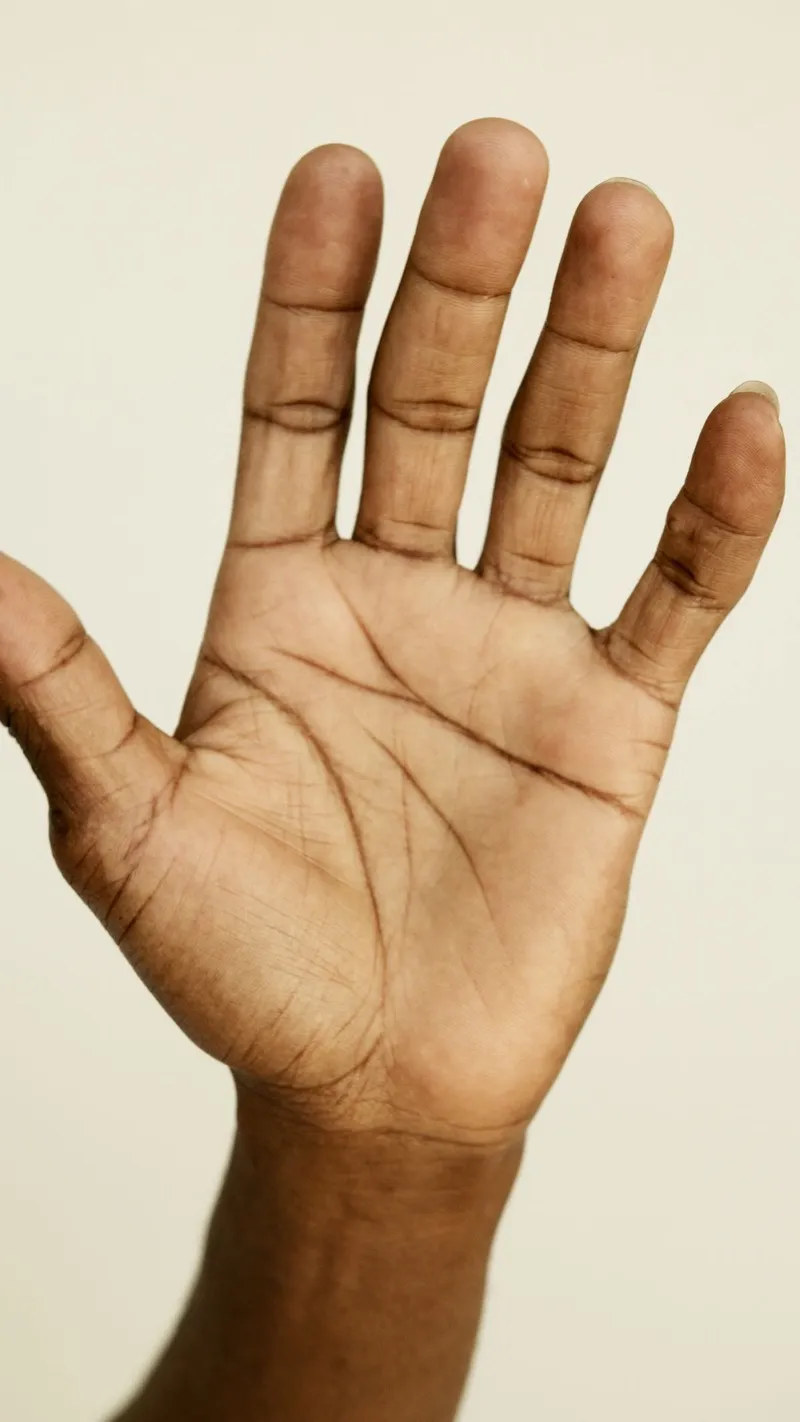
The head line crosses the middle of the palm, traced in highlighted blue-violet.
What Is the Head Line?
The head line is one of the three major lines of the palm, alongside the life line and the heart line. It runs roughly horizontally across the middle of the hand, starting on the thumb side near where the life line begins, and travelling across the palm toward the percussive (outer) edge below the little finger. On some hands the head line begins joined to the life line for a short distance before separating; on others, the two lines start cleanly apart. Both are common variations, and traditional palmistry reads each as a distinct temperament rather than a defect.
The head line sits below the heart line (which runs above it, closer to the fingers) and well above the wrist. Across Hast Samudrika Shastra, classical Chinese palmistry, and Western palmistry as systematised by Cheiro and Benham, the head line is consistently understood as the line of the mind — the intellect, the imagination, the way thought moves. Different schools use slightly different vocabularies, but they all converge on this same territory.
What the Head Line Symbolises
Thinking Style
The head line’s most consistent reading is style of thought. A straight line is read as analytical, methodical, structured thinking — the mind that builds arguments brick by brick and prefers logic to leaps. A curved or sloping line is read as intuitive, associative, image-driven thinking — the mind that sees patterns across categories and trusts hunches. Neither is read as superior; they are different temperaments. Cheiro is especially careful to say that the most accomplished people in any field tend to have well-developed versions of whichever style their work demands. The head line describes the mode of thought, not its rank.
Decision-Making
The second consistent reading is decision-making tempo. A head line that runs cleanly across the palm, with few breaks and a steady depth, is read as a mind that decides cleanly — quickly when it needs to, deliberately when the stakes warrant it. A fragmented or wavering line is read as a more deliberative temperament, one that turns decisions over and revisits them. Benham emphasises that this is not indecisiveness; it is thoroughness expressed as hesitation. A line that ends abruptly is read as decisiveness that occasionally tips into impulse. None of these patterns is read as a fault; each is a profile of how a particular mind closes a question.
Mental Energy and Focus
The depth and clarity of the head line are read as a measure of mental stamina — how much sustained attention a person brings to a problem before their mind starts to wander. A deeply incised, well-coloured head line is read as the ability to hold a single thread of thought for long stretches. A faint or shallow head line is read as a more associative mind, one that thinks in flashes and benefits from movement, conversation, and changes of scene to do its best work. Chains, islands, and small crossings along the line are read as periods where focus felt scattered — not deficiencies, but textures of a particular season of life.
Communication and Expression
Finally, the head line is read as the bridge between thought and expression — how a person translates the shape of their thinking into speech and writing. The famous writer’s fork, which we will return to below, sits at this junction. A head line that ends with a small fork is read as a mind that can hold two perspectives simultaneously and articulate them; a head line that ends in a clean point is read as a more direct, declarative style of expression. The quality of communication, in palmistry tradition, is read as much from the ending of the head line as from the line itself.
How to Read the Head Line — Length, Curve, Forks
Reading the head line begins with three observations made in sequence: length, curve, and the shape of the ending. Each one carries a distinct meaning, and they combine into a single profile of mental style.
A long head line — one that travels most of the way across the palm, reaching toward or past the percussive edge — is traditionally read as wide-ranging, multi-domain thinking. A long-head-lined person is described as interested in many fields, comfortable across disciplines, and curious by temperament. Cheiro associates this pattern with generalists, polymaths, and people whose careers span more than one craft. Length is not depth of intellect; it is breadth of curiosity.
A short head line — one that ends around the middle of the palm, often beneath the Saturn finger — is read as focused, specialised thinking. The short-head-lined mind goes deep rather than wide, often becoming an expert in a narrow domain. Tradition is explicit that this is not “less” intelligence; many of history’s great specialists carried short head lines. It is depth, not lack.
A straight head line — running horizontally across the palm with little downward bow — is read as practical, analytical, methodical thinking. The straight-line mind prefers structure, evidence, and clear reasoning. A curved or sloping head line — bowing gently down toward the wrist as it crosses the palm, often toward the Mount of Luna — is read as imaginative, creative, and associative. The sloping line belongs to writers, artists, and dreamers in classical Western tradition. Many hands carry a combination, and that combination is read as a mind that can switch modes.
Forked endings are perhaps the most discussed feature of the head line. A line that splits into two prongs at its end is the classic writer’s fork — read as eloquence, the ability to see multiple sides, and a literary or communicative gift. A three-pronged fork (rarer) is read as exceptional versatility across analytic, creative, and practical thinking. A small fork at the end is one of the most universally celebrated marks in Western palmistry, especially in Cheiro’s readings of professional writers and speakers.
Finally, the start of the head line matters as much as its ending. A joined start, where the head and life lines begin connected for a short distance, is traditionally read as cautious, considered, and family-shaped — the kind of mind that thinks before it acts. A separated start, where the two lines begin distinctly apart, is read as independent and decisive, sometimes impulsive. We will return to this in its own section below.
Common Head Line Variations
Common Head Line Variations
Forked Head Line (“Writer’s Fork”)
The writer’s fork is the most famous variation of the head line. It appears as a small Y-shaped split at the very end of the line, near the percussive edge of the palm. Cheiro describes it as one of the surest signs of literary, oratorical, or broadly communicative talent — a mind that can hold two perspectives at once and articulate the tension between them. Modern palmistry reads it as versatility of expression, the ability to write or speak with nuance. A three-pronged fork is even rarer and is read as a mind that can balance analytic, creative, and practical thinking in equal measure. It does not guarantee a literary career; it describes a capacity that may or may not be put to use.
Double Head Line
A double head line — two distinct, roughly parallel head lines — is extremely rare. Traditional palmistry reads it as exceptional intellectual capacity, or, more poetically, as a person living “two intellectual lives”: an analytic life and a creative life, an outer career and an inner one. Cheiro records seeing it on a handful of unusually gifted people across his career. Because it is so rare, most palmists treat any sighting as a moment of careful observation rather than a confident verdict. If you see what looks like a second head line on your own hand, look again in different light before concluding.
Broken Head Line
A broken head line — one with a clean gap or interruption along its length — is read as a mental shift: a change of perspective, a new field of interest, a period of doubt that resolved into a different way of seeing. It is not a sign of illness, breakdown, or any medical condition. This is one of the most important corrections in modern palmistry, because the broken head line attracts more fearful misreadings than almost any other mark. Across Indian, Chinese, and Western traditions, breaks in any line are read as transitions, not warnings. An overlap inside the break is read as a smoother transition; a wider gap as a more abrupt one.
Simian Line
The simian line is the rare pattern in which the head line and the heart line fuse into a single line that crosses the palm. It appears on roughly one in ten hands and is somewhat more common in people with Down syndrome — though it is found in millions of people with no medical condition whatsoever, and it is absolutely not diagnostic of anything on its own. In palmistry tradition, the simian line is read as intense focus and unity between thought and feeling: when this person thinks, they feel; when they feel, they think. There is no separation between the two faculties. The reading is one of intensity and concentration, not of impairment. We discuss the simian line at length in its own guide because it deserves dignity and accuracy in equal measure.
What Your Head Line Does NOT Mean
What Your Head Line Does NOT Mean
The head line attracts more myth than perhaps any other line on the palm, because it is read — in modern pop culture, not in tradition — as a measure of intelligence. It is not. No classical palmistry text in any tradition equates head line length, depth, or curve with IQ or cognitive capacity. Here are the five myths every honest reading needs to dispel.
Myth: “The head line predicts intelligence.” Reality: No tradition equates head line length or depth with intelligence. The line reflects style of thinking — analytical or intuitive, focused or wide-ranging — not capacity. People with short, faint, or broken head lines have built civilisations. Cheiro himself wrote explicitly against this misreading more than a century ago, and it has somehow persisted in parlour-room culture ever since.
Myth: “A short head line means a simple mind.” Reality: short head lines are read as focused, specialised thinking — depth over breadth. Many of history’s great specialists, scientists, and craftsmen carried short head lines. The short-line mind goes deep into a single domain rather than ranging across many. That is not simplicity; it is concentration.
Myth: “A curved head line means dreamy and impractical.” Reality: a curved head line is read as creative and imaginative. It does not mean the person cannot also be practical — many writers, inventors, and designers combine a strongly curved head line with disciplined, productive lives. Imagination and practicality are not opposites in palmistry; they are different modes of the same mind.
Myth: “A broken head line means a mental illness or breakdown.” Reality: breaks in the head line are read as transitions in thinking — a shift of perspective, a new field of interest, a life change. They are not signs of illness. This is one of the most important corrections in modern palmistry, because frightened misreadings of a broken head line do real harm. Mental health is a medical matter, not a palmistry matter.
Myth: “The head line predicts career success.” Reality: career indications in traditional palmistry are read across multiple features — the head line, the fate line, the Mount of Saturn, the Mount of Apollo — not from any single line. The head line contributes one piece of a much larger picture, and even the full picture is read as tendency, not guarantee. No line foretells a career.
Where the Head Line Starts (Joined or Separate from the Life Line)
The point at which the head line begins is one of the most reliable and stable readings in classical palmistry, because the start is a feature that tends to be set early in life and rarely shifts. There are three common patterns, each read as a distinct temperament.
A joined start — where the head and life lines begin connected and run together for a short distance before separating — is traditionally read as a cautious, considered mind. This person thinks before they act, weighs options, and was often shaped by a close, protective, or family-centred early environment. Cheiro reads this pattern as the sign of a thoughtful temperament that may, on occasion, hesitate too long.
A slightly separated start — where the two lines begin close together but distinctly apart — is read as an independent thinker. This person makes their own assessments, holds their own counsel, and was likely given room to develop their own judgment early in life. It is one of the most commonly seen patterns in modern hands.
A widely separated start — where the head line begins visibly above or distinctly apart from the life line — is read as bold, decisive, and sometimes impulsive. The widely separated start belongs to people who act on conviction and may surprise others with the speed of their decisions. Benham notes that this pattern is common on the hands of entrepreneurs, leaders, and people whose work demands quick judgment.
Left Hand vs. Right Hand Head Line
Left Hand vs. Right Hand Head Line
ReadMyPalms follows the Western convention by default: read your dominant hand’s head line as your active or current mental style, and the non-dominant hand as inherited cognitive tendencies and the temperament you were born with. If you are right-handed, read the right head line; if you are left-handed, read the left.
A noticeable difference between the two head lines is itself a reading: it describes a mind that has grown into a style distinct from the one it inherited. Indian palmistry uses different conventions — some gender-based, some lineage-specific. For the complete split, see the left-hand-vs-right-hand guide.
How to Read Your Own Head Line
How to Read Your Own Head Line
Reading your own head line takes about ten minutes with patient observation and decent light. Follow these five steps:
- Find your dominant hand and natural daylight. Sit near a window with the palm facing up. Even, indirect light shows the line most clearly.
- Locate the line. Identify the horizontal line that crosses the middle of your palm, beginning on the thumb side near where the life line begins and travelling toward the outer edge below your little finger. That is your head line.
- Observe its length, curve, depth, and ending. Move through the four properties one at a time. Note whether the line is long or short, straight or sloping, deep or faint, and whether it ends in a point, a fork, or fades out.
- Check the start. Is the head line joined to the life line at its origin, slightly separated, or widely apart? This single feature carries one of the most reliable traditional readings.
- Interpret reflectively. Match each observation to a theme in your own mental life. A small fork at the end might describe the way you weigh decisions. A break two-thirds along might be the moment you changed fields. The palm prompts; you provide the meaning.
Want an AI-assisted reading of your head line in under a minute?
Get a Free AI Palm Reading →Frequently Asked Questions
Frequently Asked Questions
What does the head line mean in palmistry?
The head line is read as a reflection of how a person thinks — their thinking style, decision-making tempo, mental focus, and how they translate thought into communication. It is not a measure of intelligence or IQ. Across traditional Indian, Chinese, and Western palmistry, the head line describes the texture of the mind, not its capacity.
Does a long head line mean someone is smarter?
No. No tradition equates head line length or depth with intelligence or IQ. A long head line is traditionally read as wide-ranging, multi-domain thinking — interest in many topics. A short head line is read as focused, specialised thinking — depth over breadth. Both can belong to brilliant minds. The line describes style, not capacity.
What is a “writer’s fork” on the head line?
A writer’s fork is a small split at the end of the head line, where the line divides into two (sometimes three) prongs near the percussive edge of the palm. Tradition associates it with eloquence, the ability to hold multiple perspectives at once, and a communicative or literary gift. It is one of the most famous and most commonly cited marks in classical Western palmistry, particularly in Cheiro’s readings.
What does a forked head line indicate?
A forked head line — split into two or three prongs at the end — is traditionally read as versatility of mind: the capacity to see multiple sides of an issue, to switch between analytic and intuitive modes, and to communicate clearly. A two-pronged fork is the classic writer’s fork. A three-pronged fork is read as exceptional mental versatility across analytic, creative, and practical domains.
Can the head line change over time?
Yes. The head line, like every line on the palm, can deepen, fade, branch, or develop new markings throughout life. Traditional palmists describe new branches as new fields of interest, deepening as growing mental focus, and new breaks as shifts in perspective. This is one reason readings are recommended every few years, not treated as final.
What does it mean if my head and life line start together?
A joined start — where the head and life lines begin connected, then separate — is traditionally read as a cautious, considered temperament. The person thinks before acting and may have been shaped by a close family or protective early environment. A separated start is read as independent and decisive. A widely separated start is read as bold and impulsive. This is one of the more stable, traditional head line readings.
Which hand’s head line should I read?
ReadMyPalms follows the Western convention: read your dominant hand (the one you write with) for your active, current mental style, and your non-dominant hand for inherited tendencies and the cognitive temperament you were born with. Indian palmistry uses different conventions, including gender-based rules in some classical schools.
How Head Line Is Read Across Traditions
Palmistry is a layered tradition, not a single system. Indian, Chinese, and Western lineages each read the head line a little differently — here is how the same line is named and interpreted across the three schools.
| Tradition | Local Term | Meaning |
|---|---|---|
| Indian (Hast Samudrika Shastra) | Mastishka Rekha / मस्तिष्क रेखा (also Buddhi Rekha) | In Hast Samudrika Shastra the Mastishka Rekha is traditionally read as the line of buddhi (intellect, discrimination), interpreted alongside the thumb and Mercury mount. Indian readers emphasise its starting point relative to the life line as an indicator of temperament — cautious versus independent. |
| Chinese (手相 Shǒuxiàng) | 智慧线 / Zhìhuì Xiàn (Wisdom Line), also 头脑线 / Tóunǎo Xiàn | In Chinese palmistry the Wisdom Line is one of the three primary lines and is read with the five-element shape of the palm. Some lineages emphasise its slope toward the moon mount as imagination versus practical mindedness, often cross-referenced with face reading and TCM-influenced zones. |
| Western (Cheiro / Benham revival) | Head Line (also Line of Mentality) | Cheiro and Benham emphasised the head line as the indicator of mentality and willpower, distinguishing a straight line (logical, materialistic thinking) from one curving toward the Mount of Moon (imaginative, creative thinking). Western revival palmistry weighed its origin, slope and quality heavily. |
Mastishka Rekha / मस्तिष्क रेखा (also Buddhi Rekha)
In Hast Samudrika Shastra the Mastishka Rekha is traditionally read as the line of buddhi (intellect, discrimination), interpreted alongside the thumb and Mercury mount. Indian readers emphasise its starting point relative to the life line as an indicator of temperament — cautious versus independent.
智慧线 / Zhìhuì Xiàn (Wisdom Line), also 头脑线 / Tóunǎo Xiàn
In Chinese palmistry the Wisdom Line is one of the three primary lines and is read with the five-element shape of the palm. Some lineages emphasise its slope toward the moon mount as imagination versus practical mindedness, often cross-referenced with face reading and TCM-influenced zones.
Head Line (also Line of Mentality)
Cheiro and Benham emphasised the head line as the indicator of mentality and willpower, distinguishing a straight line (logical, materialistic thinking) from one curving toward the Mount of Moon (imaginative, creative thinking). Western revival palmistry weighed its origin, slope and quality heavily.
Myth vs. Reality
The head line attracts more pop-culture invention than almost any other palm feature. These are the claims you will find on low-quality palmistry sites — and how traditional palmistry across Indian, Chinese, and Western schools actually reads them.
| Myth | Reality |
|---|---|
“A short head line means the person is unintelligent or has a weak mind.” | Length is traditionally read as style of thinking, not amount of intelligence. Classical Western readers like Cheiro associated a shorter head line with concrete, practical, decisive thinking, while a longer line was linked to detailed analysis. No serious tradition equates line length with IQ. Sources: Cheiro, Language of the Hand (1894), Benham, Laws of Scientific Hand Reading (1900) |
“Your left hand shows the head line you were born with and your right hand shows your destiny.” | Most schools treat the non-dominant hand as inherited potential and the dominant hand as current expression, regardless of left/right. Indian Hast Samudrika Shastra traditionally reads the right hand for men and the left for women as the active hand, so the fixed left=fate framing is a modern oversimplification. Sources: Hast Samudrika Shastra tradition, Cheiro, Language of the Hand (1894) |
“Having no head line means a person is doomed or mentally unstable.” | A truly absent head line is rare; usually it is merged with the life line as a Simian-style configuration. Traditional readers interpret this as intense focus, willpower and unified thought-action rather than pathology, and palmistry makes no medical claims. Sources: Benham, Laws of Scientific Hand Reading (1900), Hast Samudrika Shastra tradition |
“Two head lines (a double head line) guarantees genius or a double career.” | A second parallel head line is traditionally read as versatility — the capacity to hold two modes of thinking, such as creative and analytical, or two professional interests. Cheiro described it as a sign of mental range, not a guarantee of success. Sources: Cheiro, Language of the Hand (1894) |
“A broken or chained head line predicts a head injury, stroke, or mental illness.” | Breaks, islands and chains on the head line are traditionally read symbolically as periods of mental stress or scattered focus, not as medical forecasts. Reputable palmistry texts across Indian, Chinese and Western schools avoid diagnostic claims; health concerns belong with a doctor. Sources: Benham, Laws of Scientific Hand Reading (1900), Hast Samudrika Shastra tradition |
“A short head line means the person is unintelligent or has a weak mind.”
Length is traditionally read as style of thinking, not amount of intelligence. Classical Western readers like Cheiro associated a shorter head line with concrete, practical, decisive thinking, while a longer line was linked to detailed analysis. No serious tradition equates line length with IQ.
Sources: Cheiro, Language of the Hand (1894), Benham, Laws of Scientific Hand Reading (1900)
“Your left hand shows the head line you were born with and your right hand shows your destiny.”
Most schools treat the non-dominant hand as inherited potential and the dominant hand as current expression, regardless of left/right. Indian Hast Samudrika Shastra traditionally reads the right hand for men and the left for women as the active hand, so the fixed left=fate framing is a modern oversimplification.
Sources: Hast Samudrika Shastra tradition, Cheiro, Language of the Hand (1894)
“Having no head line means a person is doomed or mentally unstable.”
A truly absent head line is rare; usually it is merged with the life line as a Simian-style configuration. Traditional readers interpret this as intense focus, willpower and unified thought-action rather than pathology, and palmistry makes no medical claims.
Sources: Benham, Laws of Scientific Hand Reading (1900), Hast Samudrika Shastra tradition
“Two head lines (a double head line) guarantees genius or a double career.”
A second parallel head line is traditionally read as versatility — the capacity to hold two modes of thinking, such as creative and analytical, or two professional interests. Cheiro described it as a sign of mental range, not a guarantee of success.
Sources: Cheiro, Language of the Hand (1894)
“A broken or chained head line predicts a head injury, stroke, or mental illness.”
Breaks, islands and chains on the head line are traditionally read symbolically as periods of mental stress or scattered focus, not as medical forecasts. Reputable palmistry texts across Indian, Chinese and Western schools avoid diagnostic claims; health concerns belong with a doctor.
Sources: Benham, Laws of Scientific Hand Reading (1900), Hast Samudrika Shastra tradition
Related Palmistry Topics
The head line is one of the three major lines in traditional palmistry. Explore the rest of the cluster:
Life Line
The line curving around the thumb, traditionally read as vitality and life transitions.
Read the guide →Heart Line
The horizontal line across the upper palm, read as emotional life and attachment.
Read the guide →Fate Line
The vertical line rising up the palm, read as direction and outside forces in life.
Read the guide →Sun Line
Vertical line associated with creativity and recognition.
Read the guide →Marriage Line
Short horizontal lines on the palm edge below the pinky.
Read the guide →Health Line
Diagonal line traditionally read as constitutional vitality.
Read the guide →