Quick Answer
Does a broken heart line predict heartbreak? No.
A break in the heart line is read as a transition or shift in how a person relates emotionally — not a romantic disaster. Some traditions read breaks positively, as openings for emotional growth. The heart line describes how you love, not specific events that will or will not happen to you.
Heart Line Palm Reading: Meaning, Breaks & What It Doesn’t Predict
Last reviewed: 2026-06-27 by ReadMyPalms editorial
A reflective guide to the heart line in traditional Indian, Chinese, and Western palmistry — including the persistent myth that a broken heart line predicts a broken heart.
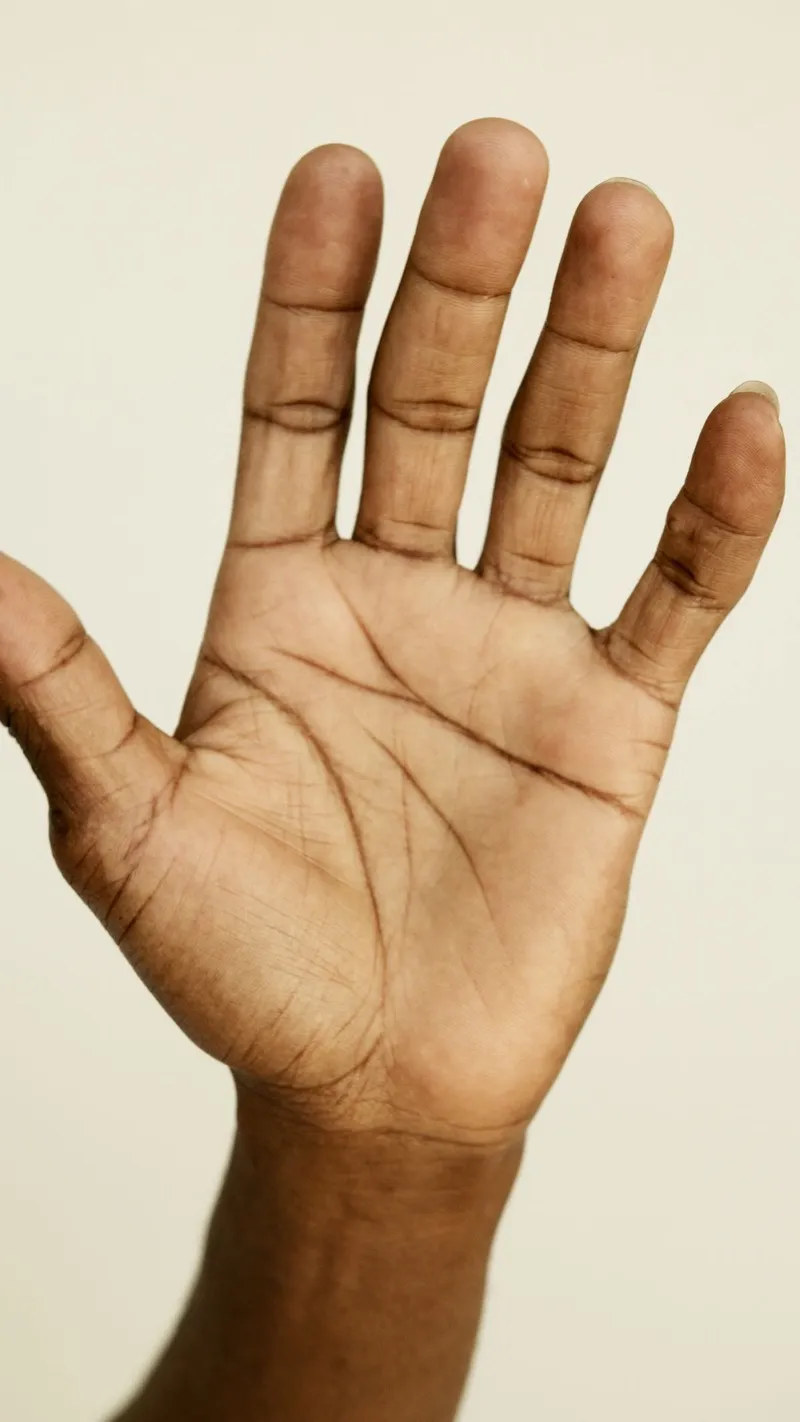
The heart line runs across the upper palm just below the finger bases, traced in highlighted rose-pink.
What Is the Heart Line?
The heart line is one of the three major lines of the palm, sitting alongside the life line and the head line as a primary reading in every classical tradition. It runs horizontally across the upper palm, just below the base of the fingers, and typically begins at the percussive (outer) edge of the palm near the pinky. From there it travels across toward the index or middle finger, where it ends or branches.
In Western palmistry, popularised by Cheiro and Benham, the heart line sits above the head line, which runs across the middle of the palm. In Hast Samudrika Shastra, the classical Indian system, this same line is tied to the anahata (heart) energy centre and read as the seat of feeling. Chinese palmistry calls it the “heaven line” among its three primary lines. Across all three traditions the heart line is treated as the major map of a person’s emotional life — the territory of feeling, bonding, and love.
What the Heart Line Symbolises
Emotional Patterns
The first and most consistent reading of the heart line across every tradition is emotional patterns — the habitual way a person processes and expresses feeling. A deep, clear, unbroken heart line is traditionally read as a steady, present emotional life: feelings register, are felt through, and are expressed. A faint or fragmented line is read as a more internalised emotional life, where feelings move quietly beneath the surface. Chains, islands, and ladder-like marks describe periods where emotion felt tangled or interrupted. None of this is a verdict on character; in traditional palmistry these are simply textures of feeling, and textures change. Indian palmistry frames the same idea through anahata: the heart centre as the place where feeling is generated and released.
Attachment Style
The heart line is traditionally read as a symbolic map of how a person bonds. Palmistry texts long predate modern attachment theory, but the categories rhyme. A heart line that curves up toward the fingers is read as a reaching, expressive attachment — what modern psychology might describe as secure or anxious expressive bonding. A straight, controlled line is read as a more self-contained attachment, closer to what is now called avoidant. A chained or broken line is read as an attachment shaped by complexity — not damage. These are symbolic framings, never clinical diagnoses. If attachment style matters to you in a real way, a therapist is the right partner, not a palm line.
How One Experiences Love
The heart line is also read as a description of the flavour of love a person tends toward. A long heart line that reaches across most of the palm is traditionally read as expansive love — love that is felt widely, given freely, and oriented outward. A short heart line is read as focused, direct love — concentrated rather than absent. A line that ends sharply upward under the index finger is read as idealistic, romantic love; an ending under the middle finger is read as more pragmatic, sensual love. Western palmistry has the richest vocabulary for this spectrum, but every classical tradition acknowledges that people love differently and that the heart line is one symbolic mirror of that difference.
Relationship to Vulnerability
Finally, the heart line is read as a map of how a person relates to vulnerability itself — the willingness to be seen, to be moved, and to let feeling change them. A deep, well-defined line is read as comfort with depth of feeling. A more guarded, controlled line is read as a more self-protective relationship with emotion, where feeling is acknowledged but kept in shape. Neither is healthier; both are temperaments, and the same person often shifts between them across a lifetime. As with every line in palmistry, the heart line is a reflection, not a verdict — and what it reflects is always changing.
How to Read the Heart Line — Endings, Curves, Forks
When you look at a heart line, traditional palmistry asks you to observe four properties in order: where it ends, its curve, any forks, and its depth and clarity. Each one carries a distinct meaning.
Where it ends is the single most weighted observation in Western palmistry. A heart line that ends under the index finger (the finger of Jupiter) is traditionally read as idealistic, romantic, devotional love — a temperament drawn to the ideal of love and to partners who carry meaning. A heart line that ends under the middle finger (Saturn) is read as more pragmatic, sensual, grounded love — less concerned with the ideal, more concerned with the present body and the present partner. An ending between the two, or one that splits and reaches toward both, is read as a balanced temperament that holds both registers at once.
Curved vs. straight describes the line’s overall shape. A heart line that curves clearly upward toward the fingers is read as emotionally expressive, outwardly affectionate, comfortable with showing what is felt. A heart line that runs straight across, with little upward arc, is read as more reserved, controlled, and interior — not less feeling, just less performative about it. Cheiro called these two patterns the “giving” and the “receiving” heart lines, and in tradition neither is preferred.
Forked endings are common and traditionally auspicious. A single fork at the end of the heart line is read as a balanced approach to love that holds idealism and pragmatism together. A double or triple fork — where the line ends in three or more small branches reaching toward different fingers — is read as emotional adaptability and a capacity to love different people in different ways. Forks are rarely read negatively in any classical tradition.
Depth and clarity describe how strongly the line is incised. A deep, clear heart line is read as strong emotional presence — feelings register, are acknowledged, and are expressed. A faint or fragmented line is read as a subtle, internalised emotional life: feeling moves quietly. This is not absence of feeling; it is a different relationship with feeling. As with all palm lines, depth often changes over time, which is why traditional palmists return to the same hand at intervals.
Common Heart Line Variations
Common Heart Line Variations
Broken Heart Line
A heart line with a clean break in it — a gap where the line interrupts and then resumes — is one of the most anxiously misread features in popular palmistry. Every major traditional source, including Cheiro and Benham in the West and the classical Indian and Chinese schools, reads breaks in the heart line as transitions: shifts in how a person relates emotionally, often tied to a significant relationship or inner change. Breaks are not romantic disasters. An overlap inside the break (where the line resumes alongside before continuing) is traditionally read as a smoother transition; a clean gap as a sharper one. Neither is a warning.
Chained Heart Line
A chained heart line looks like a series of small linked ovals rather than a single clean line. In tradition this is read as emotional sensitivity — a temperament that feels more, registers nuance, and is sometimes more affected by the emotional weather of the people around it. Some Western texts also associate chaining with periods of relationship complexity. None of this guarantees trouble; many people with chained heart lines have rich, stable emotional lives. Chaining is a description of texture, not an omen.
Island on the Heart Line
An island is a small oval-shaped mark inside the line, where the line splits briefly and rejoins. On the heart line, islands are traditionally read as a period of emotional difficulty — grief, conflicted feeling, or an inner sorting-out. Crucially, islands are always read as temporary. They describe a passage, not a permanent state. In Indian and Western palmistry alike, the meaning of an island is tied to the section of the line it appears on; islands closer to the start (the pinky side) are read as earlier in life, closer to the end as later.
Simian Line
A simian line is what palmistry calls the rare pattern where the heart line and the head line fuse into a single horizontal crease that runs straight across the palm. Roughly one in ten people in the general population has one. It is somewhat more common in people with Down syndrome, which is a real fact worth stating with care — but having a simian line is not diagnostic of anything. The overwhelming majority of people with a simian line are neurotypical. In traditional palmistry the simian line is read as an intense, single-focused integration of feeling and thinking: when this person cares, they care with all of themselves, and when they think, they think with their whole emotional weight behind it. Read with dignity, the simian line is simply one of the palm’s rarer and more striking patterns.
What Your Heart Line Does NOT Mean
What Your Heart Line Does NOT Mean
The heart line attracts more anxious interpretation than almost any other line, and most of what circulates online about it is wrong. Here are the five most common myths, each with the traditional correction.
Myth: “A broken heart line means heartbreak.” Reality: in every major palmistry tradition, breaks in the heart line are read as transitions — shifts in how a person relates emotionally — not romantic disasters. Cheiro and Benham both wrote explicitly that breaks should not be read as catastrophes. The break is the change, not a warning about the change.
Myth: “A short heart line means a cold person.” Reality: a short heart line is read in tradition as direct, focused emotional expression — not an absence of feeling. People with short heart lines often love very deeply; they simply concentrate that love rather than radiate it outward. Length describes scope, not warmth.
Myth: “If I don’t have a clear heart line, I can’t love.” Reality: every adult has a heart line. A faint or fragmented version is read as a more internalised emotional expression, where feeling moves quietly rather than visibly. It has never been read in any tradition as incapacity for love.
Myth: “The heart line predicts how many relationships I’ll have.” Reality: in traditional palmistry, the small horizontal lines below the pinky — the marriage lines — are the ones associated with significant attachments. The heart line is about how you love, not how many people you will love. Conflating the two is a modern internet error, not a classical reading.
Myth: “A bad heart line means I’m not capable of love.” Reality: no traditional palmistry source — Indian, Chinese, or Western — reads any palm line as a moral verdict on a person’s capacity for love. The palm is a mirror, not a court. Whatever the line looks like, it describes a texture of feeling, not a person’s worth as a partner.
Left Hand vs. Right Hand Heart Line
Left Hand vs. Right Hand Heart Line
ReadMyPalms follows the Western convention by default: read your dominant hand’s heart line for your active, current emotional life, and the non-dominant hand for the emotional tendencies you were born with. If you are right-handed, read the right heart line; if you are left-handed, read the left. Comparing the two is where tradition reads the gap between innate temperament and lived experience.
Indian and Chinese palmistry use different conventions, some of them gender-based in their classical forms. See the full left-vs-right discussion for the complete split across traditions.
How to Read Your Own Heart Line
How to Read Your Own Heart Line
Reading your own heart line takes about ten minutes if you are patient and have decent light. Follow these five steps:
- Find your dominant hand and natural daylight. Sit near a window. The more even the light, the more clearly the upper palm lines show.
- Locate the line. Identify the topmost horizontal line on your palm, running below the base of the fingers. It usually begins at the outer edge of the palm near the pinky and travels across toward the index or middle finger. That is your heart line.
- Observe where it ends and how it curves. Trace it from the pinky side across the palm. Where does it stop — under the index finger, the middle finger, or between them? Does it curve upward, or run straight across?
- Notice forks, breaks, chains, and islands. Look for places where the line splits at the end, interrupts and resumes, looks chained, or contains a small oval island. Note where on the line each feature appears.
- Interpret reflectively. Ask what theme each observation corresponds to in your emotional life. A break two-thirds along the line might map onto a relationship shift you can name. A fork at the end might map onto the way you balance idealism with pragmatism. The palm prompts; you provide the meaning.
Want an AI-assisted reading of your heart line in under a minute?
Get a Free AI Palm Reading →Frequently Asked Questions
Frequently Asked Questions
What is the heart line in palmistry?
The heart line is one of the three major lines of the palm, running horizontally across the upper palm just below the base of the fingers. In Western palmistry it sits above the head line. Traditionally it is read as a reflection of emotional patterns, attachment style, and how a person experiences love — not as a predictor of specific romantic events.
Does a broken heart line mean heartbreak?
No. A break in the heart line is traditionally read as a transition or shift in how a person relates emotionally — not a romantic disaster. All major palmistry traditions, including the Western schools of Cheiro and Benham, read breaks in any major line as change rather than catastrophe. Some traditions even read certain breaks positively, as openings for emotional growth.
What if I don’t have a clear heart line?
Every adult has a heart line. If yours appears faint or fragmented, traditional palmistry reads that as a more internalised or subtle emotional expression — not an absence of feeling and certainly not an inability to love. Lines also deepen and fade across a lifetime, so a faint line today may be clearer in a few years.
What is a simian line?
A simian line is a single horizontal crease formed when the heart line and head line fuse into one. It appears in roughly one in ten people in the general population. It is somewhat more common in people with Down syndrome but is absolutely not diagnostic — most people with a simian line are neurotypical. In traditional palmistry it is read as an intense, single-focused integration of feeling and thinking, not as anything medical.
Where does the heart line end on most people?
On most palms the heart line ends somewhere between the base of the index finger and the base of the middle finger. An ending under the index finger is traditionally read as idealistic and romantic. An ending under the middle finger is read as more pragmatic and sensual. An ending between the two is read as a balance of both temperaments.
Can my heart line change over time?
Yes. Palm lines, including the heart line, can deepen, fade, fork, or develop new markings throughout life. Traditional palmists recommend revisiting a reading every few years rather than treating any single reading as final. A faint heart line that strengthens after a season of significant relationship growth is read in tradition as deepening emotional expression.
Should I read my left hand or right hand heart line?
ReadMyPalms follows the Western convention by default: read the heart line on your dominant hand (the one you write with) for your active, current emotional life. The non-dominant hand reflects inherited tendencies and the emotional pattern you were born with. Indian palmistry uses different conventions, including some gender-based rules in classical schools.
How Heart Line Is Read Across Traditions
Palmistry is a layered tradition, not a single system. Indian, Chinese, and Western lineages each read the heart line a little differently — here is how the same line is named and interpreted across the three schools.
| Tradition | Local Term | Meaning |
|---|---|---|
| Indian (Hast Samudrika Shastra) | Hriday Rekha / हृदय रेखा | In classical Hast Samudrika Shastra the Hriday Rekha is traditionally read as a karmic indicator of emotional disposition, devotion (bhakti) and family bonds — interpreted alongside Jupiter and Saturn mounts and often linked to the Anahata (heart) chakra rather than romance alone. |
| Chinese (手相 Shǒuxiàng) | 感情线 / Gǎnqíng Xiàn ('emotion line'); older texts call it 天纹 / Tiānwén | Chinese palmistry treats the Gǎnqíng Xiàn as the uppermost of the 'three great lines' (三大主线) within a heaven-earth-human cosmology. It is read alongside face reading and TCM heart-meridian cues for temperament and social harmony, not as a romance map. |
| Western (Cheiro / Benham revival) | Heart Line (also Mensal Line in older texts) | Cheiro and Benham emphasised the Heart Line as a chart of romantic and affectional temperament — terminations under Jupiter read as idealistic love, under Saturn as sensual or self-focused. The modern 'physical vs mental heart line' typology descends directly from this revival. |
Hriday Rekha / हृदय रेखा
In classical Hast Samudrika Shastra the Hriday Rekha is traditionally read as a karmic indicator of emotional disposition, devotion (bhakti) and family bonds — interpreted alongside Jupiter and Saturn mounts and often linked to the Anahata (heart) chakra rather than romance alone.
感情线 / Gǎnqíng Xiàn ('emotion line'); older texts call it 天纹 / Tiānwén
Chinese palmistry treats the Gǎnqíng Xiàn as the uppermost of the 'three great lines' (三大主线) within a heaven-earth-human cosmology. It is read alongside face reading and TCM heart-meridian cues for temperament and social harmony, not as a romance map.
Heart Line (also Mensal Line in older texts)
Cheiro and Benham emphasised the Heart Line as a chart of romantic and affectional temperament — terminations under Jupiter read as idealistic love, under Saturn as sensual or self-focused. The modern 'physical vs mental heart line' typology descends directly from this revival.
Myth vs. Reality
The heart line attracts more pop-culture invention than almost any other palm feature. These are the claims you will find on low-quality palmistry sites — and how traditional palmistry across Indian, Chinese, and Western schools actually reads them.
| Myth | Reality |
|---|---|
“A short heart line means you are incapable of love or will have a short marriage.” | No major tradition — Indian, Chinese, or Western — reads line length as a literal measure of love capacity or marriage duration. Cheiro and Benham associated a shorter heart line with a more self-contained or pragmatic emotional style, not an absence of love, and Chinese sources treat depth and clarity as more telling than length. Sources: Cheiro, Language of the Hand (1894), Benham, Laws of Scientific Hand Reading (1900) |
“The left hand shows your love life and the right hand shows your future partner.” | This is a modern pop-palmistry simplification. Most Western and Indian schools use a dominant/non-dominant convention — the non-dominant hand traditionally read as inherited tendencies and the dominant hand as expressed life — and Hast Samudrika Shastra further distinguishes hands by the querent's gender rather than by relationship role. Sources: Cheiro, Language of the Hand (1894), Hast Samudrika Shastra tradition |
“Having no heart line (or a single horizontal Simian line) means you cannot feel emotion.” | A 'missing' heart line almost always means it has merged with the head line into what Western palmistry calls a Simian crease, traditionally read as intense focus or a fusion of thought and feeling — not absence of emotion. Indian and Chinese traditions similarly treat this as an unusual but symbolically rich pattern, not a deficit. Sources: Benham, Laws of Scientific Hand Reading (1900), Cheiro, Language of the Hand (1894) |
“Multiple or branching heart lines mean multiple marriages or affairs.” | Traditional palmistry does not equate branches with literal partner counts. Cheiro read upward branches as positive emotional events and downward branches as disappointments; Chinese 感情线 readings interpret forks as temperament nuances; and Indian lineages typically use separate 'marriage lines' on the Mercury edge — not heart-line branches — for relationship questions. Sources: Cheiro, Language of the Hand (1894), Chinese shǒuxiàng tradition |
“A chained or broken heart line predicts heart disease or heartbreak at a specific age.” | No classical school timestamps the heart line to specific ages with medical precision. Benham described chains and islands as indicators of emotional sensitivity or temperament, and while some TCM-adjacent Chinese readers note constitutional correlations, traditional palmistry is symbolic and is not a diagnostic substitute for medical evaluation. Sources: Benham, Laws of Scientific Hand Reading (1900), Chinese shǒuxiàng / TCM-adjacent tradition |
“A short heart line means you are incapable of love or will have a short marriage.”
No major tradition — Indian, Chinese, or Western — reads line length as a literal measure of love capacity or marriage duration. Cheiro and Benham associated a shorter heart line with a more self-contained or pragmatic emotional style, not an absence of love, and Chinese sources treat depth and clarity as more telling than length.
Sources: Cheiro, Language of the Hand (1894), Benham, Laws of Scientific Hand Reading (1900)
“The left hand shows your love life and the right hand shows your future partner.”
This is a modern pop-palmistry simplification. Most Western and Indian schools use a dominant/non-dominant convention — the non-dominant hand traditionally read as inherited tendencies and the dominant hand as expressed life — and Hast Samudrika Shastra further distinguishes hands by the querent's gender rather than by relationship role.
Sources: Cheiro, Language of the Hand (1894), Hast Samudrika Shastra tradition
“Having no heart line (or a single horizontal Simian line) means you cannot feel emotion.”
A 'missing' heart line almost always means it has merged with the head line into what Western palmistry calls a Simian crease, traditionally read as intense focus or a fusion of thought and feeling — not absence of emotion. Indian and Chinese traditions similarly treat this as an unusual but symbolically rich pattern, not a deficit.
Sources: Benham, Laws of Scientific Hand Reading (1900), Cheiro, Language of the Hand (1894)
“Multiple or branching heart lines mean multiple marriages or affairs.”
Traditional palmistry does not equate branches with literal partner counts. Cheiro read upward branches as positive emotional events and downward branches as disappointments; Chinese 感情线 readings interpret forks as temperament nuances; and Indian lineages typically use separate 'marriage lines' on the Mercury edge — not heart-line branches — for relationship questions.
Sources: Cheiro, Language of the Hand (1894), Chinese shǒuxiàng tradition
“A chained or broken heart line predicts heart disease or heartbreak at a specific age.”
No classical school timestamps the heart line to specific ages with medical precision. Benham described chains and islands as indicators of emotional sensitivity or temperament, and while some TCM-adjacent Chinese readers note constitutional correlations, traditional palmistry is symbolic and is not a diagnostic substitute for medical evaluation.
Sources: Benham, Laws of Scientific Hand Reading (1900), Chinese shǒuxiàng / TCM-adjacent tradition
Related Palmistry Topics
The heart line is one of three major lines in traditional palmistry. Explore the rest of the cluster:
Life Line
The line curving around the thumb, traditionally read as vitality and life transitions.
Read the guide →Head Line
The line across the middle of the palm, read as thinking style and decision-making.
Read the guide →Fate Line
The vertical line rising up the palm, read as direction and outside forces in life.
Read the guide →Sun Line
Vertical line associated with creativity and recognition.
Read the guide →Marriage Line
Short horizontal lines on the palm edge below the pinky.
Read the guide →Health Line
Diagonal line traditionally read as constitutional vitality.
Read the guide →