Quick Answer
Does a short life line mean a short life? No.
No credible palmistry tradition — Indian, Chinese, or Western — has ever read the length of the life line as the length of a life. The myth appears to come from 19th-century parlour fortune tellers, not from classical palmistry texts. The life line is a symbolic reflection of vitality, physical energy, and major life transitions — never a lifespan forecast.
Life Line Palm Reading: Meaning, Length & What It Doesn’t Mean
Last reviewed: 2026-06-27 by ReadMyPalms editorial
A working guide to the most-misunderstood line on the palm, drawn from traditional Indian, Chinese, and Western palmistry — with the lifespan myth dispelled in detail.
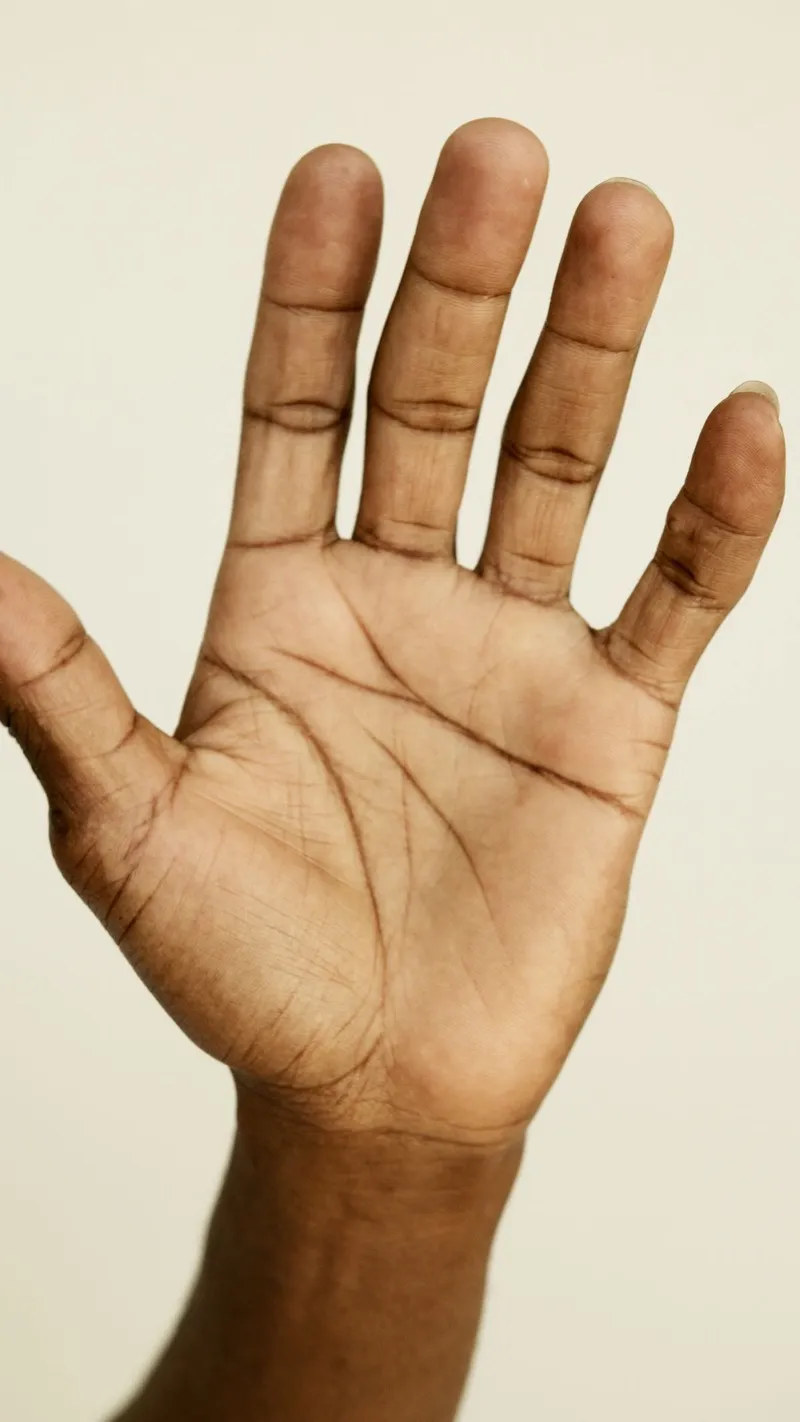
The life line curves around the base of the thumb, traced in highlighted purple.
What Is the Life Line?
The life line is one of the four major lines of the palm. It begins between the thumb and the index finger, curves around the base of the thumb — over the fleshy area Western palmistry calls the Mount of Venus — and arcs down toward the wrist. On most hands it is the deepest, longest-running curved line on the palm.
Despite the name, palmistry has never read the life line as a literal measure of how long a person will live. In Hast Samudrika Shastra, the classical Indian system, the line is associated with prana — vital life-force energy — rather than with a fixed lifespan. In Chinese palmistry it is the “earth line,” one of three primary lines tied to the body’s constitution. In Western palmistry, popularised by Cheiro and Benham, it is read as vitality and a record of the major transitions a person moves through. None of these traditions equates length with lifespan.
What the Life Line Symbolises
Vitality and Physical Energy
The first and most consistent reading of the life line across every tradition is vitality. A deep, clear, well-coloured life line is read as steady physical energy, good recovery from illness, and a body that meets the day with reserve to spare. A faint or fragmented line is read as a more depleted phase — not as illness or weakness, but as a call to attend to rest, movement, and the body’s rhythms. In Indian palmistry this is tied directly to prana; in Chinese palmistry it is described in terms of constitutional qi; in Western palmistry it is plainly called life-energy. The vocabulary differs; the meaning converges.
Major Life Transitions
The second meaning is transition. Breaks, splits, and changes along the life line are traditionally read as turning points — moments when a person’s circumstances, environment, or relationship to themselves shifts significantly. A break that overlaps with itself (where the line resumes alongside before continuing) is read as a smoother, more chosen transition. A clean break with a noticeable gap is read as a sharper change. Neither is a warning about danger; both are descriptions of texture. Palmists who try to date these transitions by measuring along the line are using a technique that varies wildly between schools, which is one reason mature palmistry treats timing claims with suspicion.
Connection to the Physical Body
The third meaning is the relationship between a person and their physical body. The life line sits at the boundary between the Mount of Venus — the fleshy base of the thumb, traditionally associated with sensuality, warmth, and embodied life — and the rest of the palm. A line that bows outward, away from the thumb and into the centre of the palm, is read as an embodied, world-engaged life; a line that hugs the thumb tightly is read as a more interior, self-contained relationship with the body. Neither pattern is better; they describe different temperaments, not different worths.
Quality of Life Experience
Finally, the life line is read as a reflection of the texture of lived experience. Depth, colour, and the presence of small marks all contribute. A deep, clear, evenly-coloured line is read as a coherent and grounded life experience. Chains (small linked marks), islands (oval gaps inside the line), and ladder-like crossing lines are read as periods where life felt fragmented, divided, or interrupted. As with every line, these are descriptions of texture, not verdicts — periods change, and so does the line.
Reading the Life Line — Length, Depth, Curve
When you look at a life line, palmistry traditions ask you to observe four properties in sequence: length, depth, curve, and colour. Each one carries a distinct meaning.
Length describes how far the line travels. A long life line — one that traces an unbroken curve from between the thumb and index finger all the way down near the wrist — is read as steady, sustained vitality across the span of life. A short life line is read as energy that comes in chapters, or a life in which long transitions reshape the underlying current. Length is not lifespan; that is the single most important sentence in any honest life-line reading.
Depth is read as the strength of the vitality the line describes. A deep, well-incised life line is read as robust constitutional energy. A faint or shallow line is read as a more delicate or sensitive constitution — or as a period of depletion that may itself pass. Depth often changes more quickly than length, which is why traditional palmists return to the same hand over time.
Curve describes how far the line bows out into the palm. A wide curve that arcs out toward the centre of the palm is read as an extroverted, world-engaged vitality; a narrow curve that hugs the thumb is read as a more inward, self-contained energy. Western palmistry, following Benham, places particular weight on this geometry.
Colour is sometimes overlooked but is a real part of the reading tradition — especially in Chinese palmistry. A pink, healthy-looking line is read as warm vitality. A pale or bluish tint is read as a phase of low energy. A reddish flush is read as heat or restlessness. These are descriptions, not diagnoses, and they do not substitute for medical attention if you have any actual health concern.
What Your Life Line Does NOT Mean
What Your Life Line Does NOT Mean
Despite what 19th-century parlour fortune tellers claimed, the length of your life line does not predict how long you will live. This is not a small clarification — it is the central correction every honest palmistry resource needs to make. The lifespan myth is the single most damaging misconception in popular palmistry, and it appears nowhere in the classical Indian, Chinese, or Western texts that the tradition is built on. It is a parlour invention, pure and simple.
A short life line does not mean a short life. It means — in traditional reading — that your vitality flows in distinct chapters, or that the texture of your physical energy has been shaped by significant transitions. People with short life lines live into their nineties all the time. People with very long, deep life lines die young, sometimes very young. The line does not know; it was never meant to.
A broken life line does not mean death or serious illness. Across every tradition, breaks are read as transitions: a relocation, a major life change, a turning point, a new chapter. The break is the change, not a warning about the change. An overlap inside the break is read as a smoother transition; a wider gap as a more abrupt one. Neither is an omen.
A faint life line does not mean you are unwell. Faint lines appear on healthy people during cerebral or sedentary phases of life, during periods of high stress, and during major transitions where the body is doing less heavy work. The line is a description of vitality’s texture, not a diagnosis. If you have a real health concern, see a doctor. If you have a faint life line and feel fine, you are fine. None of this means anything more than what every honest palmistry tradition has said for two thousand years: the palm is a mirror, not an oracle.
Left Hand vs. Right Hand Life Line
Left Hand vs. Right Hand Life Line
ReadMyPalms follows the Western convention by default: read your dominant hand’s life line as your active or current life, and the non-dominant hand as inherited tendencies and the constitution you were born with. If you are right-handed, read the right life line; if you are left-handed, read the left.
Indian and Chinese palmistry use different conventions — some gender-based, some lineage-specific. The hub guide covers the full split. See the full left-vs-right discussion in the palm reading guide.
How to Read Your Own Life Line
How to Read Your Own Life Line
Reading your own life line takes about ten minutes if you are patient and have decent light. Follow these five steps:
- Find your dominant hand and natural daylight. Sit near a window. The more even the light, the more clearly the line shows.
- Locate the line. Identify the curve that begins between your thumb and index finger and arcs down toward the wrist, around the fleshy mount at the base of the thumb. That is your life line.
- Observe its length, depth, curve, and colour. Move through the four properties one at a time. Do not jump to interpretation yet — just look.
- Notice breaks, branches, and marks. Look for places where the line splits, breaks, overlaps itself, or carries small islands, chains, or crossing lines. Note where on the line they appear (closer to the top is read as earlier in life; closer to the wrist as later).
- Interpret reflectively. Ask what theme each observation corresponds to in your own life. A break two-thirds of the way down might be a recent transition you already know about. A chained section in the upper third might be the texture of a childhood you can describe. The palm prompts; you provide the meaning.
Want an AI-assisted reading of your life line in under a minute?
Get a Free AI Palm Reading →Frequently Asked Questions
Frequently Asked Questions
Does the length of my life line predict my lifespan?
No. The length of the life line does not predict how long you will live. This is the most damaging myth in popular palmistry, and no credible palmistry tradition — Indian, Chinese, or Western — has ever taught it. The life line is read as a reflection of vitality, physical energy, and major life transitions. Its length has no bearing on lifespan.
What does a broken life line mean?
A broken life line is read as a transition — a change of environment, a turning point, a new chapter — not as illness or death. Across every major palmistry tradition, breaks and gaps in any line symbolise change. If the broken section overlaps with itself, that overlap is traditionally read as a smoother transition.
I have a short life line — should I be worried?
No. A short life line does not predict a short life. This myth appears to come from 19th-century parlour fortune tellers rather than from any classical palmistry text. In traditional palmistry the life line reflects vitality and transitions, not lifespan. Many people with long lives have short life lines, and vice versa.
What does a double life line mean?
A double life line — a second line running parallel to the main one, sometimes called a sister line or Mars line — is traditionally considered an auspicious mark in Indian and Western palmistry. It is read as added vitality, resilience, and protective energy. People with double life lines are described as recovering well from setbacks.
Can my life line change?
Yes. Palm lines, including the life line, can deepen, fade, branch, or develop new markings throughout life. This is one reason traditional palmists recommend revisiting a reading every few years rather than treating any single reading as final. A faint life line that strengthens over time is read as growing vitality and rootedness.
What does a faint life line mean?
A faint or shallow life line is traditionally read as a period of lower vitality or a less grounded relationship to the physical body — not as illness or a danger sign. Many palmists describe it as a call to slow down and pay attention to rest, nutrition, and physical activity. It is also commonly seen on people in highly cerebral or sedentary phases of life.
Which hand’s life line should I read?
ReadMyPalms follows the Western convention by default: read the life line on your dominant hand (the one you write with) for your active, current life. The non-dominant hand reflects inherited tendencies and the potential you were born with. Indian palmistry traditionally uses different rules, including gender-based ones in some classical schools.
How Life Line Is Read Across Traditions
Palmistry is a layered tradition, not a single system. Indian, Chinese, and Western lineages each read the life line a little differently — here is how the same line is named and interpreted across the three schools.
| Tradition | Local Term | Meaning |
|---|---|---|
| Indian (Hast Samudrika Shastra) | Jeevan Rekha / जीवन रेखा | In classical Hast Samudrika Shastra, the Jeevan Rekha is traditionally read as a map of prana (vital force), family ties, and constitutional strength, with its curve around the Mount of Venus (Shukra) interpreted alongside the thumb. Indian readings characteristically weave it into a karmic picture with the fate line and planetary mounts. |
| Chinese (手相 Shǒuxiàng) | 生命线 / Shēngmìng Xiàn | In Chinese palmistry the Shēngmìng Xiàn is traditionally read as an indicator of physical vitality and qi flow, conventionally interpreted alongside face reading (面相) and the Five Elements / TCM constitution. Some lineages emphasise the line's depth, colour, and any island or chain patterns as signals of energetic balance. |
| Western (Cheiro / Benham revival) | Life Line (also Vitality Line) | Cheiro and Benham emphasised the Life Line as a record of vitality, major transitions, and physical resilience, often dividing it into timed segments to flag periods of change — while warning not to equate length with lifespan. The Western revival paired it closely with the Mount of Venus and any sister or Mars line. |
Jeevan Rekha / जीवन रेखा
In classical Hast Samudrika Shastra, the Jeevan Rekha is traditionally read as a map of prana (vital force), family ties, and constitutional strength, with its curve around the Mount of Venus (Shukra) interpreted alongside the thumb. Indian readings characteristically weave it into a karmic picture with the fate line and planetary mounts.
生命线 / Shēngmìng Xiàn
In Chinese palmistry the Shēngmìng Xiàn is traditionally read as an indicator of physical vitality and qi flow, conventionally interpreted alongside face reading (面相) and the Five Elements / TCM constitution. Some lineages emphasise the line's depth, colour, and any island or chain patterns as signals of energetic balance.
Life Line (also Vitality Line)
Cheiro and Benham emphasised the Life Line as a record of vitality, major transitions, and physical resilience, often dividing it into timed segments to flag periods of change — while warning not to equate length with lifespan. The Western revival paired it closely with the Mount of Venus and any sister or Mars line.
Myth vs. Reality
The life line attracts more pop-culture invention than almost any other palm feature. These are the claims you will find on low-quality palmistry sites — and how traditional palmistry across Indian, Chinese, and Western schools actually reads them.
| Myth | Reality |
|---|---|
“A short life line means a short life or early death.” | No major tradition (Indian, Chinese, or Western) treats line length as a literal lifespan meter. Cheiro and Benham both explicitly warned against equating length with years lived; the line is traditionally read as a marker of vitality and life events, not duration. Modern studies have also found no correlation between line length and longevity. Sources: Cheiro, Language of the Hand (1894), Benham, Laws of Scientific Hand Reading (1900), Newrick et al., Journal of the Royal Society of Medicine (1990) |
“The left hand shows your past, the right hand shows your future.” | Traditions disagree and none frame it so simply. Hast Samudrika Shastra traditionally reads the right hand for men and left for women as the active hand. Western palmistry after Cheiro reads the non-dominant hand as inherited potential and the dominant as what one has made of it — not literal past vs. future. Sources: Hast Samudrika Shastra tradition, Cheiro, Language of the Hand (1894) |
“Having no visible life line means you will die young or have no life force.” | Traditional palmistry treats a faint or absent life line as a symbolic marker of low physical stamina or a life lived through the mind — not a death omen. Indian and Western texts advise looking to supporting lines (fate, head, Mercury) to compensate, and Chinese palmistry reads it alongside the thumb mount and overall hand shape. Sources: Benham, Laws of Scientific Hand Reading (1900), Cheiro's Palmistry for All (1916) |
“A break in the life line means a guaranteed accident, illness, or death on a specific date.” | Across traditions, breaks are read as symbolic markers of transition or a vulnerable period — not fixed predictions. Cheiro emphasised that breaks paired with a square or overlapping line are traditionally read as protection, and Indian palmistry weighs them against the fate line and mounts. Sources: Cheiro, Language of the Hand (1894), Hast Samudrika Shastra tradition |
“Two life lines (a 'sister line') mean you have two lives or supernatural protection.” | A parallel inner line is traditionally called the Mars line or 'sister line' in Western palmistry and is read as added vitality and resilience during difficult periods. Indian palmistry reads similar parallels as family or spiritual backing. None of the classical traditions claim it grants a literal second life. Sources: Benham, Laws of Scientific Hand Reading (1900), Cheiro, Language of the Hand (1894) |
“A short life line means a short life or early death.”
No major tradition (Indian, Chinese, or Western) treats line length as a literal lifespan meter. Cheiro and Benham both explicitly warned against equating length with years lived; the line is traditionally read as a marker of vitality and life events, not duration. Modern studies have also found no correlation between line length and longevity.
Sources: Cheiro, Language of the Hand (1894), Benham, Laws of Scientific Hand Reading (1900), Newrick et al., Journal of the Royal Society of Medicine (1990)
“The left hand shows your past, the right hand shows your future.”
Traditions disagree and none frame it so simply. Hast Samudrika Shastra traditionally reads the right hand for men and left for women as the active hand. Western palmistry after Cheiro reads the non-dominant hand as inherited potential and the dominant as what one has made of it — not literal past vs. future.
Sources: Hast Samudrika Shastra tradition, Cheiro, Language of the Hand (1894)
“Having no visible life line means you will die young or have no life force.”
Traditional palmistry treats a faint or absent life line as a symbolic marker of low physical stamina or a life lived through the mind — not a death omen. Indian and Western texts advise looking to supporting lines (fate, head, Mercury) to compensate, and Chinese palmistry reads it alongside the thumb mount and overall hand shape.
Sources: Benham, Laws of Scientific Hand Reading (1900), Cheiro's Palmistry for All (1916)
“A break in the life line means a guaranteed accident, illness, or death on a specific date.”
Across traditions, breaks are read as symbolic markers of transition or a vulnerable period — not fixed predictions. Cheiro emphasised that breaks paired with a square or overlapping line are traditionally read as protection, and Indian palmistry weighs them against the fate line and mounts.
Sources: Cheiro, Language of the Hand (1894), Hast Samudrika Shastra tradition
“Two life lines (a 'sister line') mean you have two lives or supernatural protection.”
A parallel inner line is traditionally called the Mars line or 'sister line' in Western palmistry and is read as added vitality and resilience during difficult periods. Indian palmistry reads similar parallels as family or spiritual backing. None of the classical traditions claim it grants a literal second life.
Sources: Benham, Laws of Scientific Hand Reading (1900), Cheiro, Language of the Hand (1894)
Related Palmistry Topics
The life line is one of four major lines in traditional palmistry. Explore the rest of the cluster:
Heart Line
The horizontal line across the upper palm, read as emotional life and attachment.
Read the guide →Head Line
The line across the middle of the palm, read as thinking style and decision-making.
Read the guide →Fate Line
The vertical line rising up the palm, read as direction and outside forces in life.
Read the guide →Sun Line
Vertical line associated with creativity and recognition.
Read the guide →Marriage Line
Short horizontal lines on the palm edge below the pinky.
Read the guide →Health Line
Diagonal line traditionally read as constitutional vitality.
Read the guide →