Quick Answer
Does a sun line predict fame? Not literally.
The sun line — also called the Apollo line — is the vertical line rising up the palm toward the ring finger. Tradition reads it as creativity, recognition, and inner light: the quality of being seen for what makes you distinctive. It is a tendency toward visibility, not a fame forecast. Many people with strong sun lines are recognised within local or specific contexts.
Sun Line on Palm: Apollo Line Meaning & Creative Recognition
Last reviewed: 2026-06-27 by ReadMyPalms editorial
A reflective guide to the sun line (Apollo line) in traditional Western, Hindu, and Chinese palmistry — what it symbolises about creativity, recognition, and the kind of light a person carries.
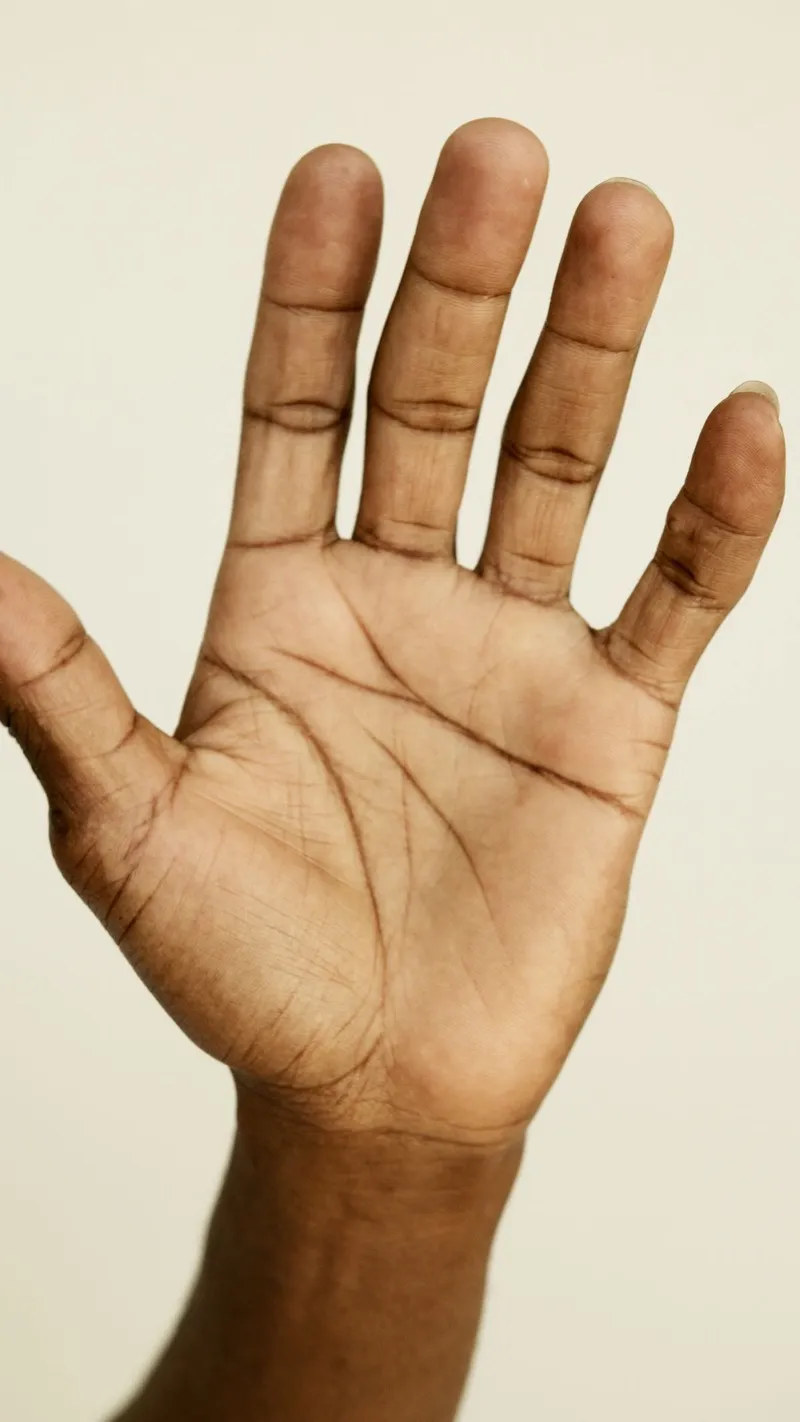
The sun line (highlighted in amber) rises vertically up the palm toward the base of the ring finger — the Apollo finger in classical palmistry.
What Is the Sun Line?
The sun line — named the Apollo line in classical Western palmistry and the Surya rekha in Hindu palmistry — is a vertical line that rises up the palm toward the base of the ring finger. It is one of the secondary lines, present on some palms and absent on others. When present, tradition treats it as a meaningful line, well below the major lines in interpretive weight but rich enough to deserve its own reading.
The line takes its name from Apollo — the Greek and Roman god of light, music, medicine, and the arts — whose finger in classical palmistry is the ring finger. In Hindu palmistry the same finger is associated with Surya, the sun. Across both traditions the underlying symbolism is identical: the line rises toward the finger of illumination, and the line itself describes how a person shines.
What the Sun Line Symbolises
Creativity
The primary reading of the sun line is creativity. A clear, strong sun line is traditionally read as a person with a genuine creative gift — an aesthetic sense, an ear for music, a feel for art, design, writing, or any of the expressive crafts. The line does not specify which medium; that is read from the rest of the palm. It speaks to the underlying quality: this person makes things, sees things, and arranges things in a way others notice.
Recognition
The second reading is recognition — the quality of being seen and acknowledged. A clear sun line is read as a temperament whose work and presence tend to be noticed by others, whether in a wide public way or in a specific community. Hindu palmistry weights this layer particularly strongly: a strong Surya rekha is read as the mark of someone who comes to be known for something. The recognition is not necessarily about fame — it is about not going unseen.
Charisma and Inner Light
The third reading is charisma — the felt presence a person carries into a room. The sun line is read as a marker of inner light: a quality of warmth, clarity, or magnetism that draws others without effort. Cheiro called this the “line of the personality.” In tradition this is not separate from the creative reading; the same inner light that makes someone’s work meaningful is what gives them presence.
Good Fortune and Success
The fourth reading concerns good fortune in pursuits. A clear sun line is traditionally read as a tendency for one’s endeavours to be received well, supported, and rewarded. This is read carefully: it is not a wealth-prediction line, and it is not a guarantee. It is read as a person whose work tends to find its audience and whose direction tends to align with circumstance. Like every line in palmistry, it is a description of tendency — never a contract.
How to Read the Sun Line — Length, Origin, and Endings
Four observations refine the sun line reading: origin, length, depth and clarity, and endings or marks.
Origin is the most weighted modifier. A sun line rising from the Mount of Luna (the lower outer edge of the palm, opposite the thumb) is read as creativity born of imagination and intuition — an artistic temperament, often with recognition that comes from creative work. A sun line rising from the head line is read as creativity grounded in intellect — recognition from work that combines thought with making. A sun line rising from near the wrist or from the rascette is read as a creative quality present from early life. A sun line rising from the fate line is read as creativity that becomes recognised through one’s public direction or career.
Length describes how prominently the quality expresses. A long sun line that runs from low on the palm up to the Mount of Apollo is read as long-running, well-developed expression. A short sun line that appears only near the top of the palm is read as recognition that comes later in life or that develops slowly.
Depth and clarity describe the strength of the quality. A deep, clear, unbroken sun line is read as a strong, present quality. A faint sun line is read as a real but subtle quality — creativity and recognition that move quietly.
Endings and marks matter at the top of the line where it meets the Mount of Apollo. A clean ending in the mount is read as a positive expression. A forked ending is read as multiple creative expressions. A star at the top is one of the most celebrated marks in classical palmistry, read as sudden creative recognition. Crosses or breaks on the line are read as interruptions or transitions in the creative life, not as failures.
Common Sun Line Variations
Long Clear Sun Line
A long, clear, deeply incised sun line is the most positively read configuration. Tradition treats it as a strong creative temperament with natural recognition. The person may not seek visibility, but their work and presence tend to be noticed.
Short Sun Line
A short sun line is read positively in its own register. It often appears near the top of the palm only, and tradition reads this as creative recognition that develops later or quietly — not as creative failure. Many people with short sun lines find their work valued in mid- or later life.
Broken Sun Line
A sun line that breaks (interrupts and resumes) is traditionally read as a creative or public life that has gone through cycles of visibility and withdrawal. Many artists have broken sun lines — not because they fail, but because the creative life rarely runs in straight lines. Cheiro read breaks as renewals.
Wavy or Chained Sun Line
A wavy or chained sun line is read as creative talent pursued with less single-pointed focus — touching multiple fields, dabbling rather than concentrating. It is read with warmth in tradition: a generalist’s creativity, the multi-instrument player, the artist who refuses one medium.
What the Sun Line Does NOT Mean
The sun line attracts overclaiming. Here are the five most common myths.
Myth: “A sun line means I’ll be famous.” Reality: tradition reads the sun line as a tendency toward recognition, never as a fame forecast. Most people with strong sun lines are recognised within specific contexts — respected teachers, beloved craftspeople, celebrated community figures. Global fame is not what the line points to.
Myth: “No sun line means I’m not creative.” Reality: a faint or absent sun line is common and is never read in tradition as lacking creativity. It points to a temperament whose creative life is private and lived for its own sake, not oriented toward visibility. Many people without sun lines are richly creative.
Myth: “A sun line guarantees wealth.” Reality: the sun line is sometimes loosely associated with material success because recognised work often pays well, but no classical source frames it as a wealth indicator. It is a recognition line, not a money line.
Myth: “A broken sun line means my creative career will fail.” Reality: breaks are read as cycles of visibility and withdrawal — the natural rhythm of most creative lives — not as failures. Cheiro specifically read breaks in the sun line as renewals.
Myth: “The sun line tells me my exact field.” Reality: the sun line describes a quality — creative recognition — not a medium. Whether you express it through music, writing, design, teaching, or some other craft is read from the rest of the palm and from your life, not from this single line.
Tradition Attribution: The Sun Line Across Schools
Western palmistry, in Cheiro and William Benham, names this line after Apollo, the Greek god of light, music, and the arts. Cheiro called it the line of the personality and gave it sustained treatment as a marker of inner light and recognition.
Hindu palmistry — Hast Samudrika Shastra — calls it the Surya rekha, the line of the sun, and reads it for fame, recognition, and bright fortune. Hindu palmistry tends to weight the recognition layer especially heavily and catalogues marks on the line in detail.
Chinese palmistry recognises it as the line rising toward the ring-finger mount and reads it for distinction and visible accomplishment. Across all three traditions the core reading is consistent: this line is the mark of someone who comes to be seen.
How to Read Your Own Sun Line
Reading the sun line takes about five minutes. Some palms have none, which is fine.
- Hold your dominant palm in natural light. Side lighting helps show secondary lines that overhead light can flatten.
- Look below the ring finger. The sun line rises toward the base of the ring finger (the Apollo finger). Scan vertically downward from the base of that finger and see how far down a clear vertical line is visible.
- Trace its origin. Follow the line downward as far as it goes. Does it begin from the Mount of Luna (lower outer palm)? From the head line? From the heart line? From the wrist? From the fate line? Each origin modifies the reading.
- Note length, depth, and clarity. A long, deep, clear line is the strongest expression; a short, faint line is a subtler one. Note breaks, forks, and any small marks (stars, crosses, squares) on the line.
- Interpret reflectively. Map what you see onto your relationship with creative expression and recognition. The line describes a quality you carry; how you live with it is yours to decide.
Want an AI-assisted reading of your sun line and other secondary lines?
Get a Free AI Palm Reading →Frequently Asked Questions
What is the sun line in palmistry?
A vertical line rising up the palm toward the base of the ring finger. Also called the Apollo line. Read as a sign of creativity, recognition, charisma, and inner light.
Where does the sun line come from on the palm?
It can rise from the Mount of Luna, the head line, near the wrist, the heart line, or the fate line. The starting point modifies the reading.
Does a sun line mean I will become famous?
No. It is read as a tendency toward recognition, not a fame forecast. Many people with strong sun lines are recognised within local or specific contexts.
What if I do not have a sun line?
Common and not negative. Read as a temperament whose recognition is quieter and more internal. Many people without sun lines have rich creative lives lived for their own sake.
What is the difference between the sun line and the fate line?
The fate line runs toward the middle finger and is read for direction in life. The sun line runs toward the ring finger and is read for creativity and recognition. Different lines, different domains.
What does a broken or wavy sun line mean?
A broken sun line is read as cycles of visibility and withdrawal in creative life. A wavy sun line is read as multi-field creative talent pursued with less concentration. Neither is read as failure.
Where does the sun line tradition come from?
All three major traditions name it. Western (Apollo line), Hindu (Surya rekha), and Chinese palmistry all read it for distinction and visible accomplishment.
How Sun Line Is Read Across Traditions
Palmistry is a layered tradition, not a single system. Indian, Chinese, and Western lineages each read the sun line a little differently — here is how the same line is named and interpreted across the three schools.
| Tradition | Local Term | Meaning |
|---|---|---|
| Indian (Hast Samudrika Shastra) | Surya Rekha / सूर्य रेखा (also Yash Rekha / यश रेखा) | In classical Hast Samudrika Shastra, the Surya Rekha is traditionally read as a marker of yash (fame) and the fruits of accumulated karma surfacing through the Mount of Sun. Indian readings emphasise it as a karmic supplement to the Bhagya Rekha rather than a standalone success indicator. |
| Chinese (手相 / Shǒuxiàng) | 太陽線 / Tàiyáng Xiàn (also 成功線 / Chénggōng Xiàn, "success line") | Some Chinese palmistry lineages treat the 太陽線 as one of the "three great lines" of accomplishment, read together with face reading and ring-finger proportion. Chinese readings traditionally emphasise harmony with overall hand balance — reflecting TCM-influenced ideas of energetic flow — rather than fame as public spotlight. |
| Western (Cheiro / Benham revival) | Sun Line (also Apollo Line, Line of Brilliancy) | Cheiro and Benham emphasised the Sun Line as an indicator of artistic temperament and public recognition, rising toward the Mount of Apollo under the ring finger. Western palmistry distinguishes a clear "line of success" from fine "lines of brilliancy" — with Benham insisting it must be confirmed by a well-formed Mount of Apollo. |
Surya Rekha / सूर्य रेखा (also Yash Rekha / यश रेखा)
In classical Hast Samudrika Shastra, the Surya Rekha is traditionally read as a marker of yash (fame) and the fruits of accumulated karma surfacing through the Mount of Sun. Indian readings emphasise it as a karmic supplement to the Bhagya Rekha rather than a standalone success indicator.
太陽線 / Tàiyáng Xiàn (also 成功線 / Chénggōng Xiàn, "success line")
Some Chinese palmistry lineages treat the 太陽線 as one of the "three great lines" of accomplishment, read together with face reading and ring-finger proportion. Chinese readings traditionally emphasise harmony with overall hand balance — reflecting TCM-influenced ideas of energetic flow — rather than fame as public spotlight.
Sun Line (also Apollo Line, Line of Brilliancy)
Cheiro and Benham emphasised the Sun Line as an indicator of artistic temperament and public recognition, rising toward the Mount of Apollo under the ring finger. Western palmistry distinguishes a clear "line of success" from fine "lines of brilliancy" — with Benham insisting it must be confirmed by a well-formed Mount of Apollo.
Myth vs. Reality
The sun line attracts more pop-culture invention than almost any other palm feature. These are the claims you will find on low-quality palmistry sites — and how traditional palmistry across Indian, Chinese, and Western schools actually reads them.
| Myth | Reality |
|---|---|
“"A long, deep Sun Line guarantees fame and wealth."” | Cheiro and Benham read a strong Sun Line as a marker of recognition or artistic charm — not a literal promise of fortune. Indian Hast Samudrika texts treat the Surya Rekha as a supportive indicator that only activates alongside a strong Fate Line and Mount of Sun. No classical school frames it as a standalone wealth guarantee. Sources: Cheiro, Language of the Hand (1894), Benham, Laws of Scientific Hand Reading (1900) |
“"If you have no Sun Line, you will never be successful or famous."” | Benham explicitly noted many accomplished people lack a visible Sun Line, with success readable from a well-developed Mount of Apollo or strong Fate Line instead. Indian palmistry traditionally treats an absent Surya Rekha as neutral — recognition comes through other karmic indicators. Absence is not read as failure in any classical lineage. Sources: Benham, Laws of Scientific Hand Reading (1900), Cheiro, Language of the Hand (1894) |
“"The Sun Line on the left hand shows destiny; the right hand shows nothing — or vice versa."” | Indian palmistry generally reads the dominant hand for present karma and the non-dominant for inherited tendencies, comparing both Surya Rekhas. Western palmistry (Cheiro, Benham) reads both hands together — passive for potential, active for what's made of it. No tradition discards one hand's Sun Line outright. Sources: Cheiro, Language of the Hand (1894), Hast Samudrika Shastra tradition |
“"Multiple Sun Lines mean multiple careers or scattered success."” | Cheiro and Benham read multiple Apollo Lines as a sign of versatility or varied talents, but cautioned that too many fine lines can indicate diffused energy rather than amplified success. Some Chinese lineages similarly read forked 太陽線 as creative versatility needing focus — not a literal count of careers. Sources: Cheiro, Language of the Hand (1894), Benham, Laws of Scientific Hand Reading (1900) |
“"A broken or short Sun Line means your fame will end at a specific age."” | Classical palmistry does not assign reliable date-stamps to the Sun Line. Cheiro treated breaks as symbolic interruptions in recognition — not deterministic endpoints. Indian Hast Samudrika texts read breaks as periods requiring effort, often offset by supporting marks. No tradition treats a break as a fixed prediction. Sources: Cheiro, Language of the Hand (1894) |
“"A long, deep Sun Line guarantees fame and wealth."”
Cheiro and Benham read a strong Sun Line as a marker of recognition or artistic charm — not a literal promise of fortune. Indian Hast Samudrika texts treat the Surya Rekha as a supportive indicator that only activates alongside a strong Fate Line and Mount of Sun. No classical school frames it as a standalone wealth guarantee.
Sources: Cheiro, Language of the Hand (1894), Benham, Laws of Scientific Hand Reading (1900)
“"If you have no Sun Line, you will never be successful or famous."”
Benham explicitly noted many accomplished people lack a visible Sun Line, with success readable from a well-developed Mount of Apollo or strong Fate Line instead. Indian palmistry traditionally treats an absent Surya Rekha as neutral — recognition comes through other karmic indicators. Absence is not read as failure in any classical lineage.
Sources: Benham, Laws of Scientific Hand Reading (1900), Cheiro, Language of the Hand (1894)
“"The Sun Line on the left hand shows destiny; the right hand shows nothing — or vice versa."”
Indian palmistry generally reads the dominant hand for present karma and the non-dominant for inherited tendencies, comparing both Surya Rekhas. Western palmistry (Cheiro, Benham) reads both hands together — passive for potential, active for what's made of it. No tradition discards one hand's Sun Line outright.
Sources: Cheiro, Language of the Hand (1894), Hast Samudrika Shastra tradition
“"Multiple Sun Lines mean multiple careers or scattered success."”
Cheiro and Benham read multiple Apollo Lines as a sign of versatility or varied talents, but cautioned that too many fine lines can indicate diffused energy rather than amplified success. Some Chinese lineages similarly read forked 太陽線 as creative versatility needing focus — not a literal count of careers.
Sources: Cheiro, Language of the Hand (1894), Benham, Laws of Scientific Hand Reading (1900)
“"A broken or short Sun Line means your fame will end at a specific age."”
Classical palmistry does not assign reliable date-stamps to the Sun Line. Cheiro treated breaks as symbolic interruptions in recognition — not deterministic endpoints. Indian Hast Samudrika texts read breaks as periods requiring effort, often offset by supporting marks. No tradition treats a break as a fixed prediction.
Sources: Cheiro, Language of the Hand (1894)
Related Palmistry Topics
The sun line works alongside the fate line and major lines to describe a person’s public-facing life. Explore the rest of the cluster:
Life Line
The line curving around the thumb, traditionally read as vitality and life transitions.
Read the guide →Heart Line
The horizontal line across the upper palm, read as emotional life and attachment.
Read the guide →Head Line
The line across the middle of the palm, read as thinking style and decision-making.
Read the guide →Fate Line
The vertical line rising up the palm, read as direction and outside forces in life.
Read the guide →Marriage Line
Short horizontal lines on the palm edge below the pinky.
Read the guide →Health Line
Diagonal line traditionally read as constitutional vitality.
Read the guide →