Quick Answer
Do three marriage lines mean three marriages? No.
The marriage lines — short horizontal lines below the pinky — are read as significant attachments, not as literal weddings. Many people with three lines marry once and have other deep relationships; some with one line marry multiple times. The lines describe emotional weight of attachment, not legal count.
Marriage Line on Palm: Meaning, How to Count & Common Myths
Last reviewed: 2026-06-27 by ReadMyPalms editorial
A reflective guide to the marriage lines (also called relationship or attachment lines) in traditional Western, Hindu, and Chinese palmistry.
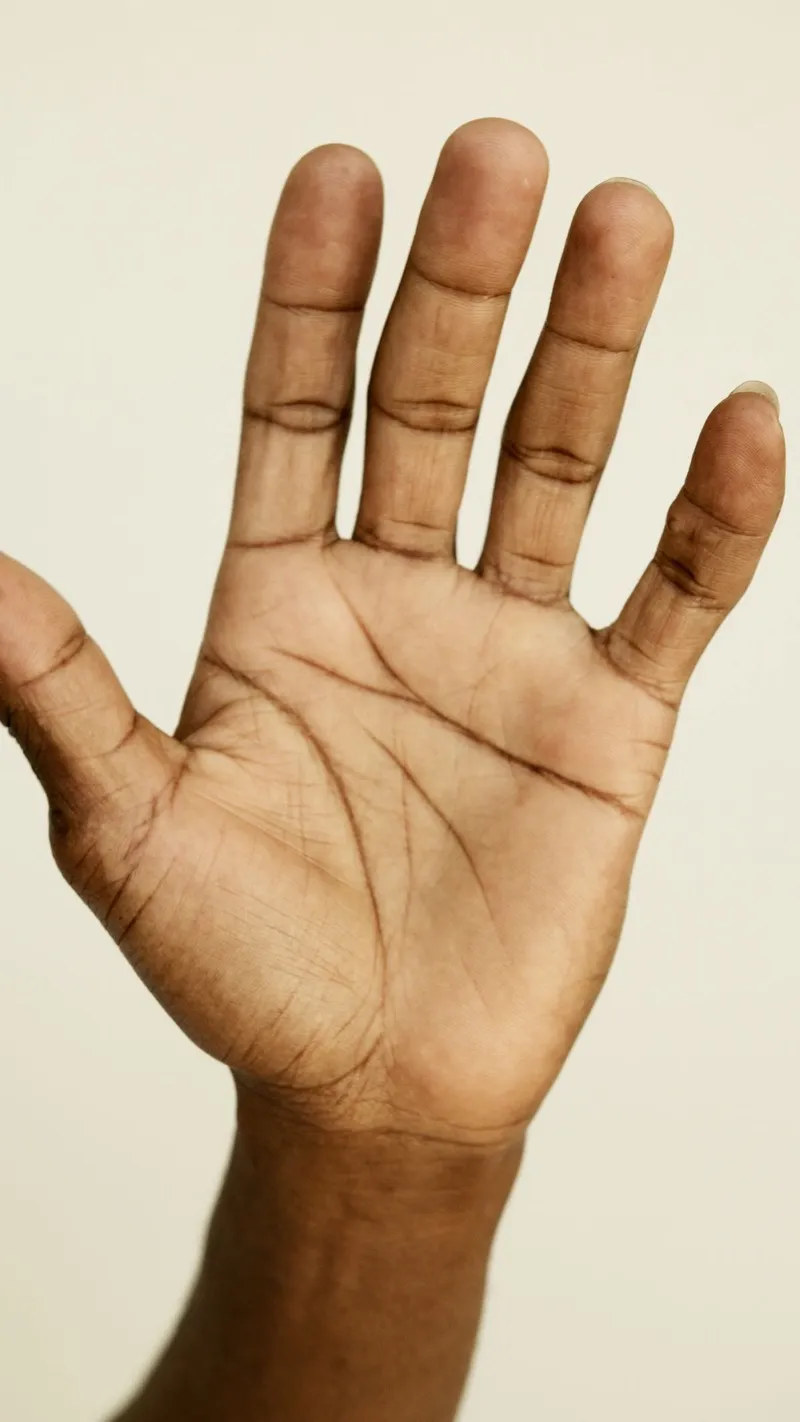
The marriage lines run inward from the percussive edge of the palm (highlighted in coral-pink), just below the pinky finger.
What Is the Marriage Line?
The marriage line — more accurately called the relationship line or attachment line in modern palmistry — is a short horizontal line on the percussive (outer) edge of the palm, sitting just below the base of the pinky finger and above the heart line. Most people have one to three such lines, varying in depth, length, and clarity.
Western palmistry, following Cheiro and Benham, names these lines after marriage because that was the most culturally legible form of significant adult attachment when those texts were written. Hindu palmistry (Hast Samudrika Shastra) uses similar vocabulary — vivah rekha, literally “marriage line” — though the term is broadly understood as “significant relationship.” Chinese palmistry calls them affection lines, which is arguably the most accurate translation across all three traditions. Whatever the name, the modern reading is the same: these lines describe significant emotional attachments, not weddings.
What the Marriage Lines Symbolise
Significant Attachments
The central reading of the marriage lines across all traditions is significant attachments. These are the relationships that carry weight: the bonds that shape a person, the people whose presence changes the rest of life. In tradition the term covers marriage where it applies, but also long partnership, committed cohabitation, life partnership without legal status, and in some readings the deepest of long friendships. The lines are about meaningful bond, not about paperwork.
Emotional Weight
The second reading is emotional weight. The depth and length of a marriage line is traditionally read as the felt weight of the attachment in the person’s life — how much it has settled into them. A deep, long line is read as a defining attachment. A short, faint line is read as a real attachment of lighter weight — a relationship that matters but does not occupy the centre. Cheiro emphasises this register: the line is the felt impression, not the relationship’s factual length.
Timing Along the Edge
Position of the line along the percussive edge is traditionally read as timing. Lines closer to the heart line are read as attachments that arrived earlier in life; lines closer to the base of the pinky are read as later in life. This is the same logic tradition uses for timing along the life line and fate line, and it is always read approximately rather than precisely. A line a third of the way up is read as “earlier” in tradition, not as “age 24.”
Capacity for Attachment
The fourth reading concerns the temperament for forming attachments. Many marriage lines — four, five, or more — are read as a temperament drawn to forming significant bonds, not necessarily marrying many people. Few or no lines are read as a temperament that bonds privately, with less outward visibility. Both temperaments are read as valid; the lines describe a person’s relational rhythm, not a verdict on it.
How to Read Marriage Line Variations
Reading marriage lines well requires four observations: how many, their length, their depth and clarity, and their endings.
How many is the most-asked question and the most misread. Tradition does not read this number as a count of marriages. It reads it as a count of significant attachments, which in any honest life includes relationships that never reach the altar. Two clear lines is the most common configuration. Three or four is read as a relationally active temperament. Many small lines, or no clear lines at all, is read separately and is described below.
Length describes the duration and reach of the attachment. A long line that extends well across the side of the palm is read as a major, defining attachment that shapes life broadly. A short line is read as a real but smaller-weight attachment.
Depth and clarity describe felt weight. A deep, clearly incised line is read as an attachment with strong emotional presence. A faint line is read as a lighter, more private attachment. Some classical readings tie depth to permanence as well, but careful modern palmistry hedges this — faint lines can deepen over time as relationships mature.
Endings tell the story of what happens to the attachment. A line that ends cleanly is read as a relationship that retains its shape. A line that forks downward is read as an attachment that has shifted or ended. A line that forks upward is read as an attachment that has grown into something more (in classical Hindu palmistry, this is read as a relationship that becomes marriage). A line that breaks — interrupts and resumes — is read as a relationship that has gone through reset or reconciliation.
Common Marriage Line Variations
Single Deep Marriage Line
One long, deep, clear marriage line is one of the most positively read configurations. It is traditionally associated with one defining attachment that anchors a person’s relational life — not necessarily one marriage, but one central bond.
Two or Three Lines
The most common pattern. Tradition reads multiple lines as multiple significant attachments across a lifetime — not all of them necessarily marriages, but each carrying real weight. Lines closer to the heart line are read as earlier in life; lines higher up as later.
Many Fine Lines
Many small, fine marriage lines — sometimes six or more — are read in tradition as a temperament drawn to many emotional connections rather than as many marriages. Cheiro associated this configuration with a warm, broadly affectionate temperament. It is not read as instability.
No Visible Marriage Lines
Faint or absent marriage lines are read as a private, interior relational life — attachments held close rather than worn visibly. Many people with no clear marriage lines marry and have rich relational lives. The lines describe outward visibility of attachment, not its presence.
What Marriage Lines Do NOT Mean
Of all the palm features, the marriage lines attract some of the most anxious misreading. Here are the five most common myths.
Myth: “The number of marriage lines equals the number of marriages I’ll have.” Reality: this is the central myth to correct. No careful classical source reads marriage lines as a literal wedding count. They are read as significant attachments. Many people with three or four lines marry once and have other deep but non-marital bonds.
Myth: “No marriage lines means I’ll be alone.” Reality: faint or absent marriage lines are common and are never read in tradition as predicting solitude. They describe a temperament where attachments move privately. Many people with no visible marriage lines have rich relational lives.
Myth: “A forked marriage line means my marriage is doomed.” Reality: tradition reads a fork as change, not as catastrophe. Some forks are read positively, especially upward forks. Down-forked lines do indicate separation in tradition, but a fork in your palm describes a pattern, not a sentence; living with the awareness of it is the point, not fearing it.
Myth: “The marriage line tells me when I’ll get married.” Reality: position along the edge gives approximate timing — earlier or later in life — but no classical tradition reads timing precisely. A line two-thirds of the way up is read as “later life,” not as a calendar date.
Myth: “A short marriage line means a short marriage.” Reality: length symbolises weight and reach of attachment, not literal duration. A short, deep marriage line is read as a real attachment with significant emotional weight even if it is brief in years. Decades of careful tradition have hedged this reading, and modern palmistry hedges it further.
Tradition Attribution: Marriage Lines Across Schools
Western palmistry, in Cheiro and William Benham, calls these the marriage lines but cautions explicitly that they should not be read as literal wedding counts. Benham preferred the term affection lines. The careful Western tradition has always read them as significant attachments rather than as weddings.
Hindu palmistry — Hast Samudrika Shastra — uses vivah rekha (marriage lines) and reads them in a similar but culturally distinct frame. Classical Hindu palmistry includes detailed readings for forks, breaks, and crosses on these lines, and weights upward forks positively (as relationships becoming marriages) and downward forks cautiously (as separations).
Chinese palmistry calls them affection lines and reads them across both marital and broader emotional attachment. The Chinese tradition is arguably the least literal of the three about reading line count as wedding count.
How to Read Your Own Marriage Lines
Reading marriage lines takes about five minutes if you have good lighting.
- Hold your dominant palm in natural light. Tilt the percussive (outer) edge of the palm toward the light so the small horizontal lines below the pinky show clearly.
- Locate the area. Look at the side of the palm between the heart line and the base of the pinky finger. The marriage lines are the short horizontal lines you see there.
- Count carefully. Note the number of clear lines and disregard faint hatching. A clear marriage line is one that runs inward from the edge of the palm by at least a few millimetres.
- Observe length, depth, and endings. For each line, note how long it is, how deeply incised, and whether it ends cleanly, forks up or down, or breaks.
- Interpret reflectively. A single deep line speaks of a defining attachment; two or three speak of multiple significant bonds across life; many fine lines speak of broadly warm relational temperament; few or none speak of a privately held relational life. Read these as descriptions, not as forecasts.
Want an AI-assisted reading of your marriage lines and other relationship signs?
Get a Free AI Palm Reading →Frequently Asked Questions
What is the marriage line in palmistry?
A short horizontal line on the percussive edge of the palm, just below the pinky and above the heart line. In tradition these are read as significant emotional attachments, not as literal marriages.
Does the number of marriage lines equal the number of marriages?
No. They are read as significant attachments, not literal weddings. Many people with three or four lines marry once and have other deep relationships.
Where are the marriage lines on the palm?
On the percussive edge of the palm, between the base of the pinky and the heart line. They are short horizontal lines that travel inward from the edge.
What does a long, deep marriage line mean?
A significant, weighty attachment with real presence in the person’s life. Length is symbolic of duration, depth of intensity. Never read as a guarantee of happy marriage.
What does a forked or broken marriage line mean?
A downward fork is read as an attachment that has shifted or ended. A break is read as a major reset or reconciliation. Both describe change, not catastrophe.
Why do I have no clear marriage lines?
Faint or absent marriage lines are common. They describe a temperament where attachments are present but expressed privately. Never read as inability to form attachments.
Do marriage lines change over time?
Yes. They can deepen, fade, fork, or develop new branches across a lifetime. The relational palm reflects the present, not a fixed future.
How Marriage Line Is Read Across Traditions
Palmistry is a layered tradition, not a single system. Indian, Chinese, and Western lineages each read the marriage line a little differently — here is how the same line is named and interpreted across the three schools.
| Tradition | Local Term | Meaning |
|---|---|---|
| Indian (Hast Samudrika Shastra) | Vivaha Rekha / विवाह रेखा | In Hast Samudrika Shastra, the Vivaha Rekha on the percussion below Mercury is traditionally read alongside the seventh house of the jyotish chart and the Mount of Venus, not as a standalone marker. The lineage frames these lines as indicators of emotional bonds and family karma rather than fixed marital timing. |
| Chinese (shou xiang) | 结婚线 / Jiéhūn Xiàn | In Chinese palmistry, the Jiéhūn Xiàn sits within a family of affection lines (感情线) and is read for whether it stays level, curves up, or droops. Readers typically cross-reference face reading (面相) features and TCM-influenced ideas about heart and kidney energy, giving it a more holistic flavour. |
| Western (Cheiro / Benham revival) | Marriage Line (also Lines of Union or Affection Lines) | Cheiro and Benham reframed these markings as 'Lines of Union' or 'Lines of Affection', emphasising deep emotional attachments rather than legal marriage. Benham treated only the deepest, clearest line as the dominant union and warned explicitly against equating short or multiple lines with literal spouse counts. |
Vivaha Rekha / विवाह रेखा
In Hast Samudrika Shastra, the Vivaha Rekha on the percussion below Mercury is traditionally read alongside the seventh house of the jyotish chart and the Mount of Venus, not as a standalone marker. The lineage frames these lines as indicators of emotional bonds and family karma rather than fixed marital timing.
结婚线 / Jiéhūn Xiàn
In Chinese palmistry, the Jiéhūn Xiàn sits within a family of affection lines (感情线) and is read for whether it stays level, curves up, or droops. Readers typically cross-reference face reading (面相) features and TCM-influenced ideas about heart and kidney energy, giving it a more holistic flavour.
Marriage Line (also Lines of Union or Affection Lines)
Cheiro and Benham reframed these markings as 'Lines of Union' or 'Lines of Affection', emphasising deep emotional attachments rather than legal marriage. Benham treated only the deepest, clearest line as the dominant union and warned explicitly against equating short or multiple lines with literal spouse counts.
Myth vs. Reality
The marriage line attracts more pop-culture invention than almost any other palm feature. These are the claims you will find on low-quality palmistry sites — and how traditional palmistry across Indian, Chinese, and Western schools actually reads them.
| Myth | Reality |
|---|---|
“A short marriage line means a short, failed, or unhappy marriage.” | Length alone is not treated as a verdict in any classical school. Cheiro and Benham emphasised that depth, clarity, and accompanying signs on the heart line and Mount of Mercury matter as much as length, while Hast Samudrika Shastra reads these lines as emotional dispositions, not fixed outcomes. Sources: Cheiro, Language of the Hand (1894), Benham, Laws of Scientific Hand Reading (1900) |
“The number of marriage lines equals the number of marriages or serious relationships you will have.” | Classical sources do not support this. In Chinese palmistry and in Cheiro's system, multiple lines under Mercury are traditionally read as significant emotional bonds rather than literal marriage counts, and most schools advise weighing only the deepest, clearest line as dominant. Sources: Cheiro, Language of the Hand (1894), Chinese shou xiang tradition |
“The marriage line on the left hand tells your fate while the right hand shows your choices.” | Hand-sidedness conventions vary and none treat one hand as sealed fate. Hast Samudrika Shastra traditionally reads the dominant hand for men and non-dominant for women, Chinese palmistry often inverts this, and Cheiro recommended reading both hands together for tendency versus development. Sources: Cheiro, Language of the Hand (1894), Hast Samudrika Shastra tradition |
“No marriage line means you will never get married or find love.” | Absence of a clear line under Mercury is not read as a guarantee of singlehood. Benham suggested faint or absent lines traditionally indicate a reserved temperament or low priority on partnership, and Indian and Chinese readers cross-check the heart line and Mount of Venus before any inference. Sources: Benham, Laws of Scientific Hand Reading (1900), Hast Samudrika Shastra tradition |
“A marriage line that curves down, breaks, or forks predicts divorce or the death of a spouse.” | Traditional schools read these as symbolic tendencies, not fixed forecasts. Cheiro associated downward curves with emotional disappointment, forks with diverging interests, and breaks with disruption — always to be cross-checked against the heart line and the hand as a whole. Sources: Cheiro, Language of the Hand (1894), Benham, Laws of Scientific Hand Reading (1900) |
“A short marriage line means a short, failed, or unhappy marriage.”
Length alone is not treated as a verdict in any classical school. Cheiro and Benham emphasised that depth, clarity, and accompanying signs on the heart line and Mount of Mercury matter as much as length, while Hast Samudrika Shastra reads these lines as emotional dispositions, not fixed outcomes.
Sources: Cheiro, Language of the Hand (1894), Benham, Laws of Scientific Hand Reading (1900)
“The number of marriage lines equals the number of marriages or serious relationships you will have.”
Classical sources do not support this. In Chinese palmistry and in Cheiro's system, multiple lines under Mercury are traditionally read as significant emotional bonds rather than literal marriage counts, and most schools advise weighing only the deepest, clearest line as dominant.
Sources: Cheiro, Language of the Hand (1894), Chinese shou xiang tradition
“The marriage line on the left hand tells your fate while the right hand shows your choices.”
Hand-sidedness conventions vary and none treat one hand as sealed fate. Hast Samudrika Shastra traditionally reads the dominant hand for men and non-dominant for women, Chinese palmistry often inverts this, and Cheiro recommended reading both hands together for tendency versus development.
Sources: Cheiro, Language of the Hand (1894), Hast Samudrika Shastra tradition
“No marriage line means you will never get married or find love.”
Absence of a clear line under Mercury is not read as a guarantee of singlehood. Benham suggested faint or absent lines traditionally indicate a reserved temperament or low priority on partnership, and Indian and Chinese readers cross-check the heart line and Mount of Venus before any inference.
Sources: Benham, Laws of Scientific Hand Reading (1900), Hast Samudrika Shastra tradition
“A marriage line that curves down, breaks, or forks predicts divorce or the death of a spouse.”
Traditional schools read these as symbolic tendencies, not fixed forecasts. Cheiro associated downward curves with emotional disappointment, forks with diverging interests, and breaks with disruption — always to be cross-checked against the heart line and the hand as a whole.
Sources: Cheiro, Language of the Hand (1894), Benham, Laws of Scientific Hand Reading (1900)
Related Palmistry Topics
The marriage lines work alongside the heart line and the Mount of Venus to describe the relational palm. Explore the rest of the cluster:
Life Line
The line curving around the thumb, traditionally read as vitality and life transitions.
Read the guide →Heart Line
The horizontal line across the upper palm, read as emotional life and attachment.
Read the guide →Head Line
The line across the middle of the palm, read as thinking style and decision-making.
Read the guide →Fate Line
The vertical line rising up the palm, read as direction and outside forces in life.
Read the guide →Sun Line
Vertical line associated with creativity and recognition.
Read the guide →Health Line
Diagonal line traditionally read as constitutional vitality.
Read the guide →