Quick Answer
Does the health line diagnose illness? No — never.
The health line — also called the Mercury line — is a symbolic reflection of constitutional temperament, how the body handles stress, and recovery patterns. It is not, and never has been, a diagnostic tool. Cheiro wrote that the strongest palms often have no health line at all. Real health questions belong to doctors. The line is a reflective lens, not a clinical sign.
Health Line on Palm: Mercury Line Meaning & Constitution Reading
Last reviewed: 2026-06-27 by ReadMyPalms editorial
A reflective guide to the health line (Mercury line) in traditional palmistry — what it symbolises about vitality and recovery, and the firm boundary between symbolic reading and medical diagnosis.
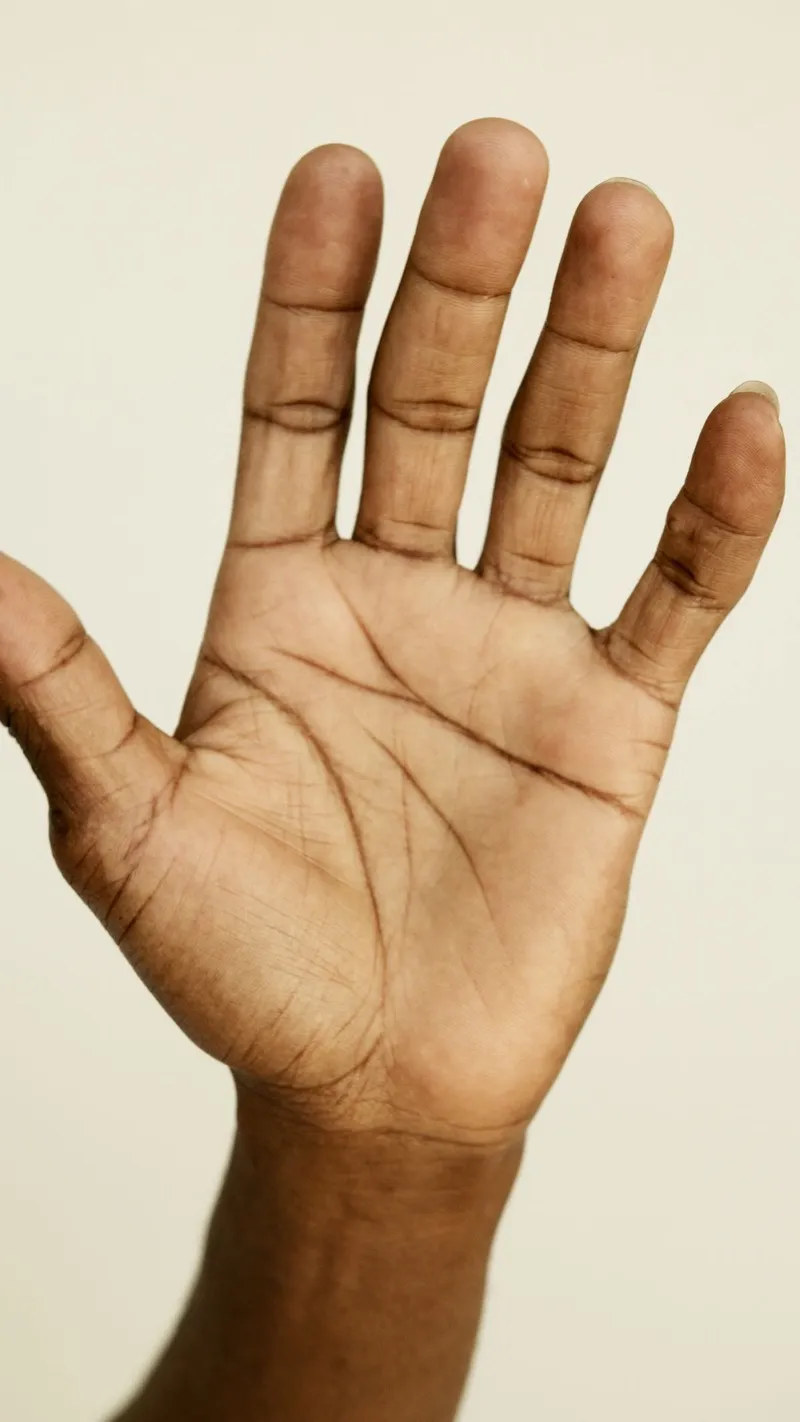
The health line (highlighted in cyan) runs diagonally from the lower outer edge of the palm toward the base of the pinky finger — the Mount of Mercury.
What Is the Health Line?
The health line — also called the Mercury line, the hepatica, or the liver line in older Western texts — is a diagonal line that runs from the lower outer edge of the palm (near the wrist on the pinky side) upward toward the base of the pinky. It usually crosses the head line, and sometimes the heart line, on its way up.
Despite the name, the health line is read in every careful classical tradition as a symbolic indicator of constitutional vitality — not as a medical line. Cheiro and Benham both warned explicitly against reading it as diagnostic. Hindu palmistry treats it as a marker of prakriti, the constitutional temperament described in Ayurveda. Chinese palmistry reads it similarly. The line speaks to how a person handles stress and recovers, not to specific conditions.
What the Health Line Symbolises
Constitutional Vitality
The first and central reading of the health line is constitutional vitality— the underlying quality of the person’s energy and resilience. A clear, deep, unbroken health line is traditionally read as a person attentive to their constitution and engaged with it. Crucially, the line’s absence is read as a robust constitution that has not needed to develop a marker; this is the tradition’s most counter-intuitive reading and it is important to state plainly.
Response to Stress
The second reading is response to stress. A clear health line is read as a temperament that registers stress and processes it through the body — someone who feels their pressures somatically and who recovers through attentive care. A wavy or chained health line is read as a more sensitive nervous system, one that takes on environmental stress vividly. A broken health line is read as a temperament that has experienced cycles of strain and recovery.
Recovery Patterns
The third reading concerns recovery. Tradition reads the health line as a marker of how a person comes back — the rhythm of return to baseline after illness, exhaustion, or grief. A strong, deep health line is read as a person with clear recovery patterns: they know what helps them, and they use it. A faint line is read as someone whose recovery is more diffuse and less attended-to. As with every reading, this is descriptive, not predictive.
Intuition About the Body
A fourth tradition reading, emphasised particularly in Hindu palmistry, is intuition about the body. People with clear health lines are read as having a strong sense of what they need — what foods agree with them, what activity restores them, when to rest. This is read as a positive register, not as hypochondria. The line is a quality of bodily self-awareness, useful for living well.
How to Read the Health Line — Presence, Depth, and Variations
Four properties refine the health line reading: presence vs. absence, depth and clarity, continuity, and intersections with other lines.
Presence vs. absence is the most counter-intuitive observation in health-line reading. In every classical school, an absent health line is read as a sign of robust constitution — a body that has not needed to develop a Mercury-line marker. A clear health line is read as a temperament more attentively engaged with the body. Neither is better; the line’s presence describes engagement, not health.
Depth and clarity describe the strength of the engagement. A deep, clear health line is read as a person who attends to their constitution consistently. A faint line is read as occasional engagement — awareness that comes and goes.
Continuity matters. An unbroken health line is read as steady self-care. A broken line is read as cycles of strain and recovery, often tied to periods of life when health required more attention. A chained or wavy line is read as a sensitive constitution — one that responds vividly to environment.
Intersections with other lines add nuance. Where the health line crosses the head line is read as a meeting of constitution and thinking — clean crossings as integration, troubled crossings as stress that has affected focus. Where it crosses the heart line is read similarly for emotional life. None of these are read as predictions; they are reflective points of tension or integration in the present.
Common Health Line Variations
No Health Line at All
The most positively read configuration in tradition. An absent health line is read as a constitution so naturally resilient that no Mercury-line marker has developed. Cheiro called this the most favourable Mercury-line reading possible. If your palm has no health line, do not search for one; tradition treats its absence as a quiet blessing.
Clear Unbroken Health Line
A clear, deep, unbroken health line is read as a person who attends to their constitution attentively and consistently. Their body and mind are integrated in self-care. This is also read positively, just in a different register than absence.
Broken Health Line
A broken health line is read as a constitution that has gone through cycles — strain followed by recovery, repeating across seasons of life. This is read as a rhythm, not as a verdict. Many people with broken health lines have rich, long lives; the breaks describe how they got there, not where they will end.
Wavy or Chained Health Line
A wavy or chained health line is read as a sensitive constitution — a body and nervous system that respond vividly to environment, mood, food, and stress. This is often associated in tradition with strong intuition about the body and with a need for routine and care that other temperaments may not require. Sensitivity is a real temperament; the line marks it without judging it.
What the Health Line Does NOT Mean
More than any other palm line, the health line attracts misuse. Here are the five most important corrections.
Myth: “The health line predicts what illness I’ll get.” Reality: this is the most important correction to make. No careful tradition reads the health line diagnostically. It describes temperament, not pathology. Real health concerns belong to doctors, who can examine your body in ways no palm reading can substitute for.
Myth: “No health line means I’m unhealthy.” Reality: the opposite is true in tradition. An absent health line is read as a robust constitution that has not needed to develop the marker. Cheiro wrote explicitly that the strongest palms often have no health line at all.
Myth: “A broken health line predicts a major illness.” Reality: a broken health line is read as cycles of strain and recovery, often already past. It is not read as a forecast of future illness in any classical tradition, and using it that way is a misuse of palmistry.
Myth: “A wavy health line means I’m mentally unwell.” Reality: a wavy health line is read as a sensitive constitution and an intuitive relationship with the body. Sensitivity is a temperament, not a diagnosis, and tradition treats it warmly, not pathologically.
Myth: “The health line shows when I’ll die.” Reality: no traditional palmistry source reads any line as a death predictor. The health line is read as constitution and recovery, both present-tense. No careful palmist makes mortality predictions from any palm feature.
Tradition Attribution: The Health Line Across Schools
Western palmistry, in Cheiro and Benham, names this line after Mercury because it terminates at the Mount of Mercury below the pinky. Cheiro cautioned strongly against reading it diagnostically and famously wrote that the best palms often have no health line at all.
Hindu palmistry reads the same line through the lens of prakriti, the constitutional temperament described in Ayurveda. The reading concerns the body’s natural balance and the patterns by which it returns to equilibrium. Hindu palmistry shares the Western caution against diagnostic readings.
Chinese palmistry reads the same line as a marker of vitality and the body’s energetic balance. Chinese vocabulary for this is closer to traditional Chinese medicine’s concept of qi — vital energy that moves through the body. As in the other traditions, the line is read reflectively, not diagnostically.
How to Read Your Own Health Line
Reading the health line takes about five minutes. Many palms have none, which is fine and is read positively.
- Open your dominant palm in natural light. Side lighting helps small lines show.
- Look at the outer side of the palm near the wrist. The health line begins on the percussive (pinky) side of the lower palm and runs diagonally upward toward the Mount of Mercury below the pinky.
- Trace it upward. Follow the diagonal line as far as it goes. Note where it ends, what other lines it crosses, and whether it is continuous, broken, wavy, or chained.
- Look for marks on the line. Crosses, stars, and squares each carry their own readings on the health line, mostly as descriptions of seasons of intensity or stability.
- Interpret reflectively, never diagnostically. If you find a clear health line, read it as a temperament reading. If you find none, read it as a robust constitution. Either way, do not let the line make medical claims.
Want an AI-assisted reading of your secondary lines, including the health line if present?
Get a Free AI Palm Reading →Frequently Asked Questions
What is the health line in palmistry?
A diagonal line that runs from the lower outer edge of the palm toward the Mount of Mercury below the pinky. Read as a symbolic reflection of constitutional vitality and how the body handles stress — never as a medical diagnosis.
Does the health line predict illness?
Absolutely not. No classical palmistry source reads the health line diagnostically. It is a reflective reading of temperament, recovery patterns, and the body’s general energy. Real health questions belong to doctors.
Is no health line a good sign?
Yes, traditionally. An absent or very faint health line is read as a robust constitution that has not needed to develop the marker. Cheiro wrote that the best palms often have no health line at all.
Where is the health line on the palm?
Diagonally from the lower outer edge of the palm (near the wrist on the pinky side) upward toward the base of the pinky finger.
What does a broken or wavy health line mean?
A broken health line is read as cycles of strain and recovery. A wavy health line is read as a sensitive constitution. Neither is read as illness.
Why is it also called the Mercury line?
Because it rises toward the Mount of Mercury below the pinky. Mercury in classical astrology and Western palmistry governs the nervous system and dynamic energy.
Can the health line change over time?
Yes, more visibly than most lines. It can appear, deepen, fade, and even disappear in response to changes in stress and recovery. Revisit the palm every few years.
How Health Line Is Read Across Traditions
Palmistry is a layered tradition, not a single system. Indian, Chinese, and Western lineages each read the health line a little differently — here is how the same line is named and interpreted across the three schools.
| Tradition | Local Term | Meaning |
|---|---|---|
| Indian (Hast Samudrika Shastra) | Swasthya Rekha / स्वास्थ्य रेखा (also Budh Rekha / बुध रेखा) | In classical Hast Samudrika Shastra, the Swasthya Rekha is traditionally tied to the Budh (Mercury) mount and read as a reflection of digestion, nervous balance and pranic constitution rather than fate or longevity. Its absence is often considered auspicious. |
| Chinese (手相 Shǒuxiàng) | 健康线 / Jiànkāng Xiàn (sometimes 水星线 / Shuǐxīng Xiàn) | In Chinese palmistry the line is traditionally read through a TCM-flavoured lens, with classical readers cross-checking it against the Life Line and palm colour to assess qi, spleen and liver function. Some lineages treat a clear line as a sign of mental overwork affecting digestion rather than a forecast. |
| Western (Cheiro / Benham revival) | Health Line (also called the Hepatica or Line of Mercury) | Cheiro and Benham both emphasised that the Health Line is one of the few lines whose absence is more favourable than its presence, traditionally reading a deep line as preoccupation with stomach, liver or nerves. Breaks and islands were symbolically tied to bilious tendencies, never to diagnoses. |
Swasthya Rekha / स्वास्थ्य रेखा (also Budh Rekha / बुध रेखा)
In classical Hast Samudrika Shastra, the Swasthya Rekha is traditionally tied to the Budh (Mercury) mount and read as a reflection of digestion, nervous balance and pranic constitution rather than fate or longevity. Its absence is often considered auspicious.
健康线 / Jiànkāng Xiàn (sometimes 水星线 / Shuǐxīng Xiàn)
In Chinese palmistry the line is traditionally read through a TCM-flavoured lens, with classical readers cross-checking it against the Life Line and palm colour to assess qi, spleen and liver function. Some lineages treat a clear line as a sign of mental overwork affecting digestion rather than a forecast.
Health Line (also called the Hepatica or Line of Mercury)
Cheiro and Benham both emphasised that the Health Line is one of the few lines whose absence is more favourable than its presence, traditionally reading a deep line as preoccupation with stomach, liver or nerves. Breaks and islands were symbolically tied to bilious tendencies, never to diagnoses.
Myth vs. Reality
The health line attracts more pop-culture invention than almost any other palm feature. These are the claims you will find on low-quality palmistry sites — and how traditional palmistry across Indian, Chinese, and Western schools actually reads them.
| Myth | Reality |
|---|---|
“A long, deep Health Line means you will have a long, healthy life.” | Across Indian, Chinese and Western lineages, the Health Line (when present) is traditionally read as a marker of constitutional sensitivity or the digestive/nervous system, not a lifespan meter. Cheiro and Benham both warned that a strong, well-formed Health Line is often considered less favourable than its absence. Sources: Cheiro, Language of the Hand (1894), Benham, Laws of Scientific Hand Reading (1900) |
“No Health Line on the palm means you are doomed to be sickly.” | Most Western palmists from the Cheiro/Benham revival treat the absence of a Health Line as a positive sign, traditionally read as a robust constitution that does not need to register health on the hand. Indian and Chinese sources similarly do not treat absence as pathological. Sources: Cheiro, Language of the Hand (1894), Benham, Laws of Scientific Hand Reading (1900) |
“The Health Line on the left hand shows fate while the right hand shows current health.” | Hand-sidedness conventions vary by tradition and by author. Indian palmistry typically reads the dominant hand for men and non-dominant for women; Western palmists like Cheiro read the left as potential and right as actualised. No school treats one side as a fixed health verdict. Sources: Cheiro, Language of the Hand (1894), Hast Samudrika Shastra tradition |
“A broken or wavy Health Line predicts a specific illness on a specific date.” | Traditional palmistry is symbolic, not predictive of specific dates or diagnoses. Breaks, islands or waviness on the Mercury/Health Line are classically read as periods of digestive sensitivity or nervous strain in Western sources, and as constitutional fluctuation in Chinese and Indian readings. Sources: Benham, Laws of Scientific Hand Reading (1900), Cheiro, Language of the Hand (1894) |
“Multiple Health Lines mean multiple serious illnesses.” | Multiple faint lines in the Mercury region are traditionally read as nervous sensitivity, restlessness or scattered vitality, not as a count of future diseases. Chinese lineages sometimes link a network of fine lines here to digestive or sleep imbalance in a TCM-flavoured reading. Sources: Benham, Laws of Scientific Hand Reading (1900) |
“A long, deep Health Line means you will have a long, healthy life.”
Across Indian, Chinese and Western lineages, the Health Line (when present) is traditionally read as a marker of constitutional sensitivity or the digestive/nervous system, not a lifespan meter. Cheiro and Benham both warned that a strong, well-formed Health Line is often considered less favourable than its absence.
Sources: Cheiro, Language of the Hand (1894), Benham, Laws of Scientific Hand Reading (1900)
“No Health Line on the palm means you are doomed to be sickly.”
Most Western palmists from the Cheiro/Benham revival treat the absence of a Health Line as a positive sign, traditionally read as a robust constitution that does not need to register health on the hand. Indian and Chinese sources similarly do not treat absence as pathological.
Sources: Cheiro, Language of the Hand (1894), Benham, Laws of Scientific Hand Reading (1900)
“The Health Line on the left hand shows fate while the right hand shows current health.”
Hand-sidedness conventions vary by tradition and by author. Indian palmistry typically reads the dominant hand for men and non-dominant for women; Western palmists like Cheiro read the left as potential and right as actualised. No school treats one side as a fixed health verdict.
Sources: Cheiro, Language of the Hand (1894), Hast Samudrika Shastra tradition
“A broken or wavy Health Line predicts a specific illness on a specific date.”
Traditional palmistry is symbolic, not predictive of specific dates or diagnoses. Breaks, islands or waviness on the Mercury/Health Line are classically read as periods of digestive sensitivity or nervous strain in Western sources, and as constitutional fluctuation in Chinese and Indian readings.
Sources: Benham, Laws of Scientific Hand Reading (1900), Cheiro, Language of the Hand (1894)
“Multiple Health Lines mean multiple serious illnesses.”
Multiple faint lines in the Mercury region are traditionally read as nervous sensitivity, restlessness or scattered vitality, not as a count of future diseases. Chinese lineages sometimes link a network of fine lines here to digestive or sleep imbalance in a TCM-flavoured reading.
Sources: Benham, Laws of Scientific Hand Reading (1900)
Related Palmistry Topics
The health line works alongside the life line and major lines to describe constitutional temperament. Explore the rest of the cluster:
Life Line
The line curving around the thumb, traditionally read as vitality and life transitions.
Read the guide →Heart Line
The horizontal line across the upper palm, read as emotional life and attachment.
Read the guide →Head Line
The line across the middle of the palm, read as thinking style and decision-making.
Read the guide →Fate Line
The vertical line rising up the palm, read as direction and outside forces in life.
Read the guide →Sun Line
Vertical line associated with creativity and recognition.
Read the guide →Marriage Line
Short horizontal lines on the palm edge below the pinky.
Read the guide →