Quick Answer
Is the fish sign on the palm really auspicious? In Hindu palmistry, yes.
The fish sign — matsya rekha — is named and honoured in Hast Samudrika Shastra, the classical Indian palmistry text. It is traditionally read as a sign of dharma flowing in the right direction, often with prosperity and learning as effects. It is not a guarantee of wealth; it is a symbol of alignment. Western palmistry does not name the fish sign at all.
Fish Sign on Palm: Meaning in Hindu Palmistry (Matsya Rekha)
Last reviewed: 2026-06-27 by ReadMyPalms editorial
A reflective guide to the fish sign on the palm in Hast Samudrika Shastra — its position, what tradition says it symbolises, and how to interpret it without overclaiming.
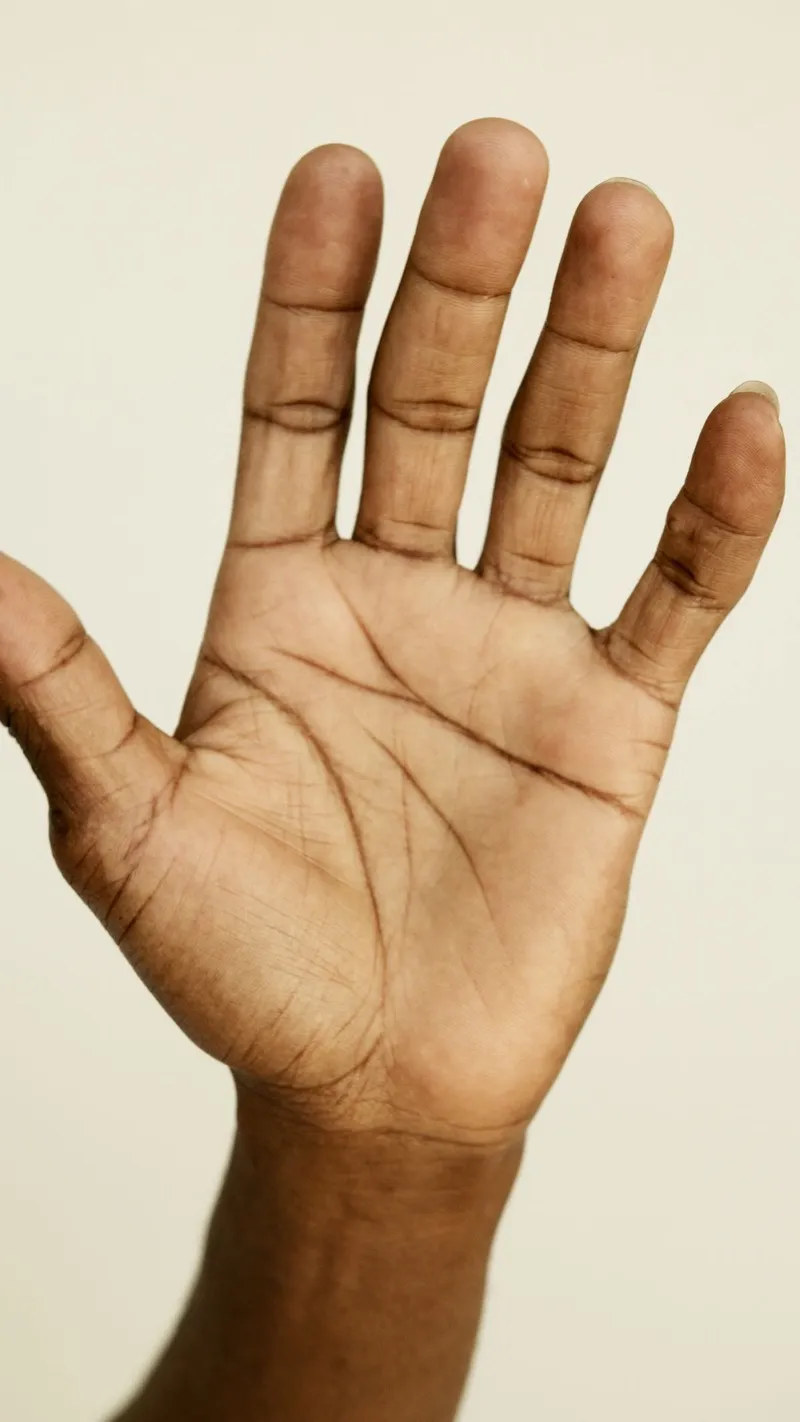
A reference right palm. The fish sign is not a single fixed line — look for fish-shaped crossings of secondary lines, most often on the Mounts of Jupiter or Venus.
What Is the Fish Sign on the Palm?
The fish sign — matsya rekha in Sanskrit, where matsya means fish and rekha means line — is a fish-shaped mark on the palm formed by two curved lines that intersect like the outline of a fish, sometimes with a small third line forming the tail. It is one of the named auspicious signs in Hast Samudrika Shastra, the classical Hindu palmistry text, and it draws on the broader Vedic symbolism of the fish: the first avatar of Vishnu and one of the eight auspicious symbols (ashtamangala) of Indian iconography.
In tradition the fish sign is read as a strongly favourable mark when it appears clearly. The exact reading depends on where on the palm the fish sits: at the base of the index finger it speaks to leadership; at the thumb base it speaks to love and family; near the wrist it speaks to long-term prosperity. Read reflectively, the fish is a symbol of dharma in motion — meaningful work flowing in the right direction, with prosperity or recognition as one common effect rather than as a separate promise.
What the Fish Sign Symbolises
Prosperity and Abundance
The most widely cited reading of the fish sign in Hindu palmistry is prosperity. The fish is associated with flowing water, which in Vedic symbolism stands for wealth and life-force that moves and renews itself. A clear fish on the Mount of Jupiter (below the index finger) or near the rascette lines at the wrist is read as a tendency toward abundance — not because the mark causes wealth, but because it symbolises a temperament aligned with receiving and circulating it. This is a tradition reading, not a financial forecast.
Learning and Wisdom
The fish is also tied to knowledge. Matsya, the fish avatar of Vishnu, rescued the Vedas from a great flood in Hindu mythology — preserving knowledge through catastrophe. In palmistry tradition this layer gives the fish sign an association with a strong appetite for learning, an aptitude for study, and an ability to retain and transmit wisdom. A fish near the head line or on the Mount of Mercury (below the pinky) is read in this register particularly clearly.
Dharma and Right Direction
At its deepest layer the fish sign is read as a sign of dharma — the right ordering of one’s life and purpose. In Hast Samudrika Shastra, fish signs cluster in the readings of people whose work feels meaningful to them and whose lives feel aligned. This is the framing that holds the prosperity and learning readings together: prosperity follows alignment, and learning serves alignment. The fish is the symbol of the whole flow, not of any single output.
Blessing and Protection
Finally, because the fish is one of the eight ashtamangala (auspicious symbols) of Indian tradition, its appearance on the palm carries a layer of blessing. The fish in Vedic culture is shown on temple thresholds, wedding invitations, and bridal art as a marker of good fortune; on the palm it carries the same meaning — a small visual statement that this hand belongs to a person held in some way by good fortune. Whether one accepts this metaphysically or simply symbolically, the tradition is consistent.
How to Read Fish Sign Variations
Reading the fish sign well means observing four things: shape, location, clarity, and orientation. Each modifies the basic auspicious reading.
Shape is the first observation. A classical fish sign has two curved lines meeting in a pointed head and a pointed tail, with a clear oval body in between. Some fish signs include a small extra line bisecting the tail, like the V of a fish’s caudal fin; Hast Samudrika Shastra treats this as a particularly clear variant. A vague almond-shaped crossing without a defined head and tail is read as a partial fish — auspicious but weaker.
Location determines what domain of life the fish blesses. On the Mount of Jupiter the fish is read for leadership and recognition. On the Mount of Venus it is read for love, family, and emotional life. On the Mount of Apollo (below the ring finger) it is read for creativity and reputation. Near the wrist on the rascette lines it is read for long-term wealth and stability. At the end of the life line it is traditionally read as a blessed older age.
Clarity matters in every tradition. A deeply incised, well-defined fish carries more weight than a faint one. Hast Samudrika Shastra explicitly notes that an unbroken fish is more potent than one whose outline is interrupted by other lines — though even an interrupted fish is read positively, just with the qualification that the blessing comes through some friction.
Orientation — whether the fish’s head points toward the fingers or toward the wrist — is treated differently in different schools. Some Hindu palmists read a fish pointing toward the fingers as “swimming upward,” meaning the blessing is still developing; a fish pointing toward the wrist as “swimming home,” meaning the blessing is already settled. Other schools do not weight orientation at all. Where traditions disagree, treat orientation as a soft modifier rather than a primary reading.
Common Fish Sign Variations
Fish on the Mount of Jupiter
A fish sign on the cushion below the index finger is one of the most cited variations in Hast Samudrika Shastra. It is traditionally read as an auspicious mark for leadership, public recognition, and natural authority. People with this configuration are read as having a temperament that draws responsibility toward them. As always, the mark is a reflection of tendency, not a guarantee of any specific outcome.
Fish on the Mount of Venus
A fish on the fleshy thumb-base mount is read for love, family, and sensuality. In tradition this configuration speaks to a warm, abundant emotional life and to good relationships with family. It is also read as auspicious for marriage in classical Hindu palmistry, though never as a literal prediction.
Fish Near the Rascette Lines
The rascette lines are the small horizontal lines at the wrist where the palm meets the forearm. A fish sign positioned just above them, near the base of the palm, is traditionally read for long-term material prosperity and a settled older age. This is one of the configurations Hast Samudrika Shastra weights most positively.
Fish at the End of the Life Line
When the life line ends in or near a small fish-shaped formation, Hindu palmistry reads this as an auspicious old age — a life completed with dignity, family around, and meaningful work behind one. This is one of the more poetic configurations in the tradition, and it is always read reflectively rather than literally.
What the Fish Sign Does NOT Mean
As the fish sign has spread through social media, several myths have attached to it. Here are the five most common, each with the tradition correction.
Myth: “A fish sign guarantees I’ll be rich.” Reality: Hast Samudrika Shastra never frames any mark as a guarantee. The fish is read as a tendency toward prosperity, often as a side effect of dharma flowing in the right direction. Wealth follows alignment in the tradition’s logic; the mark is the symbol of alignment, not a promise of money.
Myth: “Only one in a million people have it.” Reality: clear fish signs are uncommon but not vanishingly rare. Many palms have partial fish-shaped crossings of secondary lines that a careful reader can identify. The “extreme rarity” framing is a social-media exaggeration, not a tradition reading.
Myth: “If I don’t have a fish sign, I’m unlucky.” Reality: Hindu palmistry catalogues dozens of auspicious signs — trident, conch, lotus, swastika, temple, flag, throne, and many more. The fish is one of several, and most palms carry at least one auspicious configuration of some kind. Not having a fish does not mean lacking blessing; it just means your blessing is shaped differently.
Myth: “Western palmistry agrees the fish is a wealth sign.” Reality: Western palmistry, in Cheiro and Benham, does not name the fish sign at all. The fish reading is specifically Hindu. If you read your palm through a Western lens, the same shape might be classified as an island plus a crossing line, with completely different readings.
Myth: “Once you have a fish sign, your luck is permanent.” Reality: every classical tradition, including Hast Samudrika Shastra, accepts that palm marks evolve. Signs can deepen, fade, or develop new features over years. A fish today may be different in ten years, and the tradition reads that as natural. What is shown on the palm today reflects the present, not an unalterable future.
Tradition Attribution: Where the Fish Sign Comes From
The fish sign is squarely a Hindu palmistry tradition. It is named in Hast Samudrika Shastra, the classical Indian text on hand reading, and it draws its symbolic weight from the broader Vedic place of the fish: Matsya, the first avatar of Vishnu, who rescued the Vedas; and the fish’s place among the eight ashtamangala auspicious symbols of Indian iconography.
Western palmistry — the schools of Cheiro and Benham — does not give the fish a special name. A fish-shaped crossing of lines in a Western reading would simply be analysed as its component parts: an island, perhaps, with an intersecting line. No special auspicious meaning is attached.
Chinese palmistry uses a different vocabulary of marks — including stars, crosses, and squares — but does not specifically name a fish sign in the way Hindu palmistry does. If you are drawn to read your palm with the fish lens, you are reading in the Indian tradition.
How to Find a Fish Sign on Your Own Palm
Finding a fish sign takes patience and good light. Follow these five steps.
- Use natural daylight. Sit near a window with your dominant palm open and relaxed. Side lighting throws the small secondary lines into relief better than overhead lighting.
- Scan the mounts first. The fish sign most often appears on a mount rather than on a major line. Start with the Mount of Jupiter (below the index), then Venus (the thumb base), then Apollo (below the ring), then Mercury (below the pinky), then near the rascette lines at the wrist.
- Look for the silhouette, not for thick lines. A fish sign is rarely drawn in bold incised lines; it is more often formed by faint crossings that, taken together, sketch a fish shape. Soften your gaze and look for the outline rather than tracing individual lines.
- Photograph and zoom. Take a clear close-up photo of each mount with your phone, then pinch to zoom. Many partial fish signs become visible only at zoom. Photograph both hands.
- Read the location. If you find a clear fish, identify which mount or region it sits on, and interpret accordingly — Jupiter for leadership, Venus for love, Apollo for creativity, Mercury for communication, wrist for long-term stability.
Want an AI-assisted scan of your palm for auspicious signs?
Get a Free AI Palm Reading →Frequently Asked Questions
What is the fish sign on the palm?
The fish sign — matsya rekha in Sanskrit — is a fish-shaped mark formed when two curved lines intersect like the outline of a fish, sometimes with a small intersecting line forming the tail. It is a recognised sign in Hast Samudrika Shastra, the classical Indian palmistry text, and is read as a strongly auspicious mark associated with prosperity, learning, and dharma.
Where does the fish sign tradition come from?
The fish sign is a Hindu palmistry tradition, specifically from Hast Samudrika Shastra. The fish is one of the eight auspicious symbols (ashtamangala) in Vedic tradition and the first avatar of Vishnu. Western palmistry does not name the fish sign.
Does the fish sign mean I will be rich?
The fish sign is traditionally associated with prosperity, but no classical source frames it as a guarantee. It points to alignment with dharma, with prosperity often following as an effect. Read it reflectively, not as a forecast.
Where on the palm does the fish sign usually appear?
On the Mount of Jupiter (leadership), Mount of Venus (love and family), the rascette lines at the wrist (long-term wealth), or near the end of the life line (blessed older age). The location determines the domain it speaks to.
Is the fish sign rare?
A clear, well-formed fish is uncommon but not extremely rare. Many palms have partial fish-shaped crossings of secondary lines. Even a partial fish is read positively in tradition.
Does the fish sign mean the same in Western palmistry?
No. Western palmistry does not name the fish sign. The Hindu reading is the tradition that gives it its meaning. Cheiro and Benham would simply read the same shape as a configuration of secondary lines.
Can the fish sign disappear or appear over time?
Yes. Palm markings can deepen, fade, or develop new branches over a lifetime. Hast Samudrika Shastra accepts that signs evolve, and traditional readers recommend revisiting the palm at intervals.
How Fish Sign on Palm Is Read Across Traditions
Palmistry is a layered tradition, not a single system. Indian, Chinese, and Western lineages each read the fish sign on palm a little differently — here is how the same line is named and interpreted across the three schools.
| Tradition | Local Term | Meaning |
|---|---|---|
| Indian (Hast Samudrika Shastra) | Matsya Rekha / मत्स्य रेखा | In classical Hast Samudrika Shastra the matsya rekha is one of the most celebrated auspicious marks, traditionally read as a sign of dharmic prosperity, devotion and ancestral blessings, especially near the wrist or fate line. The fish symbolises Matsya, an avatar of Vishnu, tying its meaning to spiritual merit as much as material gain. |
| Chinese (手相 Shǒuxiàng) | 鱼形纹 / Yú Xíng Wén (fish-shape mark) | Some Chinese palmistry lineages, often paired with face reading and TCM, treat a clear yú xíng wén as a positive auxiliary mark indicating accumulated fortune (福 fú) and harmonious career flow, especially near the wealth line. The emphasis is less devotional than India's and more on worldly luck and balance of qi. |
| Western (Cheiro / Benham revival) | Fish sign (no distinct local term) | The fish is not a headline sign in 19th-century Western palmistry. Cheiro and Benham emphasised the seven mounts and major lines, often reading small enclosed figures as 'islands' rather than discrete fish. Where modern Western readers reference it, meaning depends on which mount it sits on, e.g. Jupiter or Mercury. |
Matsya Rekha / मत्स्य रेखा
In classical Hast Samudrika Shastra the matsya rekha is one of the most celebrated auspicious marks, traditionally read as a sign of dharmic prosperity, devotion and ancestral blessings, especially near the wrist or fate line. The fish symbolises Matsya, an avatar of Vishnu, tying its meaning to spiritual merit as much as material gain.
鱼形纹 / Yú Xíng Wén (fish-shape mark)
Some Chinese palmistry lineages, often paired with face reading and TCM, treat a clear yú xíng wén as a positive auxiliary mark indicating accumulated fortune (福 fú) and harmonious career flow, especially near the wealth line. The emphasis is less devotional than India's and more on worldly luck and balance of qi.
Fish sign (no distinct local term)
The fish is not a headline sign in 19th-century Western palmistry. Cheiro and Benham emphasised the seven mounts and major lines, often reading small enclosed figures as 'islands' rather than discrete fish. Where modern Western readers reference it, meaning depends on which mount it sits on, e.g. Jupiter or Mercury.
Myth vs. Reality
The fish sign on palm attracts more pop-culture invention than almost any other palm feature. These are the claims you will find on low-quality palmistry sites — and how traditional palmistry across Indian, Chinese, and Western schools actually reads them.
| Myth | Reality |
|---|---|
“A fish sign on the palm guarantees you will become rich and famous in this lifetime.” | No serious palmistry school treats any single mark as a guarantee. Hast Samudrika Shastra reads the matsya rekha as auspicious only when supported by a strong fate line and clear mounts; Cheiro and Benham barely treat the fish as a stand-alone sign, always reading marks in context of the whole hand. Sources: Hast Samudrika Shastra tradition, Cheiro, Language of the Hand (1894), Benham, Laws of Scientific Hand Reading (1900) |
“A bigger or longer fish sign means a bigger fortune, while a small fish sign means a small one.” | Classical Indian palmistry emphasises clarity and placement of the matsya rekha far more than raw size; a small clean fish on a strong mount is traditionally rated above a large but broken one. Size-equals-fortune is a modern social-media shortcut, not a position found in Hast Samudrika Shastra or Cheiro. Sources: Hast Samudrika Shastra tradition, Cheiro, Language of the Hand (1894) |
“The fish sign only counts on the right hand for men and the left hand for women, otherwise it is meaningless.” | Hand conventions vary by school. Indian palmistry reads the dominant hand as active life and the non-dominant as inherited potential, so the fish carries meaning on either hand. Chinese palmistry typically reads both hands together, and Benham treated the non-dominant hand as latent traits. Sources: Hast Samudrika Shastra tradition, Benham, Laws of Scientific Hand Reading (1900) |
“Having multiple fish signs on the palm multiplies your luck and means you will get rich many times over.” | Traditional palmistry does not stack signs arithmetically. In Hast Samudrika Shastra, multiple matsya rekha are read as distinct phases or sources of fortune rather than a cumulative multiplier, and crowded auspicious marks can also suggest scattered focus. Cheiro warns against reading any single sign in isolation. Sources: Hast Samudrika Shastra tradition, Cheiro, Language of the Hand (1894) |
“No fish sign on the palm means you are destined to struggle financially and spiritually.” | Absence of a fish mark is not a negative omen in any major school. Cheiro and Benham do not rely on the fish at all, focusing on major lines and mounts. Indian palmistry treats matsya rekha as one of many auspicious marks; its absence simply means the reader looks elsewhere for prosperity indicators. Sources: Hast Samudrika Shastra tradition, Benham, Laws of Scientific Hand Reading (1900) |
“A fish sign on the palm guarantees you will become rich and famous in this lifetime.”
No serious palmistry school treats any single mark as a guarantee. Hast Samudrika Shastra reads the matsya rekha as auspicious only when supported by a strong fate line and clear mounts; Cheiro and Benham barely treat the fish as a stand-alone sign, always reading marks in context of the whole hand.
Sources: Hast Samudrika Shastra tradition, Cheiro, Language of the Hand (1894), Benham, Laws of Scientific Hand Reading (1900)
“A bigger or longer fish sign means a bigger fortune, while a small fish sign means a small one.”
Classical Indian palmistry emphasises clarity and placement of the matsya rekha far more than raw size; a small clean fish on a strong mount is traditionally rated above a large but broken one. Size-equals-fortune is a modern social-media shortcut, not a position found in Hast Samudrika Shastra or Cheiro.
Sources: Hast Samudrika Shastra tradition, Cheiro, Language of the Hand (1894)
“The fish sign only counts on the right hand for men and the left hand for women, otherwise it is meaningless.”
Hand conventions vary by school. Indian palmistry reads the dominant hand as active life and the non-dominant as inherited potential, so the fish carries meaning on either hand. Chinese palmistry typically reads both hands together, and Benham treated the non-dominant hand as latent traits.
Sources: Hast Samudrika Shastra tradition, Benham, Laws of Scientific Hand Reading (1900)
“Having multiple fish signs on the palm multiplies your luck and means you will get rich many times over.”
Traditional palmistry does not stack signs arithmetically. In Hast Samudrika Shastra, multiple matsya rekha are read as distinct phases or sources of fortune rather than a cumulative multiplier, and crowded auspicious marks can also suggest scattered focus. Cheiro warns against reading any single sign in isolation.
Sources: Hast Samudrika Shastra tradition, Cheiro, Language of the Hand (1894)
“No fish sign on the palm means you are destined to struggle financially and spiritually.”
Absence of a fish mark is not a negative omen in any major school. Cheiro and Benham do not rely on the fish at all, focusing on major lines and mounts. Indian palmistry treats matsya rekha as one of many auspicious marks; its absence simply means the reader looks elsewhere for prosperity indicators.
Sources: Hast Samudrika Shastra tradition, Benham, Laws of Scientific Hand Reading (1900)
Related Palmistry Topics
The fish sign is one of many auspicious marks named in Hindu palmistry. Explore the rest of the cluster:
Life Line
The line curving around the thumb, traditionally read as vitality and life transitions.
Read the guide →Heart Line
The horizontal line across the upper palm, read as emotional life and attachment.
Read the guide →Head Line
The line across the middle of the palm, read as thinking style and decision-making.
Read the guide →Fate Line
The vertical line rising up the palm, read as direction and outside forces in life.
Read the guide →Sun Line
Vertical line associated with creativity and recognition.
Read the guide →Marriage Line
Short horizontal lines on the palm edge below the pinky.
Read the guide →