Quick Answer
A forked head line splits into two branches at its end, most often beneath the ring or little finger. Traditionally called the writer’s fork, it is read as the capacity to combine logical, structured thinking with imagination and creative expression — practical and abstract thought used together rather than one at the expense of the other.
Forked Head Line: The Writer's Fork Explained
Last reviewed: 2026-08-21 by ReadMyPalms editorial
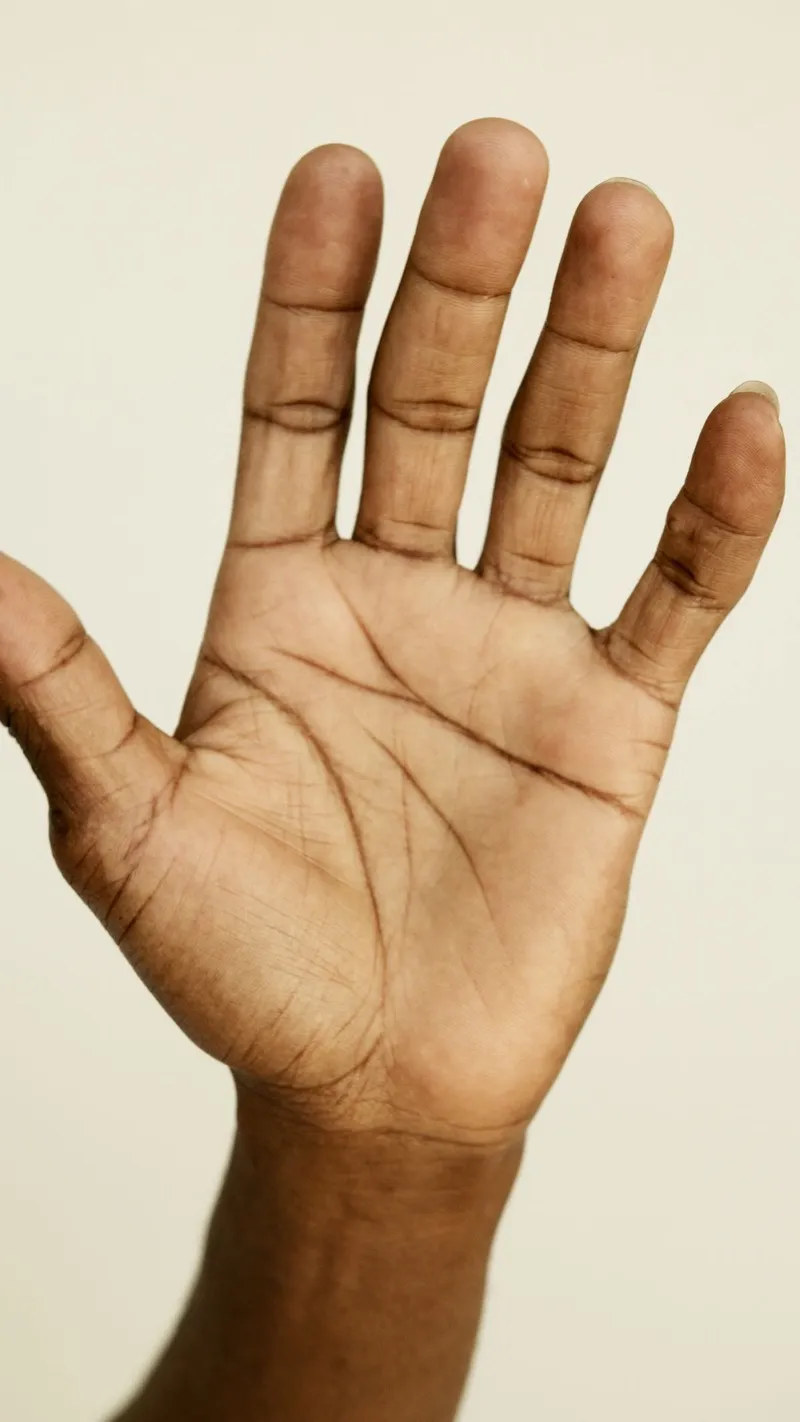
Follow the head line from the thumb side of the palm across toward the outer edge. The fork appears at the far end, where the single line divides into two branches heading in slightly different directions, usually toward the lower palm.
Why it is called the writer’s fork
The name reflects the classic reading: a mind equally comfortable with structured, logical work and with imaginative or creative expression. Writing is the traditional example because it requires both — clear thinking and the capacity to imagine something that is not yet in front of you — but the reading is not limited to literal writers.
The fork is read as balance rather than division. Where a single straight line is read as consistently logical and a single curved line as consistently imaginative, the fork is read as access to both registers, deployed depending on what a situation calls for.
How wide, and where the prongs point
A wide fork with well-separated branches is read as a pronounced version of this duality — someone who moves fluidly between analytical and creative modes. A narrow fork, with the branches close together, is read as a milder blend of the same qualities.
A branch angled sharply down toward the mount of the Moon (the outer edge of the lower palm) is traditionally read as strong imaginative pull; a branch that stays straighter and more horizontal is read as the analytical side remaining dominant even within the fork.
Distinguishing a true fork from fraying
A true writer’s fork has two clear, roughly equal-strength branches. Many hands show a head line that simply frays into several thin, faint lines at the end — this is a different marking, read as scattered or restless thinking rather than the balanced duality of a clean fork.
If one branch is markedly fainter than the other, the reading leans toward the stronger branch's quality being dominant, with the fainter branch read as a secondary, less-expressed capacity.
Variations
Wide, even fork
A pronounced and balanced blend of analytical and creative thinking.
Narrow fork
The same duality in a milder, less pronounced form.
Branch toward the mount of the Moon
Strong imaginative or creative pull within the fork.
Branch staying horizontal
The analytical side remaining dominant even within a forked line.
Frayed rather than forked
A different marking — read as scattered attention rather than balanced duality.
Myth vs. Reality
Myth vs. Reality
| Myth | Reality |
|---|---|
“A forked head line means a split personality.” | It is read as balance between two modes of thinking used together, not division or conflict. |
“Only writers have this marking.” | The name is traditional shorthand for the quality it represents — combined logical and creative thinking — not a literal prediction about occupation. |
“A forked head line means a split personality.”
It is read as balance between two modes of thinking used together, not division or conflict.
“Only writers have this marking.”
The name is traditional shorthand for the quality it represents — combined logical and creative thinking — not a literal prediction about occupation.
Common Questions
What is the writer’s fork in palmistry?
A forked head line, traditionally read as the capacity to combine logical and imaginative thinking rather than favouring one over the other.
Is a forked head line rare?
Some end-of-line splitting is fairly common; a clean, wide, two-pronged fork is less so than fraying into several faint lines.
Does a forked head line mean I will be a writer?
No. The name reflects the traditional reading of balanced analytical and creative thought, not a specific occupation.
What is the difference between a fork and fraying?
A fork has two clear branches of comparable strength. Fraying is several thin, faint lines, read as scattered rather than balanced thinking.
See this on your own palm
Upload a photo and our reader walks the four major lines on your hand, showing you where each one runs and what tradition associates with what it finds.
Read my palm — freeRelated Palmistry Topics
Life Line
The line curving around the thumb, traditionally read as vitality and life transitions.
Read the guide →Heart Line
The horizontal line across the upper palm, read as emotional life and attachment.
Read the guide →Head Line
The line across the middle of the palm, read as thinking style and decision-making.
Read the guide →Fate Line
The vertical line rising up the palm, read as direction and outside forces in life.
Read the guide →Sun Line
Vertical line associated with creativity and recognition.
Read the guide →Marriage Line
Short horizontal lines on the palm edge below the pinky.
Read the guide →