Quick Answer
A forked heart line splits into two or more branches, most often at the end beneath the index finger. Traditionally it is read as a favourable marking — emotional range, the ability to hold both heart and head when attaching — rather than as division or conflict.
Forked Heart Line: Meaning of a Split End
Last reviewed: 2026-08-17 by ReadMyPalms editorial
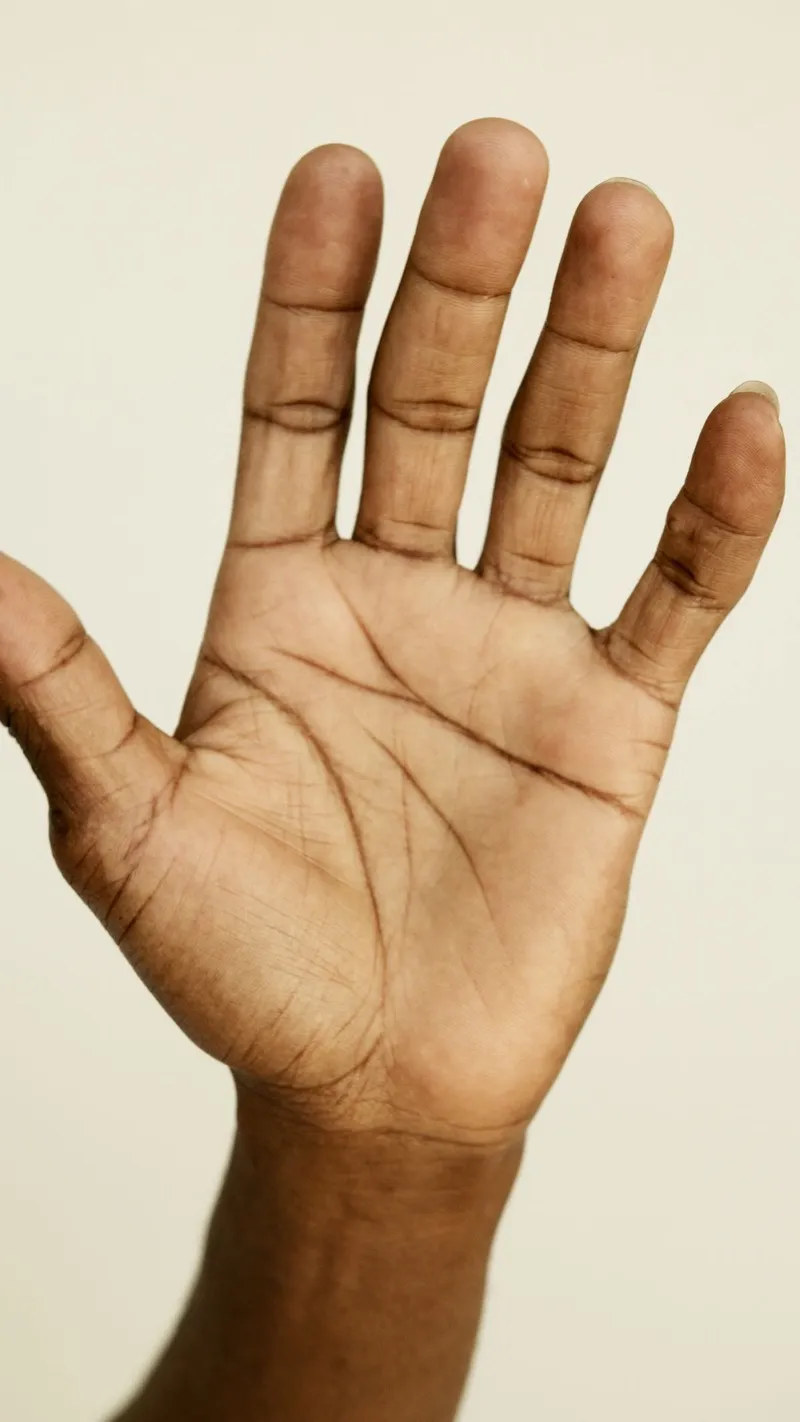
Follow the heart line from under the little finger across the palm toward the index. The fork usually appears at the far end, where the line separates into two or three prongs.
Why the fork is read positively
Where a break interrupts the line, a fork extends it. The reading follows that: the line does not stop, it reaches in more than one direction. Traditionally this is read as emotional versatility — the capacity to love in more than one register, and to bring both feeling and judgement to attachment.
The three-pronged fork, sometimes called the trident, is regarded across traditions as one of the more fortunate heart line markings. It is read as balance between heart, mind and practical sense rather than as indecision.
Where the prongs point
Direction carries the detail. A prong reaching the base of the index finger is read as idealism in love — high standards, and a tendency to attach to what a partner could become. A prong landing between index and middle finger is read as the more grounded, reciprocal form of attachment.
A downward prong dropping toward the head line is read as feeling checked by reasoning: someone unlikely to abandon judgement when attached. Practitioners commonly read this as protective rather than cold.
Fork, branch, or fray?
A fork is a clean split into continuing branches of comparable strength. Small hair-like lines feathering off the heart line are a different marking, traditionally read as emotional sensitivity to environment rather than as a fork.
If the branches are thin and numerous, you are looking at fraying rather than a fork, and the reading shifts toward changeability. Two or three clear prongs of similar weight is the classic fork.
Variations
Two-pronged fork
Read as balance between emotional and rational attachment — feeling with judgement intact.
Three-pronged fork (trident)
Traditionally one of the most fortunate heart line markings; read as balance of heart, mind and practicality.
Prong to the index finger
Associated with idealism in love and high expectations of a partner.
Prong between index and middle
Read as grounded, reciprocal attachment — the steadier form.
Downward prong toward the head line
Feeling moderated by reasoning; read as protective rather than unemotional.
Myth vs. Reality
Myth vs. Reality
| Myth | Reality |
|---|---|
“A forked heart line means you will be torn between two people.” | The fork is traditionally read as emotional range, not divided loyalty. The pulled-in-two-directions reading is a modern invention. |
“A fork means an unstable love life.” | Most traditions read the fork — especially the three-pronged form — as one of the more favourable markings on the heart line. |
“A forked heart line means you will be torn between two people.”
The fork is traditionally read as emotional range, not divided loyalty. The pulled-in-two-directions reading is a modern invention.
“A fork means an unstable love life.”
Most traditions read the fork — especially the three-pronged form — as one of the more favourable markings on the heart line.
Common Questions
What does a forked heart line mean?
It is traditionally read as emotional versatility — the ability to bring both feeling and judgement to attachment. The three-pronged form is considered particularly favourable.
Is a forked heart line good or bad?
Traditionally favourable. Unlike a break, a fork extends the line rather than interrupting it, and the reading follows that logic.
What is a trident on the heart line?
A three-pronged fork at the end of the line, read across traditions as balance between heart, mind and practical sense.
Does everyone have a forked heart line?
No, though some form of split at the end is common. Clean two- or three-pronged forks are distinct from the fine feathering seen on many palms.
See this on your own palm
Upload a photo and our reader walks the four major lines on your hand, showing you where each one runs and what tradition associates with what it finds.
Read my palm — freeRelated Palmistry Topics
Life Line
The line curving around the thumb, traditionally read as vitality and life transitions.
Read the guide →Heart Line
The horizontal line across the upper palm, read as emotional life and attachment.
Read the guide →Head Line
The line across the middle of the palm, read as thinking style and decision-making.
Read the guide →Fate Line
The vertical line rising up the palm, read as direction and outside forces in life.
Read the guide →Sun Line
Vertical line associated with creativity and recognition.
Read the guide →Marriage Line
Short horizontal lines on the palm edge below the pinky.
Read the guide →