Quick Answer
Does having an M on your palm mean you’re rich, special, or blessed? Honestly — not really.
Most people have an M-like pattern on their palms because the three major lines (heart, head, life) plus the fate line naturally form an M when they intersect. The “M sign” is a real concept in Hindu palmistry, but the viral social media version overpromises. Here’s what it actually means.
The M Sign on Your Palm: What It Really Means in Tradition (vs. on TikTok)
Last reviewed: 2026-06-27 by ReadMyPalms editorial
An honest guide to the viral “M sign” — what Hindu palmistry actually teaches, why most people have one, and how the TikTok framing diverges from tradition.
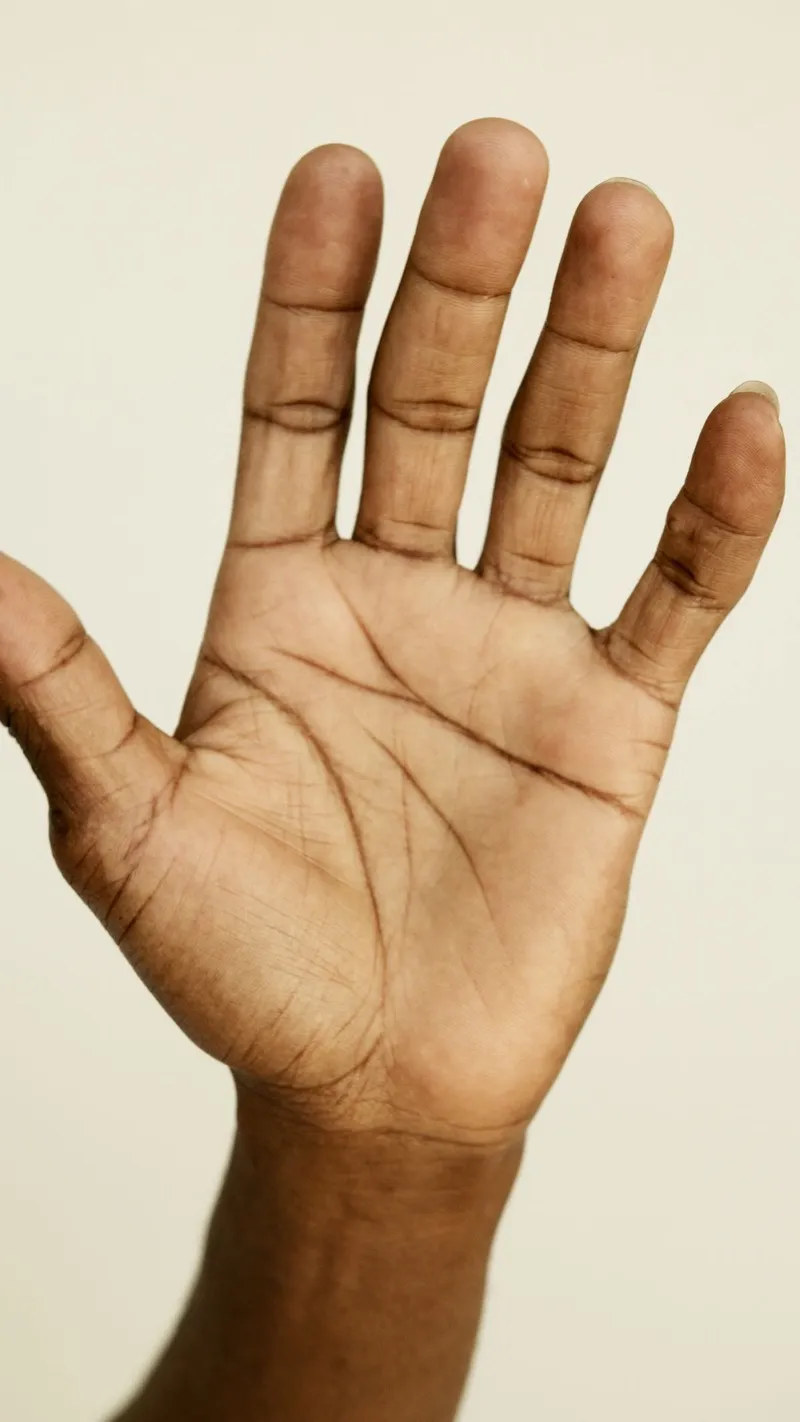
The “M” is formed when the heart line, head line, life line, and a vertical line (often the fate line) intersect to create the letter M shape on the palm.
What Is the M Sign?
The M sign is the letter-M-shaped pattern that appears on the palm when four lines intersect in just the right way. It is not a single line; it is a composite figure made of pieces of the major lines you already have. Each of the four strokes of the M is contributed by a different line:
- The heart line forms the top-right stroke of the M, running across the upper palm beneath the fingers.
- The head line forms the bottom of the M, crossing the middle of the palm horizontally.
- The life line forms the left stroke, curving down from between the thumb and index finger.
- A vertical line — usually the fate line — creates the centre-down stroke that completes the letter.
The M is most clearly visible on hands where all four lines are present and reasonably well-defined. The clarity varies enormously: some Ms are crisp and almost calligraphic, others are abstract and only suggest the letter. The concept originated in Hindu palmistry — specifically in Hast Samudrika Shastra, the classical Indian system — where it is listed among several auspicious symbols a hand can carry.
What Tradition Actually Says About the M Sign
Here is the honest, slightly deflating version that almost no other site will give you: in Hindu palmistry, the M sign is considered auspicious — but not in the dramatic way social media suggests. The traditional reading associates a clear, unbroken M with self-discipline, intuition, and good judgement. That is the actual claim. It is a meaningful claim, but it is a much smaller one than “you will be a millionaire.”
The M sign is not a guarantee of wealth, fame, or special destiny in any traditional source. Those framings are modern social media additions, layered onto a real but modest tradition. The four lines that form the M each describe something different: emotional life (heart line), thinking style (head line), vitality (life line), and direction or sense of purpose (fate line). When all four are clear enough to form a legible M, tradition reads that as a person whose emotional, mental, vital, and directional currents are reasonably well-integrated — which is a nice thing to be, but it is not a winning lottery ticket.
Western palmistry, notably, does not single out the M as a separate sign at all. Cheiro and Benham — the two figures whose work shaped the modern Western tradition — do not name it. The M concept comes primarily from the Indian tradition, and it travelled west via the same diaspora and translation channels that brought us yoga and chakra vocabulary. That history matters, because the viral version often presents the M as a universal, hidden-meaning sign rather than as one symbol within one specific cultural lineage.
Most people have an M-shaped pattern on their palms because the four lines that form it are present on virtually all hands. The “rare and special” framing is misleading. What is true is that a clear, unbroken M reflects four healthy major lines — and tradition does associate that combination with general well-being and a balanced disposition. The mark is real; the overclaim is not.
How to Find the M on Your Palm
Spotting your M takes about a minute once you know what to look for. Use your dominant hand — the right palm for most right-handed people, the left for left-handed — and sit somewhere with even natural light. Then trace the four lines in sequence:
- Find your heart line. It is the uppermost horizontal line, running across the palm beneath the fingers. It usually starts on the percussion edge of the hand (the side opposite the thumb) and travels toward the index or middle finger.
- Find your head line. It is the middle horizontal line, generally running parallel to and below the heart line, often beginning near the same point where the life line starts.
- Find your life line. It is the curve that begins between the thumb and index finger and arcs down around the fleshy base of the thumb toward the wrist.
- Find a vertical line connecting them. Most often this is the fate line, which runs roughly vertically up the centre of the palm toward the middle finger. Sometimes a sun line or another more minor vertical mark plays this role.
- Trace the M with your eyes. Start at the upper edge of the heart line on the percussion side, move down along the heart line, then down the vertical centre line, then back up along the life line. That zig-zag is your M.
An M doesn’t need to be perfect to “count.” Most are approximate, with strokes that are uneven, slightly disconnected, or asymmetric. If the basic letter is discernible, you have one. If a stroke is missing entirely — for instance, no visible fate line — that is itself a meaningful reading, covered below in the myth-busting section and in the dedicated fate line guide.
The Viral TikTok “M Sign” Trend
The Viral TikTok “M Sign” Trend
Sometime around 2020–2022, the M sign became a viral palmistry topic on TikTok and Instagram Reels. The hook is consistently the same: a creator points at their palm, traces the letter M, and announces that if you have one too, you are part of a special group — destined for wealth, blessed with psychic intuition, marked for greatness, or some variation. The videos rack up millions of views, and the claims spread fast, because the M is genuinely easy to spot once someone points it out.
Here is the problem: those claims are not supported by any traditional palmistry source. Not Hindu palmistry, not Chinese palmistry, not Western palmistry, not Cheiro, not Benham, not any classical text. The viral framing is a modern remix — it takes a real Hindu palmistry concept and exaggerates it for engagement. The exaggeration is understandable (“mildly auspicious composite mark” doesn’t go viral; “you’re a millionaire” does), but it is still an exaggeration.
What is actually true, without the spin:
- The M sign IS a traditional Hindu palmistry concept.
- It IS considered mildly auspicious in that tradition.
- Most people have one, because the lines that form it are present on virtually every hand.
- It does NOT predict wealth, fame, intuition level, psychic ability, or destiny in any traditional source.
The honest framing: it is fun to spot the M on your palm, and it can be a useful reflective prompt — a starting point for thinking about how your emotional, mental, vital, and directional lines relate to one another. But the social media “millionaire / special / chosen” framing is overclaim, full stop. You are not less interesting for having an ordinary M, and you are not more destined for having a clear one.
What the M Sign Does NOT Mean
What the M Sign Does NOT Mean
Four myths in particular tend to circulate around the M sign. Each is worth correcting directly.
Myth: “An M on the palm means you’ll be a millionaire.” Reality: NO traditional source claims this. The lines that form the M are about emotional patterns (heart line), thinking style (head line), vitality (life line), and direction in life (fate line) — not wealth. A clear M is read as integration across those four currents, which tradition associates with general well-being, not with a bank balance.
Myth: “Only special people have the M sign.” Reality: most people have an M-like pattern. The four lines that form it are present on virtually every hand. What varies is the clarity, not the existence of the shape itself. Treating the M as a rare mark is one of the most consistent misreadings in the viral framing.
Myth: “A clear M means special intuition or psychic abilities.” Reality: nothing in tradition links the M sign to psychic capability. Intuition in Hindu palmistry is associated with specific features — the intuition line (sometimes called the line of Luna), certain markings on the Mount of the Moon, and the shape of the head line as it slopes — none of which are the M. The honest answer is that the M is just where four common lines meet.
Myth: “If I don’t have a clear M, I’m unlucky.” Reality: a less-distinct M just means the lines that form it are less prominent — which has its own readings. A faint fate line, for instance, is traditionally read as a self-directed path rather than a misfortune (see the fate line guide). A faint heart, head, or life line shifts the reading toward the individual lines, not toward an absent M as a verdict. The absence of a crisp M is not bad luck; it is simply a different hand.
Frequently Asked Questions
Frequently Asked Questions
What does the M sign on the palm mean?
The M sign is the letter-M shape formed when the heart line, head line, life line, and a vertical line (usually the fate line) intersect on the palm. In Hindu palmistry it is traditionally read as a mildly auspicious mark associated with self-discipline, intuition, and good judgement when the four lines are clear and unbroken. It is not, in any traditional source, a guarantee of wealth, fame, or special destiny — those framings are modern social media additions.
Does the M sign on the palm mean I’ll be rich?
No. No traditional palmistry source — Hindu, Chinese, or Western — claims the M sign predicts wealth. The four lines that form the M each describe something quite different: emotional patterns (heart line), thinking style (head line), vitality (life line), and direction in life (fate line). None of them is a wealth indicator. The “millionaire” framing is a 2020s social media invention, not a tradition.
Is the M sign rare?
No — and this is the central honest correction to make. Most people have an M-like pattern on their palms because the four lines that form it (heart, head, life, and a vertical line) are present on virtually every hand. The clarity varies, but the basic M shape is extremely common. The “rare and special” framing on social media is misleading.
Where does the M sign tradition come from?
The M sign is primarily a concept from Hindu palmistry — Hast Samudrika Shastra, the classical Indian palmistry system — where it is listed among several auspicious symbols on the hand. Western palmistry, including Cheiro and Benham, does not single out the M as a distinct sign. The modern viral framing draws loosely on the Indian tradition but exaggerates the claims considerably.
Do both my hands have the M sign?
Often, yes. Because the M is formed by the major lines that appear on virtually every hand, most people have an M shape on both palms, though the clarity may differ between the two. Tradition follows the usual left-vs-right convention: the dominant hand reflects your active life, the non-dominant hand reflects inherited tendencies and potential.
What if my M sign is broken or unclear?
A less-distinct M simply means one or more of the four lines that form it is faint, broken, or absent. That is not unlucky — it just shifts the reading to the individual lines themselves. A faint fate line, for example, is traditionally read as a self-directed path rather than a misfortune. The M is a composite mark; its clarity reflects the clarity of its component lines.
Is the TikTok M sign trend accurate?
Partly. The M sign IS a real concept in Hindu palmistry, and it IS considered mildly auspicious in that tradition. But the viral TikTok claims — that it predicts wealth, fame, psychic intuition, or special destiny — are not supported by any traditional source. The honest summary: real concept, exaggerated framing. Fun to spot, but the “millionaire / special” version is overclaim.
How M Sign on Palm Is Read Across Traditions
Palmistry is a layered tradition, not a single system. Indian, Chinese, and Western lineages each read the m sign on palm a little differently — here is how the same line is named and interpreted across the three schools.
| Tradition | Local Term | Meaning |
|---|---|---|
| Indian (Hast Samudrika Shastra) | M Chinha / एम चिन्ह (described via component rekhas) | Hast Samudrika Shastra does not isolate an 'M' as a named sign; it reads the Hriday, Mastak, and Jeevan Rekhas with the Bhagya Rekha. When these intersect into an M-like pattern, the tradition traditionally interprets it as a confluence of intellect, emotional steadiness, and karmic effort — often linked with self-made progress. |
| Chinese (手相 Shǒuxiàng) | M 形手纹 / M Xíng Shǒuwén | In Chinese palmistry the M shape is a modern descriptor; classical readings focus on the 感情线, 智慧线, 生命线, and 事业线. Some contemporary lineages, blended with face reading and Five Elements thinking, read a well-formed M as perceptive judgement and resourcefulness — but only if mount fullness and finger proportions agree. |
| Western (Cheiro / Benham revival) | M Sign / 'Letter M on the palm' (no distinct local term) | Cheiro and Benham did not name an 'M sign'; the term is a later popular synthesis. Within their framework the crossing of heart, head, life, and fate lines is read line-by-line — Benham emphasised each line's mount association, while Cheiro stressed the head line's slope and fate line's origin as the real indicators, not the letter shape. |
M Chinha / एम चिन्ह (described via component rekhas)
Hast Samudrika Shastra does not isolate an 'M' as a named sign; it reads the Hriday, Mastak, and Jeevan Rekhas with the Bhagya Rekha. When these intersect into an M-like pattern, the tradition traditionally interprets it as a confluence of intellect, emotional steadiness, and karmic effort — often linked with self-made progress.
M 形手纹 / M Xíng Shǒuwén
In Chinese palmistry the M shape is a modern descriptor; classical readings focus on the 感情线, 智慧线, 生命线, and 事业线. Some contemporary lineages, blended with face reading and Five Elements thinking, read a well-formed M as perceptive judgement and resourcefulness — but only if mount fullness and finger proportions agree.
M Sign / 'Letter M on the palm' (no distinct local term)
Cheiro and Benham did not name an 'M sign'; the term is a later popular synthesis. Within their framework the crossing of heart, head, life, and fate lines is read line-by-line — Benham emphasised each line's mount association, while Cheiro stressed the head line's slope and fate line's origin as the real indicators, not the letter shape.
Myth vs. Reality
The m sign on palm attracts more pop-culture invention than almost any other palm feature. These are the claims you will find on low-quality palmistry sites — and how traditional palmistry across Indian, Chinese, and Western schools actually reads them.
| Myth | Reality |
|---|---|
“Having the M sign on your palm means you are guaranteed to be wealthy, lucky, and successful in life.” | No classical palmistry text — Indian, Chinese, or Western — guarantees wealth from a single configuration. The 'M sign' is a modern internet meme built from lines most hands naturally show. Traditional readings, when they comment, treat it as one symbolic indicator among many. Sources: Cheiro, Language of the Hand (1894), Benham, Laws of Scientific Hand Reading (1900) |
“Only rare, special people have the M sign on their palm.” | The 'M' is formed by the three major lines plus the fate line crossing in a common geometry across human hands. Hast Samudrika Shastra, Chinese 手相, and Western palmistry all read the individual lines on their own merits and do not single out an 'M' as a rare marker. Sources: Hast Samudrika Shastra tradition, Cheiro, Language of the Hand (1894) |
“A clear M on the left hand vs the right hand reveals fundamentally different fates.” | Hand-sided conventions differ by tradition. Indian palmistry traditionally reads the dominant hand for cultivated self and non-dominant for innate tendencies. Western (Cheiro/Benham) treats the passive hand as potential and active as developed character. None frame the 'M' itself as a left/right oracle. Sources: Cheiro, Language of the Hand (1894), Hast Samudrika Shastra tradition |
“If you don't have an M sign on your palm, you are unlucky or lack intuition.” | Classical palmistry across all three traditions reads absence of a marking as neutral, not negative. Benham and Cheiro stressed reading the whole hand — mounts, finger shape, line quality — rather than drawing conclusions from a single missing letter-shape. Sources: Benham, Laws of Scientific Hand Reading (1900) |
“A sharper or more pronounced M means stronger psychic abilities or money-making power.” | Line clarity in traditional palmistry signals strength of qualities tied to each individual line — not a compounding 'psychic bonus' from an M shape. Stacking head-line clarity and fate-line strength into a single 'psychic + wealth M' is a modern conflation unsupported by classical sources. Sources: Cheiro, Language of the Hand (1894), Benham, Laws of Scientific Hand Reading (1900) |
“Having the M sign on your palm means you are guaranteed to be wealthy, lucky, and successful in life.”
No classical palmistry text — Indian, Chinese, or Western — guarantees wealth from a single configuration. The 'M sign' is a modern internet meme built from lines most hands naturally show. Traditional readings, when they comment, treat it as one symbolic indicator among many.
Sources: Cheiro, Language of the Hand (1894), Benham, Laws of Scientific Hand Reading (1900)
“Only rare, special people have the M sign on their palm.”
The 'M' is formed by the three major lines plus the fate line crossing in a common geometry across human hands. Hast Samudrika Shastra, Chinese 手相, and Western palmistry all read the individual lines on their own merits and do not single out an 'M' as a rare marker.
Sources: Hast Samudrika Shastra tradition, Cheiro, Language of the Hand (1894)
“A clear M on the left hand vs the right hand reveals fundamentally different fates.”
Hand-sided conventions differ by tradition. Indian palmistry traditionally reads the dominant hand for cultivated self and non-dominant for innate tendencies. Western (Cheiro/Benham) treats the passive hand as potential and active as developed character. None frame the 'M' itself as a left/right oracle.
Sources: Cheiro, Language of the Hand (1894), Hast Samudrika Shastra tradition
“If you don't have an M sign on your palm, you are unlucky or lack intuition.”
Classical palmistry across all three traditions reads absence of a marking as neutral, not negative. Benham and Cheiro stressed reading the whole hand — mounts, finger shape, line quality — rather than drawing conclusions from a single missing letter-shape.
Sources: Benham, Laws of Scientific Hand Reading (1900)
“A sharper or more pronounced M means stronger psychic abilities or money-making power.”
Line clarity in traditional palmistry signals strength of qualities tied to each individual line — not a compounding 'psychic bonus' from an M shape. Stacking head-line clarity and fate-line strength into a single 'psychic + wealth M' is a modern conflation unsupported by classical sources.
Sources: Cheiro, Language of the Hand (1894), Benham, Laws of Scientific Hand Reading (1900)
Related Palmistry Topics
The M sign is built from the four major lines of the palm. Explore each one, and the rest of the cluster:
Life Line
The line curving around the thumb, traditionally read as vitality and life transitions.
Read the guide →Heart Line
The horizontal line across the upper palm, read as emotional life and attachment.
Read the guide →Head Line
The line across the middle of the palm, read as thinking style and decision-making.
Read the guide →Fate Line
The vertical line rising up the palm, read as direction and outside forces in life.
Read the guide →Sun Line
Vertical line associated with creativity and recognition.
Read the guide →Marriage Line
Short horizontal lines on the palm edge below the pinky.
Read the guide →