Quick Answer
A palm with no visible fate line is not unusual, and it is not traditionally read as a bad sign. The fate line describes an externally shaped, single-track career or path; without it, the reading shifts to a life built through active choice, multiple directions, and adaptability rather than one path laid out from the start.
No Fate Line? What It Actually Means
Last reviewed: 2026-08-21 by ReadMyPalms editorial
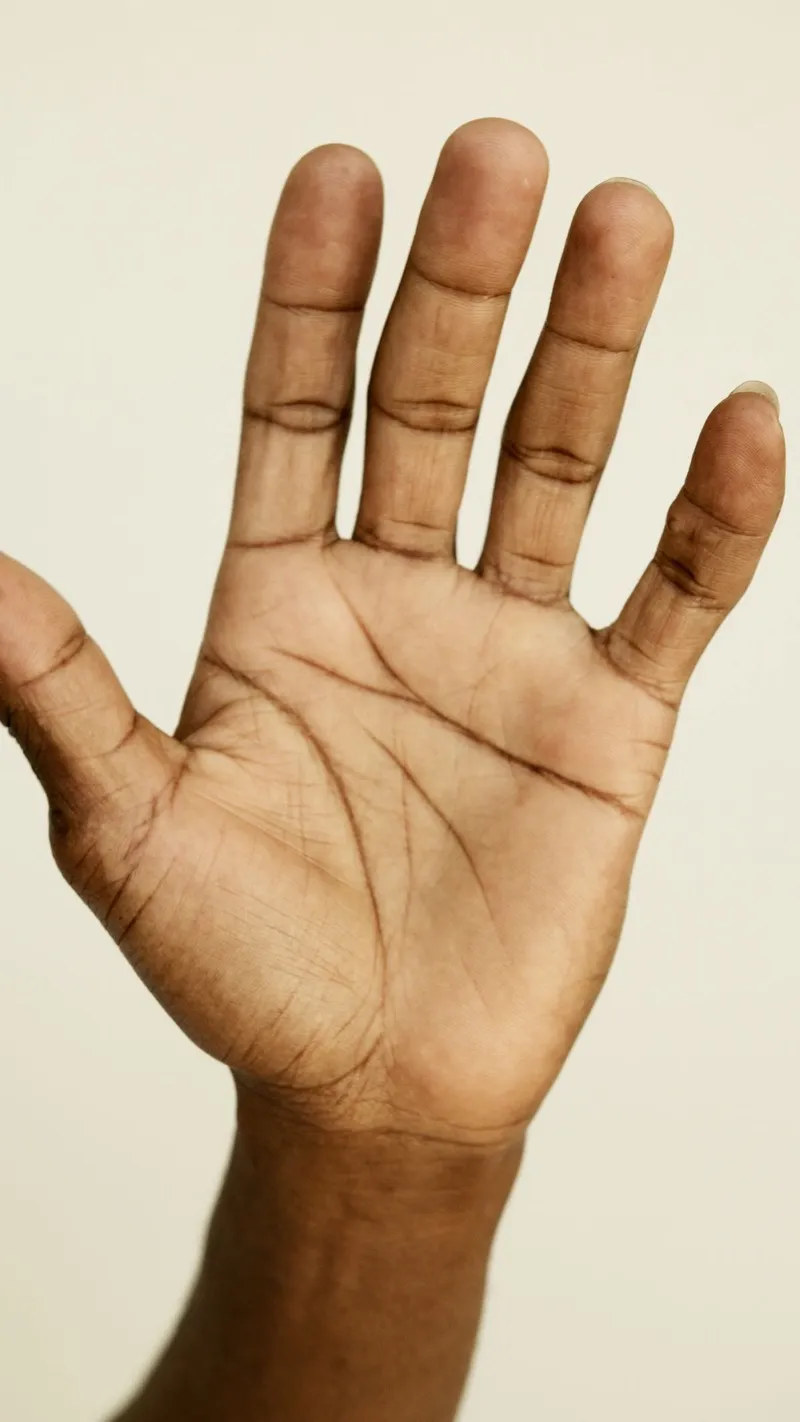
The fate line runs vertically up the centre of the palm, from the base toward the middle finger. On many hands it is faint, short, or genuinely absent — look closely under angled light before concluding there is none at all.
Why an absent fate line is not a bad omen
The fate line’s traditional subject is a path shaped by circumstance — family expectation, an early calling, a single career followed for life. Its absence is read as the opposite condition: a life where direction comes from the person's own decisions rather than from an external track, and where the path is expected to change more than once.
Practitioners across traditions generally do not read an absent fate line as unlucky. If anything, it is read as freedom from a fixed script — more choice, not less, at the cost of a clearer single throughline.
Faint versus genuinely absent
Many "no fate line" readings are actually a very faint line that only appears under close, angled light. A faint but present line is read the same way as an absent one for most of the reading, with the caveat that some structure is there, just less pronounced.
A line that appears only in sections — present in youth, absent in the middle of the palm, resuming later — is read as a life with a clear early direction, a middle period of active reinvention, and a later return to a defined path.
What tends to accompany a missing fate line
A strong, well-defined head line alongside an absent fate line is traditionally read as direction supplied by deliberate planning rather than circumstance — someone who builds their own path through clear thinking rather than following one that was given to them.
A strong life line alongside an absent fate line is read as vitality and adaptability substituting for a fixed track: the person thrives through changing course rather than through consistency.
Variations
Genuinely absent, no trace
Read as a life fully shaped by active choice rather than by circumstance or a single calling.
Very faint but present
The same reading as absent, with slightly more underlying structure to the path.
Present early, absent mid-palm
An early defined direction followed by a period of active reinvention.
Absent early, appears later
A path that becomes clear only after a period without one — traditionally read as a later calling.
Absent alongside a strong head line
Direction supplied by deliberate planning rather than external circumstance.
Myth vs. Reality
Myth vs. Reality
| Myth | Reality |
|---|---|
“No fate line means bad luck or no destiny.” | The line describes an externally shaped, single-track path. Its absence is read as active choice and adaptability, not misfortune. |
“Everyone is supposed to have a fate line.” | A faint or absent fate line is common. It is one of the more frequently missing major lines on real hands. |
“No fate line means bad luck or no destiny.”
The line describes an externally shaped, single-track path. Its absence is read as active choice and adaptability, not misfortune.
“Everyone is supposed to have a fate line.”
A faint or absent fate line is common. It is one of the more frequently missing major lines on real hands.
Common Questions
Does everyone have a fate line?
No. A faint or absent fate line is common and is not read as unusual or negative.
What does it mean if you have no fate line?
Traditionally, a life shaped by active choice and adaptability rather than one fixed, externally given path.
Is it bad to not have a fate line?
No. Most traditions read its absence as freedom from a fixed script rather than as misfortune.
Can a fate line appear later in life?
Palm lines change gradually over years. A line becoming visible later is traditionally read as a direction or calling arriving later than usual.
See this on your own palm
Upload a photo and our reader walks the four major lines on your hand, showing you where each one runs and what tradition associates with what it finds.
Read my palm — freeRelated Palmistry Topics
Life Line
The line curving around the thumb, traditionally read as vitality and life transitions.
Read the guide →Heart Line
The horizontal line across the upper palm, read as emotional life and attachment.
Read the guide →Head Line
The line across the middle of the palm, read as thinking style and decision-making.
Read the guide →Fate Line
The vertical line rising up the palm, read as direction and outside forces in life.
Read the guide →Sun Line
Vertical line associated with creativity and recognition.
Read the guide →Marriage Line
Short horizontal lines on the palm edge below the pinky.
Read the guide →