Quick Answer
Does a simian line mean I have Down syndrome? Absolutely not.
A simian line — one crease across the palm where head and heart lines fuse — appears in roughly 1 in 10 people in the general population. It is slightly more common in people with Down syndrome, but it is not diagnostic of anything. The vast majority of people with a simian line are neurotypical. Traditional palmistry reads it as intense focus — feeling and thinking as a single act.
Simian Line on Palm: Meaning, Rarity & The Truth Behind the Myths
Last reviewed: 2026-06-27 by ReadMyPalms editorial
A careful, dignified guide to the simian line — what palmistry says about it, how common it is, and why the medical myth around it is wrong.
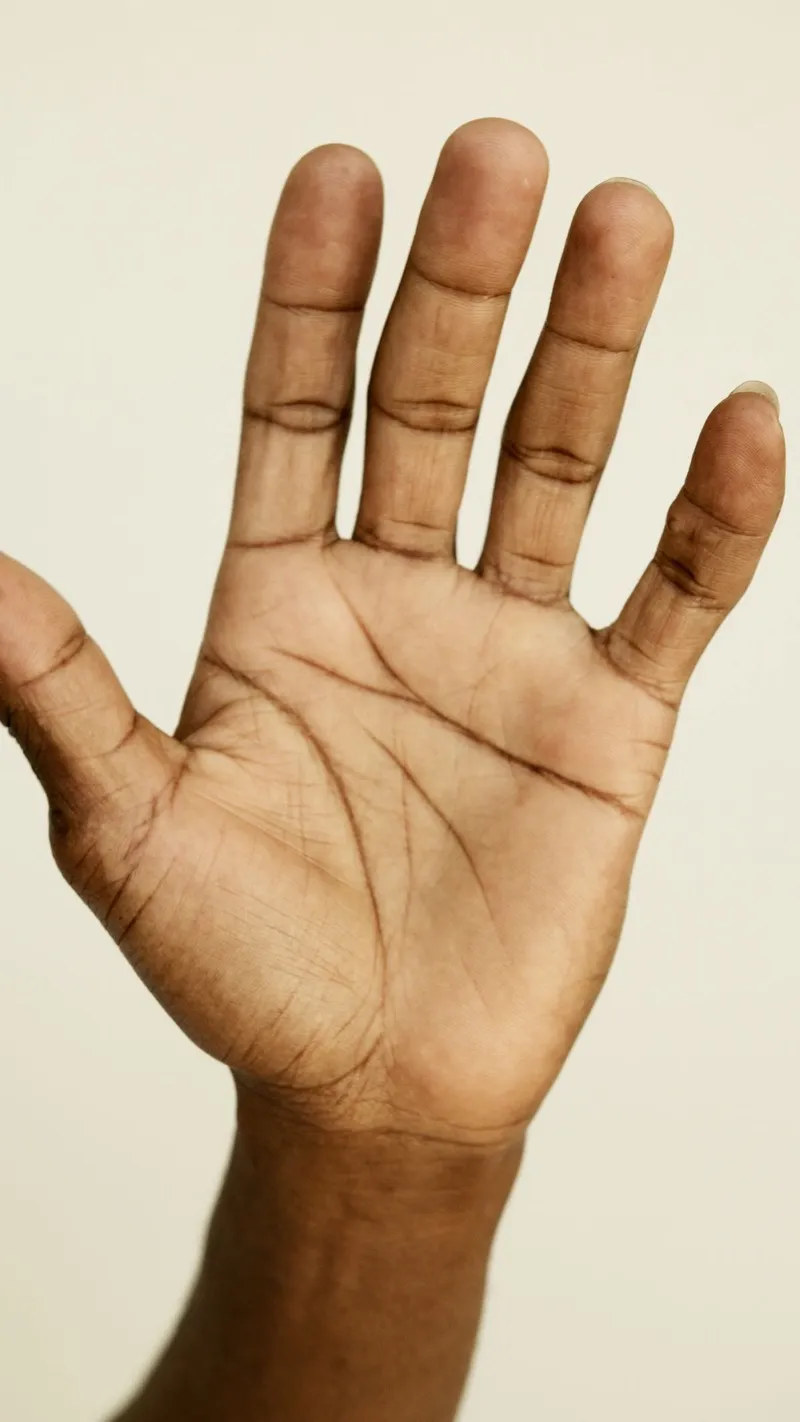
On most palms the heart line (rose-pink) and the head line are two separate lines. On a simian palm, those two fuse into a single horizontal crease across the palm.
What Is a Simian Line?
A simian line — also called a single palmar crease in clinical literature — is the name palmistry gives to the rare configuration where the heart line and the head line, normally two separate horizontal creases on the upper palm, fuse into a single straight line that runs all the way across the palm. Where two lines would normally appear, a simian palm shows one.
The name comes from the older observation that great apes and many primates have a single horizontal palm crease rather than two. It is an anatomical descriptor — no value judgement was historically intended — but the term has unfortunately acquired connotations in modern usage that make it worth saying once, clearly: a simian line on a human palm is a perfectly normal variant of human anatomy. About one in ten people have one, on at least one hand. The line itself is just a crease.
What the Simian Line Symbolises
Intense Focus
Across every classical tradition that names the simian line, the central reading is intense focus. Because the head line and heart line are fused into one, the person is read as bringing their full self — thinking and feeling together — to whatever they engage with. Cheiro called this “the line of single purpose,” and Hindu palmistry reads it similarly: a person whose energies converge rather than divide. People with simian lines often describe themselves the same way — when they care, they care completely.
Unity of Thought and Feeling
The second classical reading is the integration of thought and feeling. On a normal palm the head line and heart line run as parallel separate currents — you can think one thing while feeling another. On a simian palm, tradition says, these two currents are not separate at all. Thinking and feeling are one act. The temperament is read as one of committed alignment: when this person decides something is worth caring about, the whole self moves with it.
Depth Over Breadth
A third tradition reading concerns scope. Simian-line temperaments are read as deep rather than wide — people who pour intensity into fewer relationships, fewer projects, fewer ideas, but who go further in each of them than most. This is not the same as social inflexibility; many simian-line people are warm and broadly engaged. It is a description of where their energy concentrates when they care, not of how many people they like.
Distinctive Temperament
Finally, the simian line is read as a marker of distinctiveness. In every culture that names it, the simian line is treated as the kind of palm that tells you something specific about a person — not better or worse than the standard pattern, but different in a way worth noticing. People with simian lines are read as people who are likely to live and care in a way that stands out. As with every line in palmistry, this is a reflection, not a verdict — and the person you become is always larger than what any single crease shows.
How to Read a Simian Line — Variations and Modifiers
Once you identify a simian line, four properties refine the reading: which hand(s), depth of the line, whether it is complete, and what else is nearby.
Which hand matters because Western palmistry reads the dominant hand as active life and the non-dominant hand as innate tendency. A simian line on the dominant hand only is read as a learned intensity — a focus the person has grown into. A simian line on the non-dominant hand only is read as an innate intensity that the person may have refined into something subtler in active life. Bilateral simian lines — both hands — are read as the strongest expression of the simian temperament.
Depth of the line follows the same logic as any palm line. A deep, sharply incised simian line is read as a strong, present expression of the temperament. A faint simian line is read as a milder version — the integration is there, but it moves more quietly.
Whether the line is complete — running fully from one side of the palm to the other — matters. A complete simian line is the classical form. A partial simian line, where the fusion only happens for part of the line’s length and one of the two original lines is faintly visible alongside, is sometimes called a “simian transition” or a quasi-simian: a hand still showing both head and heart, with their territories blurring into each other.
What else is nearby modifies meaning. A simian line accompanied by a clear, deep life line is read as a focused, vital temperament. A simian line with forks branching off it is read as the focus opening up into multiple expressions. As always, no single mark is read in isolation; the rest of the palm contextualises it.
Common Simian Line Variations
Bilateral Simian Line
A simian line on both palms is the rarest configuration — about one in thirty people. Tradition reads this as the fullest expression of the simian temperament: deep focus expressed in both inherited tendency and active life. People with bilateral simian lines are often described as intense, committed, and unusually aligned in what they care about.
Single-Hand Simian Line
A simian line on only one hand is about twice as common as bilateral. Western palmistry reads it through the dominant/non-dominant frame described above. Hindu palmistry reads it with a slightly different vocabulary but with the same general idea: the simian temperament shows up in one register but not the other.
Partial / Quasi-Simian Line
A partial simian line — where the head and heart lines fuse for part of their length but split apart elsewhere — is read as a milder version of the temperament. The person carries some of the simian focus but also retains the separateness of thinking and feeling that a normal palm shows.
Sydney Line
A Sydney line is a related but distinct anatomical variant where the head line runs all the way across the palm to the percussive edge but the heart line is still present as a separate line above it. It is sometimes confused with a simian line. In palmistry tradition the Sydney line is read as intellectual breadth — thinking that reaches across the whole field — while the simian line is read as intellectual depth fused with feeling. They are not the same line.
What the Simian Line Does NOT Mean
Few palm features attract more anxious misinterpretation than the simian line. Here are the five most common myths, each addressed honestly.
Myth: “A simian line means Down syndrome.” Reality: this is the central correction. A simian line is somewhat more common in people with Down syndrome — that is a real anatomical observation — but it is not diagnostic. About 45% of people with Down syndrome have a simian line on at least one hand; about 10% of the general population also has one. Most people with simian lines are neurotypical, and many people with Down syndrome do not have one. Palm creases are not medical signs.
Myth: “A simian line means I’m violent or unstable.” Reality: this myth comes from outdated 20th-century pop-psychology and has no basis in any palmistry tradition or any contemporary science. Cheiro and Benham both explicitly cautioned against reading the simian line negatively. The intensity it describes is energy of focus, not energy of harm.
Myth: “A simian line predicts a hard life.” Reality: no classical tradition reads any single palm mark as a verdict on the difficulty of a life. People with simian lines have the full range of lives that people without them have. The reading is about temperament — how this person engages — not about what happens to them.
Myth: “A simian line means I’m especially gifted.” Reality: equally untrue. The simian line is not a destiny mark, a genius mark, or a rare-blood-quantum-of-talent mark. It is a temperament descriptor. Many people with simian lines are gifted in specific ways, and so are many people without them.
Myth: “Once a simian, always a simian.” Reality: palm creases, including the major lines, can change subtly over a lifetime. A faint simian line can deepen, and the fusion can become more or less pronounced. As with every palm reading, this is a snapshot, not a fixed sentence.
Tradition Attribution: How Different Schools Read the Simian Line
Western palmistry, in the schools of Cheiro and William Benham, was the first to give the simian line a sustained named treatment in popular literature. Both authors read it positively as a sign of concentrated purpose and warned explicitly against reading it as a defect.
Hindu palmistry — Hast Samudrika Shastra — names the fusion of hridaya rekha (heart line) and mastak rekha(head line) as a distinct configuration. The reading is similar to the Western one: concentration, focus, and a person who lives close to the centre of themselves.
Chinese palmistry treats the simian line as a fusion of two of its three primary lines (the “heaven” and “humanity” lines). Chinese readings emphasise determination and self-direction as the dominant qualities. Across all three traditions, the simian line is treated as distinctive, never as a flaw.
How to Identify a Simian Line on Your Own Palm
Identifying a simian line is straightforward. Follow these five steps.
- Open your palm fully in natural light. Side lighting throws the creases into the clearest relief. Look at both hands one at a time.
- Count the horizontal lines on the upper palm. On a normal palm you will see two horizontal creases below the fingers: a higher one (the heart line) and a lower one (the head line). On a simian palm you will see only one.
- Trace the line all the way across. A true simian line runs continuously from one side of the palm to the other — from below the index finger across to below the pinky. If the line breaks into two halfway across, you may have a partial simian rather than a full one.
- Check both hands separately. Many people have a simian line on one hand only. Note which hand — dominant or non-dominant — carries the simian.
- Read reflectively, not diagnostically. If you find a simian line, read it as the tradition reads it: as an indication of focused, integrated intensity. Do not read it as a medical sign of anything; it is not.
Want an AI-assisted reading that recognises a simian line in your palm?
Get a Free AI Palm Reading →Frequently Asked Questions
What is a simian line?
A simian line is a single horizontal line that runs straight across the palm, formed when the heart line and head line fuse into one rather than appearing as two separate lines. It appears in roughly one in ten people. In tradition it is read as an intense, single-focused integration of feeling and thinking.
Does a simian line mean Down syndrome?
No. A simian line is somewhat more common in people with Down syndrome, but it is absolutely not diagnostic. The vast majority of people with a simian line are neurotypical, and many people with Down syndrome do not have one. Palm creases are not medical signs.
How rare is a simian line?
Uncommon but not rare. It appears in roughly 10% of the general population on at least one hand. Single-hand simian lines are about twice as common as bilateral. It is somewhat more common in men than in women.
What does the simian line mean in palmistry tradition?
Traditional palmistry reads it as an intense, single-focused integration of feeling and thinking. People with simian lines think and feel as one act rather than separately. Cheiro called it a sign of unusual concentration of purpose; Hindu palmistry reads it similarly.
Is a simian line lucky or unlucky?
Neither in tradition. No classical source frames it as lucky or unlucky. It is read as a distinctive temperament rather than as a fortune indicator.
Can I have a simian line on only one hand?
Yes, and this is the more common pattern. About two-thirds of people with simian lines have one on just one hand.
Should I be concerned about my simian line?
No. A simian line on its own is not a sign of any medical condition. It is a normal anatomical variant present in millions of healthy people.
How Simian Line Is Read Across Traditions
Palmistry is a layered tradition, not a single system. Indian, Chinese, and Western lineages each read the simian line a little differently — here is how the same line is named and interpreted across the three schools.
| Tradition | Local Term | Meaning |
|---|---|---|
| Indian (Hast Samudrika Shastra) | Ekarekha / एकरेखा (bhava-buddhi sangam) | In Hast Samudrika Shastra the Simian Line is traditionally read as ekarekha — the fusion of mastak rekha (head) and hriday rekha (heart) into one crease, symbolising union of buddhi (intellect) and bhava (emotion). Vedic lineages frame this as a karmic marker of single-pointed focus (ekagrata), not a fortune sign. |
| Chinese (手相 / Shǒuxiàng) | 断掌 / Duànzhǎng ('broken palm'); also 通贯掌 / Tōngguàn Zhǎng | In Chinese palmistry it is called duànzhǎng, and folk readings classically split by gender — older sayings treat it as wealth-creating drive in men but warn of domestic friction for women. Modern Chinese palmistry, read alongside face reading and the five elements, softens this into a marker of strong willpower. |
| Western (Cheiro / Benham revival) | Simian Line (also 'Simian Crease') | Cheiro and Benham in the 19th-century revival emphasised the Simian Line as a rare sign where emotion and reason fuse into one channel, producing what Benham called 'all-or-nothing' intensity and concentrated purpose. This lineage focuses on temperament — extremes of focus — and avoids the gendered fortune readings of Chinese folk tradition. |
Ekarekha / एकरेखा (bhava-buddhi sangam)
In Hast Samudrika Shastra the Simian Line is traditionally read as ekarekha — the fusion of mastak rekha (head) and hriday rekha (heart) into one crease, symbolising union of buddhi (intellect) and bhava (emotion). Vedic lineages frame this as a karmic marker of single-pointed focus (ekagrata), not a fortune sign.
断掌 / Duànzhǎng ('broken palm'); also 通贯掌 / Tōngguàn Zhǎng
In Chinese palmistry it is called duànzhǎng, and folk readings classically split by gender — older sayings treat it as wealth-creating drive in men but warn of domestic friction for women. Modern Chinese palmistry, read alongside face reading and the five elements, softens this into a marker of strong willpower.
Simian Line (also 'Simian Crease')
Cheiro and Benham in the 19th-century revival emphasised the Simian Line as a rare sign where emotion and reason fuse into one channel, producing what Benham called 'all-or-nothing' intensity and concentrated purpose. This lineage focuses on temperament — extremes of focus — and avoids the gendered fortune readings of Chinese folk tradition.
Myth vs. Reality
The simian line attracts more pop-culture invention than almost any other palm feature. These are the claims you will find on low-quality palmistry sites — and how traditional palmistry across Indian, Chinese, and Western schools actually reads them.
| Myth | Reality |
|---|---|
“"A Simian Line means the person has Down syndrome or a genetic disorder."” | The single transverse crease is statistically more common in some chromosomal conditions, but it also appears in roughly 1–4% of the general population with no associated condition. Traditional palmistry (Cheiro, Benham, Hast Samudrika) reads it as a temperament marker of intensity and fused thinking-feeling, and makes no diagnostic claim about genetics. Sources: Cheiro, Language of the Hand (1894), Benham, Laws of Scientific Hand Reading (1900) |
“"A Simian Line on the left hand vs the right hand means completely opposite things."” | Most schools read both hands together, not as opposites. Western and Indian palmistry traditionally treat the non-dominant hand as inherited tendencies and the dominant hand as expressed life, so a Simian Line on one side is read as latent intensity and on the other as how that intensity is being lived — a difference of emphasis, not a reversed meaning. Sources: Cheiro, Language of the Hand (1894), Hast Samudrika Shastra tradition |
“"Having a Simian Line on both hands means you have a special mission, psychic powers, or a unique karmic destiny."” | This claim is heavily promoted by modern online palmistry but has no basis in classical Cheiro, Benham or Hast Samudrika texts, which treat a bilateral Simian Line simply as a stronger expression of the same trait — pronounced focus and emotional-intellectual fusion — rather than as proof of psychic gifts or a destined mission. Sources: Benham, Laws of Scientific Hand Reading (1900) |
“"A Simian Line on a woman's hand means a bad marriage or misfortune for her family."” | This gendered reading comes from Chinese folk sayings about 女人断掌 and is not echoed in Indian Hast Samudrika or Western Cheiro/Benham palmistry, both of which read the line the same way regardless of gender. Contemporary Chinese practitioners increasingly treat the old saying as cultural folklore rather than a reading. Sources: Chinese folk palmistry sayings on 断掌, Cheiro, Language of the Hand (1894) |
“"The length or shortness of the Simian Line predicts how successful or troubled your life will be."” | Across Cheiro, Benham and Hast Samudrika the line is interpreted by presence and clarity, not by length-based fortune scoring. A short or partial crease is generally read as a partial fusion of head and heart tendencies, not a measurable prediction of success, lifespan or hardship — palmistry is symbolic, not predictive. Sources: Cheiro, Language of the Hand (1894), Benham, Laws of Scientific Hand Reading (1900), Hast Samudrika Shastra tradition |
“"A Simian Line means the person has Down syndrome or a genetic disorder."”
The single transverse crease is statistically more common in some chromosomal conditions, but it also appears in roughly 1–4% of the general population with no associated condition. Traditional palmistry (Cheiro, Benham, Hast Samudrika) reads it as a temperament marker of intensity and fused thinking-feeling, and makes no diagnostic claim about genetics.
Sources: Cheiro, Language of the Hand (1894), Benham, Laws of Scientific Hand Reading (1900)
“"A Simian Line on the left hand vs the right hand means completely opposite things."”
Most schools read both hands together, not as opposites. Western and Indian palmistry traditionally treat the non-dominant hand as inherited tendencies and the dominant hand as expressed life, so a Simian Line on one side is read as latent intensity and on the other as how that intensity is being lived — a difference of emphasis, not a reversed meaning.
Sources: Cheiro, Language of the Hand (1894), Hast Samudrika Shastra tradition
“"Having a Simian Line on both hands means you have a special mission, psychic powers, or a unique karmic destiny."”
This claim is heavily promoted by modern online palmistry but has no basis in classical Cheiro, Benham or Hast Samudrika texts, which treat a bilateral Simian Line simply as a stronger expression of the same trait — pronounced focus and emotional-intellectual fusion — rather than as proof of psychic gifts or a destined mission.
Sources: Benham, Laws of Scientific Hand Reading (1900)
“"A Simian Line on a woman's hand means a bad marriage or misfortune for her family."”
This gendered reading comes from Chinese folk sayings about 女人断掌 and is not echoed in Indian Hast Samudrika or Western Cheiro/Benham palmistry, both of which read the line the same way regardless of gender. Contemporary Chinese practitioners increasingly treat the old saying as cultural folklore rather than a reading.
Sources: Chinese folk palmistry sayings on 断掌, Cheiro, Language of the Hand (1894)
“"The length or shortness of the Simian Line predicts how successful or troubled your life will be."”
Across Cheiro, Benham and Hast Samudrika the line is interpreted by presence and clarity, not by length-based fortune scoring. A short or partial crease is generally read as a partial fusion of head and heart tendencies, not a measurable prediction of success, lifespan or hardship — palmistry is symbolic, not predictive.
Sources: Cheiro, Language of the Hand (1894), Benham, Laws of Scientific Hand Reading (1900), Hast Samudrika Shastra tradition
Related Palmistry Topics
The simian line is a fusion of the heart line and head line. Explore the rest of the cluster:
Life Line
The line curving around the thumb, traditionally read as vitality and life transitions.
Read the guide →Heart Line
The horizontal line across the upper palm, read as emotional life and attachment.
Read the guide →Head Line
The line across the middle of the palm, read as thinking style and decision-making.
Read the guide →Fate Line
The vertical line rising up the palm, read as direction and outside forces in life.
Read the guide →Sun Line
Vertical line associated with creativity and recognition.
Read the guide →Marriage Line
Short horizontal lines on the palm edge below the pinky.
Read the guide →