Quick Answer
Is a star on the palm really lucky? In tradition, almost always yes.
A clear star-shaped mark on the palm is read as auspicious across Hindu, Western, and Chinese palmistry — traditionally associated with sudden good fortune, recognition, or unexpected blessing. The exact meaning depends on where the star sits: on which mount or line. A star is a symbol of potential, not a guaranteed prediction.
Star on Palm: Meaning by Location in Palmistry
Last reviewed: 2026-06-27 by ReadMyPalms editorial
A reflective guide to star marks on the palm — what they symbolise across traditions, what their location means, and how to read them honestly.
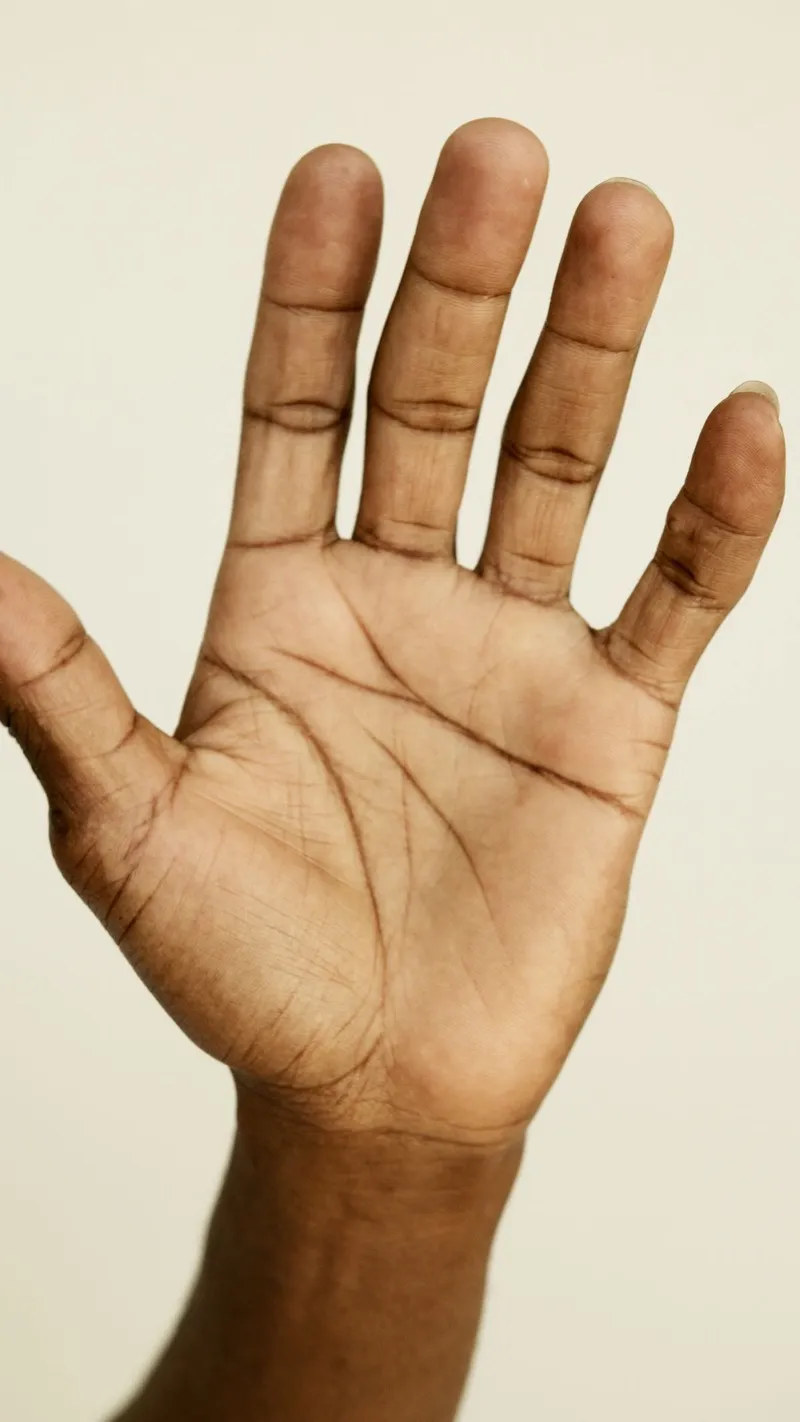
Star marks are small — usually formed by five or more short lines crossing at a single point. Look for them on the mounts and along the major lines.
What Is a Star on the Palm?
A star in palmistry is a small mark formed when five or more short lines cross at a single point, creating a star-shaped or asterisk-shaped figure. A classical star has at least five distinct rays radiating outward from a clear centre; a four-rayed mark is usually called a cross instead, and a three-rayed mark is called a trident.
Across all three major palmistry traditions — Hindu (Hast Samudrika Shastra), Western (Cheiro, Benham), and Chinese — a clear star is read as an auspicious mark. The traditional reading is one of sudden good fortune — unexpected blessing, recognition, or a meaningful turning point in the area of life associated with the star’s location. The exact meaning depends entirely on where the star sits.
What a Star on the Palm Symbolises
Sudden Blessing
The most consistent reading of a star across every tradition is sudden blessing — unexpected good fortune that arrives without much warning. Cheiro called the star “the most fortunate of all the marks of the hand,” and Hast Samudrika Shastra echoes this framing. Stars are read as moments of grace that show up rather than as outcomes of slow accumulation. The bigger and brighter the star, the stronger this reading.
Recognition and Visibility
The second reading is recognition. A star is read as a sign that the qualities associated with its location will become seen — visible to others, acknowledged publicly. A star on the Mount of Apollo (the ring finger), the traditional seat of creativity, is read as creative recognition; a star on the Mount of Jupiter (the index finger), the seat of leadership, is read as authority recognised by others. Stars do not just bless inwardly; they tend to draw outward attention.
Turning Points
A third reading is turning points. Where a star sits on a major line is read as a moment of meaningful change in the domain that line governs. A star on the life line is read as a significant turning point in vitality or life direction. A star at the end of the fate line is read as a sudden success in career direction. A star on the heart line is read as a meaningful attachment that shifts the temperament. As always, these are symbolic turning points, not dates.
Concentrated Energy
The deepest tradition reading of a star is concentrated energy. Because a star is formed by many small lines converging at one point, classical palmistry reads it as a place where the palm itself is gathering force. Hast Samudrika Shastra describes stars as tej rekha — bright marks — where the hand’s energy bunches and amplifies. Whatever the location’s normal meaning is, a star intensifies it.
How to Read Star Locations
Location is everything for reading stars. The same mark means very different things depending on where it sits. Here is the standard tradition map across mounts and lines.
Star on the Mount of Jupiter (below the index finger) is the most celebrated configuration. Cheiro and Benham both read it as a sign of leadership and public recognition. Hindu palmistry reads it as an indicator of authority earned and respected. It is one of the most positive marks in any tradition.
Star on the Mount of Apollo (below the ring finger) is read as creative recognition — visible artistry, fame in the creative arts, public praise for one’s work. This is the “artist’s star,” and it is read positively in every tradition.
Star on the Mount of Mercury (below the pinky) is read as sudden success in commerce, communication, or eloquence. Cheiro associated it with successful negotiation and persuasion. Hindu palmistry reads it as auspicious for trade.
Star on the Mount of Venus (thumb base) is read as a significant attachment or attraction that shapes the emotional life. Western tradition reads this positively as a great love; Hindu palmistry adds the layer of family blessing.
Star on the Mount of Saturn (below the middle finger) is the one configuration tradition treats with caution. Some Western schools read it as sudden disruption rather than sudden blessing. Hindu palmistry reads it as a season of tested discipline. It is not a warning of disaster, but it is the less purely positive of the mount stars.
Star on a major line — life, heart, head, or fate — marks a significant turning point in the domain that line governs. The location along the line gives a sense of when in tradition timing: closer to the start of the line is earlier in life, closer to the end is later.
Common Star Mark Variations
Five-Rayed Bright Star
The classical form — five clear rays radiating from a definite centre, all roughly the same length. This is the most powerful version of the mark in tradition, and it is read at full strength.
Six- or Seven-Rayed Star
A star with more than five rays is rare and is read as particularly auspicious. Hindu palmistry calls a clear seven-rayed star the sapta rekha — the seven-fold mark — and treats it as one of the strongest blessing-signs on the palm.
Faint or Partial Star
A faint star, or one with rays of unequal length, is read as a milder version of the same meaning. The blessing is present but understated. Some classical readings treat a partial star as a blessing “still in formation” — coming, but not yet at full strength.
Star at a Line Intersection
When a star sits exactly at the intersection of two major lines — say, where the head line crosses the fate line — it is read as a turning point that touches both domains at once. These are some of the most striking configurations in palmistry and are read as multidimensional events: a significant shift that affects more than one part of life simultaneously.
What a Star on the Palm Does NOT Mean
Even one of the most positive marks in palmistry attracts misreading. Here are the five most common myths.
Myth: “A star on the palm guarantees I’ll become famous.” Reality: stars are read as tendencies toward recognition, never as fame forecasts. Many people with clear stars live private lives; their recognition is quieter and more local. The star points to a quality being seen, not to a particular scale of fame.
Myth: “Every five-pointed mark is a lucky star.” Reality: a true tradition star has rays that all radiate from a single clear centre. Random crossings of lines that happen to form a star-ish shape are not the same as a properly formed star. Be honest about what you see.
Myth: “A star on the Mount of Saturn is a death omen.” Reality: even the Saturn star, the one traditionally read with caution, is never read as a death omen. It is read as a period of tested discipline or unexpected disruption. Disruption is not disaster.
Myth: “If I don’t have a star, I’ll never have good luck.” Reality: stars are one of dozens of auspicious marks in classical palmistry. Triangles, squares, fish, conches, and many others all carry positive readings. Not having a star means your blessing is shaped differently, not absent.
Myth: “A star tells me exactly when something will happen.” Reality: traditional palmistry uses position along a line as a rough timing indicator, but it is never precise. A star two-thirds along the fate line is read as “later life” in tradition, not as “age 47”.
Tradition Attribution: Stars Across Schools
Western palmistry, in Cheiro and Benham, treats the star as the most fortunate of all hand marks. Their texts catalogue stars by mount and line in detail, with the Jupiter star receiving the most positive treatment.
Hindu palmistry — Hast Samudrika Shastra — calls the star tara rekha (star line) or tej rekha (bright mark) and catalogues it among the auspicious signs. The mount-by-mount readings are broadly similar to the Western ones, with Hindu palmistry adding additional layers for family, dharma, and spiritual recognition.
Chinese palmistry reads the star similarly, with emphasis on fortune in the domain of the location. Specific vocabulary differs but the core reading — auspicious, sudden, recognition-bringing — is consistent across all three traditions.
How to Find Stars on Your Own Palm
Spotting stars takes patience. They are small. Follow these five steps.
- Use a strong, angled light source. Side lighting from a window or lamp throws small crossings into the clearest relief. Overhead light tends to flatten them.
- Scan the mounts methodically. Start at the Mount of Jupiter (below the index finger) and work through each of the seven mounts in turn. Stars most often appear on mounts rather than on the lines themselves.
- Look for a clear centre. A true star has a definite central point with rays radiating outward. If the “star” you see is really just lines passing near each other without converging at one point, it is not a star.
- Count the rays. Five or more rays is a star. Four is a cross. Three is a trident or simple crossing. Be honest about what you see.
- Map location to meaning. Use the location guide above — Jupiter for leadership, Apollo for creativity, Mercury for commerce, Venus for love — and read accordingly. If you find a star on a major line, observe where along the line it sits.
Want an AI-assisted scan that flags star marks across your palm?
Get a Free AI Palm Reading →Frequently Asked Questions
What does a star on the palm mean?
A star is a small mark formed when five or more short lines cross at a single point. In every classical tradition a clear star is read as an auspicious mark, traditionally associated with sudden good fortune, recognition, or unexpected blessing.
Is a star on the palm rare?
Clear stars are uncommon but not rare. Many palms have one or two faint star-like crossings. A bright, fully formed five-rayed star is rarer and is treated as more significant.
Where can stars appear on the palm?
On any of the seven mounts, any of the major or secondary lines, and at line intersections. Each location carries its own reading.
Are stars on the palm always good?
Almost always. The Mount of Saturn star is the one some traditions read with caution, as it can indicate disruption rather than blessing. Most stars in most locations are read positively.
How is a star different from a cross?
A star is formed by five or more lines crossing at one point, with multiple rays. A cross is formed by exactly two lines, creating a simple X or plus. Their readings differ.
Does a star guarantee good luck?
No classical tradition reads any palm mark as a guarantee. A star is read as a strong tendency toward fortunate developments — potential, not contract.
Can stars appear and disappear over time?
Yes. Stars formed by intersections of small secondary lines can deepen, fade, or rearrange across a lifetime. Traditional palmistry treats this as natural.
How Star on Palm Is Read Across Traditions
Palmistry is a layered tradition, not a single system. Indian, Chinese, and Western lineages each read the star on palm a little differently — here is how the same line is named and interpreted across the three schools.
| Tradition | Local Term | Meaning |
|---|---|---|
| Indian (Hast Samudrika Shastra) | Tara Chinha / तारा चिन्ह (also Nakshatra Chinha) | In Hast Samudrika Shastra the tara chinha is traditionally read as a marker of intensified karmic ripening at the mount or line where it sits — a star on Guru parvat (Jupiter) is read as elevated recognition through dharmic effort, while one on a damaged line is read as karmic disturbance. The emphasis is on prarabdha and conduct. |
| Chinese (手相 Shǒuxiàng) | 星纹 / Xīng Wén (literally 'star pattern') | In classical Chinese palmistry the xīng wén is one of many auspicious or inauspicious pattern marks (掌纹), read alongside face reading and the Five Elements rather than in isolation. Some lineages link a clear star on the palm centre with sudden opportunity, but the reading is always weighted by overall qi, mount fullness, and birth chart context. |
| Western (Cheiro / Benham revival) | Star (sign) | Cheiro and Benham systematised the star into a mount-by-mount lookup: on Jupiter, ambition realised; on Apollo, fame in the arts; on Saturn, a serious warning; on Mercury, success in commerce; on Venus, a disruptive love event. This precise positional schema distinguishes the Western revival from holistic Indian and Chinese frameworks. |
Tara Chinha / तारा चिन्ह (also Nakshatra Chinha)
In Hast Samudrika Shastra the tara chinha is traditionally read as a marker of intensified karmic ripening at the mount or line where it sits — a star on Guru parvat (Jupiter) is read as elevated recognition through dharmic effort, while one on a damaged line is read as karmic disturbance. The emphasis is on prarabdha and conduct.
星纹 / Xīng Wén (literally 'star pattern')
In classical Chinese palmistry the xīng wén is one of many auspicious or inauspicious pattern marks (掌纹), read alongside face reading and the Five Elements rather than in isolation. Some lineages link a clear star on the palm centre with sudden opportunity, but the reading is always weighted by overall qi, mount fullness, and birth chart context.
Star (sign)
Cheiro and Benham systematised the star into a mount-by-mount lookup: on Jupiter, ambition realised; on Apollo, fame in the arts; on Saturn, a serious warning; on Mercury, success in commerce; on Venus, a disruptive love event. This precise positional schema distinguishes the Western revival from holistic Indian and Chinese frameworks.
Myth vs. Reality
The star on palm attracts more pop-culture invention than almost any other palm feature. These are the claims you will find on low-quality palmistry sites — and how traditional palmistry across Indian, Chinese, and Western schools actually reads them.
| Myth | Reality |
|---|---|
“A star on the palm guarantees fame, wealth, and worldly success no matter where it appears.” | Traditional readings are highly position-dependent. Cheiro and Benham both stressed that a star is read very differently by mount — a star on Jupiter is traditionally framed as ambition fulfilled, while a star on Saturn was read as a warning. Most classical sources treat the star as an intensifier, not a blanket promise. Sources: Cheiro, Language of the Hand (1894), Benham, Laws of Scientific Hand Reading (1900) |
“A star on the right palm and a star on the left palm mean the same thing.” | Most lineages distinguish the two hands. Indian Hast Samudrika Shastra traditionally reads the dominant hand as acquired karma and the non-dominant as inherited prarabdha. Western palmistry of the Cheiro era similarly separated the passive hand (potential) from the active hand (what the person does with it). Sources: Hast Samudrika Shastra tradition, Cheiro, Language of the Hand (1894) |
“Having multiple stars on your palm means multiple guaranteed strokes of luck.” | Classical Western palmistry warns the opposite — Benham treated a profusion of stars as a sign of a nervous, scattered temperament rather than stacked good fortune, and stars on certain mounts (Saturn, lower Mars) were read as warnings. Chinese palmistry similarly tends to read clusters of small markings as turbulence rather than additive blessing. Sources: Benham, Laws of Scientific Hand Reading (1900) |
“No star on the palm means you will never be successful or spiritually gifted.” | No traditional school treats the absence of a star as a verdict on a person's life. Indian, Chinese, and Western palmistry all read the palm as a whole — mounts, line quality, finger shape, and hand type — and any single sign is one symbol among many. Cheiro explicitly cautioned against reading any single mark in isolation. Sources: Cheiro, Language of the Hand (1894) |
“A star at the base of the index finger means you'll definitely become rich and famous by a specific age.” | Even in lineages that read a star on the Mount of Jupiter favourably — as ambition or recognition — no credible classical source ties it to a guaranteed outcome or a specific date. Western palmistry uses timing only loosely, and Indian and Chinese readings frame such markings as inclinations shaped by conduct, not fixed events. Sources: Cheiro, Language of the Hand (1894), Benham, Laws of Scientific Hand Reading (1900) |
“A star on the palm guarantees fame, wealth, and worldly success no matter where it appears.”
Traditional readings are highly position-dependent. Cheiro and Benham both stressed that a star is read very differently by mount — a star on Jupiter is traditionally framed as ambition fulfilled, while a star on Saturn was read as a warning. Most classical sources treat the star as an intensifier, not a blanket promise.
Sources: Cheiro, Language of the Hand (1894), Benham, Laws of Scientific Hand Reading (1900)
“A star on the right palm and a star on the left palm mean the same thing.”
Most lineages distinguish the two hands. Indian Hast Samudrika Shastra traditionally reads the dominant hand as acquired karma and the non-dominant as inherited prarabdha. Western palmistry of the Cheiro era similarly separated the passive hand (potential) from the active hand (what the person does with it).
Sources: Hast Samudrika Shastra tradition, Cheiro, Language of the Hand (1894)
“Having multiple stars on your palm means multiple guaranteed strokes of luck.”
Classical Western palmistry warns the opposite — Benham treated a profusion of stars as a sign of a nervous, scattered temperament rather than stacked good fortune, and stars on certain mounts (Saturn, lower Mars) were read as warnings. Chinese palmistry similarly tends to read clusters of small markings as turbulence rather than additive blessing.
Sources: Benham, Laws of Scientific Hand Reading (1900)
“No star on the palm means you will never be successful or spiritually gifted.”
No traditional school treats the absence of a star as a verdict on a person's life. Indian, Chinese, and Western palmistry all read the palm as a whole — mounts, line quality, finger shape, and hand type — and any single sign is one symbol among many. Cheiro explicitly cautioned against reading any single mark in isolation.
Sources: Cheiro, Language of the Hand (1894)
“A star at the base of the index finger means you'll definitely become rich and famous by a specific age.”
Even in lineages that read a star on the Mount of Jupiter favourably — as ambition or recognition — no credible classical source ties it to a guaranteed outcome or a specific date. Western palmistry uses timing only loosely, and Indian and Chinese readings frame such markings as inclinations shaped by conduct, not fixed events.
Sources: Cheiro, Language of the Hand (1894), Benham, Laws of Scientific Hand Reading (1900)
Related Palmistry Topics
Stars are one of several traditional marks on the palm. Explore the rest of the cluster:
Life Line
The line curving around the thumb, traditionally read as vitality and life transitions.
Read the guide →Heart Line
The horizontal line across the upper palm, read as emotional life and attachment.
Read the guide →Head Line
The line across the middle of the palm, read as thinking style and decision-making.
Read the guide →Fate Line
The vertical line rising up the palm, read as direction and outside forces in life.
Read the guide →Sun Line
Vertical line associated with creativity and recognition.
Read the guide →Marriage Line
Short horizontal lines on the palm edge below the pinky.
Read the guide →